

How to Return Original Art Online: A 2026 Guide
Sep 05, 2026
Table of Contents
- What to Check Before You Request a Return for Original Art
- Step 1: Contact the Gallery and Get a Return Authorization
- Step 2: How to Pack Original Paintings for Shipping
- Step 3: Arrange the Return Shipment and Insurance
- Step 4: What to Do If Art Arrives Damaged
- Understanding Return Shipping Costs and Refunds
- Why a Clear Art Return Policy Template Matters
- Final Checklist for Returning Original Art
- Frequently Asked Questions
Last Updated: September 5, 2026
What to Check Before You Request a Return for Original Art
Buying original art online carries inherent risk. Unlike prints or posters, a painting is a one-of-a-kind object, and its texture, scale, and colour depth can differ from what a screen shows. Knowing how to return original art online before you click "buy" protects your investment if the piece misses the mark.
Most galleries and artists publish their terms clearly, and returning a painting is rarely as simple as sending back a pair of shoes. At Cairngorm Artists, the process hinges on a few non-negotiable details. Before you contact anyone, pull up the original order confirmation and the gallery's policy page.
Your first checklist should cover three areas: the return window, the condition rules, and the proof of purchase requirements. Many sellers require you to request a return within a set period, often 7 to 14 days after delivery (gov.uk). The artwork must typically be in its original condition, unframed alterations void the policy, and you will need your digital invoice or order number to start the process. If the piece is a commissioned work or a final sale item, expect those categories to be exempt from standard returns.
Step 1: Contact the Gallery and Get a Return Authorization
A return authorization is written permission from the seller to send the artwork back. Never ship a painting without one, as galleries use this to track the parcel, link it to your order, and process the refund against the correct payment method.
Start by emailing the gallery's customer service team. Include your order number, the artist's name, and the title of the work. State clearly whether you are returning the piece because it was misrepresented, damaged in transit, or simply not right for your space. Most reputable sellers, including the UK's consumer protection guidance on distance selling, require you to notify them within 14 days of receiving goods bought online.
Once the gallery confirms the return, they will issue a return authorization number and often a return label. Keep this correspondence in a dedicated folder. If the seller requires you to arrange the courier yourself, ask for their preferred shipping method and any specific labelling instructions. Attach the authorization number to the outside of the package and include a copy inside the box.
Step 2: How to Pack Original Paintings for Shipping
Packing an original painting for shipping is the step where most returns go wrong. A canvas can survive a 500-mile journey only to be ruined by poor repackaging on the way back. The goal is to recreate the protective layers the piece arrived in, or better them.
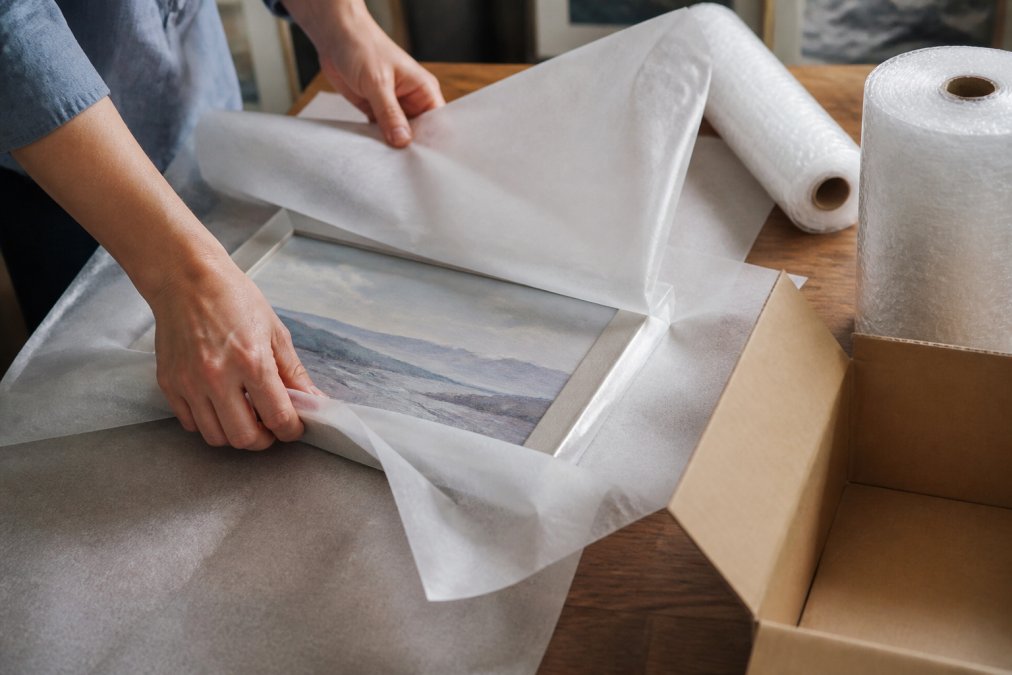
Begin with a clean, dry surface. Lay the painting face up and cover the front with a sheet of acid-free glassine paper. This prevents the surface from scratching without sticking to the paint. Never use newspaper, as the ink can transfer onto the artwork.
Next, wrap the entire piece in a layer of bubble wrap, with the bubbles facing inward against the glassine. Secure it with tape, but keep the tape off the frame itself. For framed works, protect the corners with cardboard corner protectors, as these take the brunt of any impact. Place the wrapped painting into a sturdy cardboard box that allows at least 5 centimetres of space on every side. Fill that void with crumpled paper or foam peanuts so the painting cannot shift during transit.
Step 3: Arrange the Return Shipment and Insurance
Returning original art means shipping a fragile, high-value item, so treat the journey back with the same care as the journey out. If the gallery provided a return label, use it. If not, you are now the shipper, and the choices you make here determine whether you get a full refund or a costly dispute.
Choosing a Courier That Handles Art
Do not default to the cheapest standard courier. A painting is not a book. Look for services that specialise in fine art logistics or at least offer a dedicated "high-value" tier. In the UK, couriers like Pack & Send or specialist art handlers such as Crown Fine Art offer white-glove collection and packing verification. In the US, UPS and FedEx have declared-value limits that often cap out well below the price of an original painting, so you may need to use a broker or a specialist like U.S. Art Transport.
A common pattern among galleries is to require the buyer to use a courier that provides a signed proof of collection and a condition report at pickup. If the courier does not offer this, ask the driver to note the package's condition on the waybill before they leave. This document becomes your first line of defence if the gallery claims the piece arrived damaged.
Declaring Value and Purchasing the Right Insurance
Insurance is not optional here. A standard courier's basic liability rarely covers the full value of an original painting. Purchase coverage for the artwork's purchase price, and confirm the courier service accepts liability for damage caused by poor handling, not just loss. Ask specifically whether the policy covers "all-risk" transit damage or only "total loss." Many basic policies will not pay out for a scratched canvas or a broken frame, they only pay if the entire parcel is lost.
When you declare the value, you will likely need to provide proof of purchase. Have your invoice ready. Declare the contents accurately on the shipping form, describing the parcel as "original artwork" rather than "goods" or "merchandise." Some couriers will ask for a commercial invoice even for domestic returns; this is normal and helps customs if the piece is crossing a border.
The Paper Trail That Protects You
Keep the tracking number and a copy of the insurance certificate. Send both to the gallery immediately after the courier collects the parcel. This creates a clear paper trail showing the item left your possession in good condition, which matters if a dispute arises over who is responsible for damage during the return journey.
Also, save the courier's collection receipt. It should show the date, time, and the driver's signature. If the gallery claims they never received the parcel, this receipt proves the courier took it from you. Most couriers have a claims window of 7 to 14 days after delivery, so do not wait to file a claim if something goes wrong.
If the Gallery Insists on Their Own Courier
Some galleries have negotiated rates with a specific courier and will insist you use them. This is fine, but ask for the following in writing before you book:
- The courier's full name and contact details
- Whether the gallery or you are the policyholder on the transit insurance
- The declared value they will use
- Who files the claim if the piece is damaged
If the gallery is the policyholder, you are relying on them to file the claim on your behalf. Get a written commitment that they will do so within 48 hours of delivery if damage is reported. Without this, you could be left waiting weeks while the gallery and courier argue over liability.
International Returns: The Layer Most Guides Miss
If you are returning art across a border, the logistics multiply. You will need a commercial invoice that states the reason for return as "Return of unsold merchandise" or "Temporary export for return." This matters because customs officials may otherwise charge import duties on the artwork's value when it re-enters the seller's country.
For UK-to-EU returns post-Brexit, you may need an EORI number to ship commercially. For US-to-UK returns, the seller may need to provide a customs form that exempts the piece from VAT on re-import. Ask the gallery for their preferred customs declaration language before you ship. A wrong code can delay the parcel for weeks and trigger unexpected fees that come out of your refund.
The Insurance Claim Process, Step by Step
If the artwork is damaged in transit, do not accept a quick settlement offer from the courier without documentation. The claims process typically looks like this:
- Notify the courier in writing within 48 hours of delivery (or discovery of damage).
- Provide photographs of the outer packaging and the damaged artwork.
- Submit the original invoice or proof of value.
- Wait for the courier's assessor to inspect the damage (they may request the artwork be held for inspection).
- Receive a settlement offer, which should match the declared value if the piece is irreparable.
Most practitioners find that couriers initially offer a low settlement or deny the claim on a technicality. If this happens, escalate to the courier's claims department with your documentation and reference the insurance certificate. If you are still unsatisfied, you can complain to the relevant ombudsman or regulatory body in your country, for UK consumers, this is the Financial Ombudsman Service; for US consumers, it is your state's insurance commissioner.
By treating the return shipment as a professional logistics operation, not a casual trip to the post office, you protect your refund and your relationship with the gallery.
Step 4: What to Do If Art Arrives Damaged
Original art arriving damaged in transit is the scenario every collector dreads. How you respond in the first 48 hours determines whether you receive a full refund, a replacement, or nothing at all.
Document everything before you touch the parcel. Photograph the outer box from all angles, capturing any dents, punctures, or crushed corners. Film yourself opening the package, as this proves the damage was not caused by your unpacking. If the artwork itself is scratched, torn, or has a broken frame, photograph it against a plain background with a ruler for scale.
Contact the gallery immediately with your evidence. Most reputable sellers have a safe-arrival promise that covers damage sustained during shipping. At Cairngorm Artists, every piece travels with protection against transit damage, so collectors are not left absorbing the cost of a courier's mistake. The gallery will typically file a claim with the courier service on your behalf, but they need your documentation to do so. Do not attempt to repair the artwork yourself, as this voids most insurance policies and return agreements.
Understanding Return Shipping Costs and Refunds
Who pays for return shipping depends entirely on why the artwork is going back. If the piece was misrepresented, arrived damaged, or does not match its description, the seller should cover the cost. If you simply changed your mind, most policies place the shipping costs and the responsibility for safe transit on you.
The Legal Basis for Who Pays
In the UK, the Consumer Contracts Regulations 2013 give you a 14-day cooling-off period for online purchases (legislation.gov.uk). During this window, you can cancel for any reason, but you are responsible for the direct cost of returning the goods unless the seller agreed to absorb it. The seller must refund the full purchase price plus standard delivery costs within 14 days of receiving the returned item, but they can deduct for diminished value if you handled the artwork negligently.
In the US, there is no federal cooling-off law for art purchases. The FTC's Mail, Internet, or Telephone Order Merchandise Rule covers delivery timelines, not returns. Your protection comes from the seller's stated policy or, if the piece was misrepresented, from state consumer protection laws. Some states, like California, have specific rules about art dealers and consignment sales, but these rarely apply to individual online purchases.
For EU buyers, the Consumer Rights Directive mirrors the UK's 14-day rule, but cross-border returns can trigger customs complications that delay refunds.
How Refunds Are Calculated
A full refund should include the original purchase price and the standard shipping cost you paid to receive the artwork. It does not typically include expedited shipping upgrades unless the seller misrepresented the piece. If you chose next-day delivery and the policy only covers standard shipping, you will not get the upgrade fee back.
Restocking fees are legal in most jurisdictions if they are disclosed in the policy before purchase. They typically range from 10% to 25% of the purchase price. Some galleries waive the fee if you accept store credit instead of a cash refund. Ask for this option before you ship, it can save you a significant amount.
The Refund Timeline, Step by Step
Refund processing timelines vary, but a full refund should be issued once the gallery receives the artwork and confirms its condition. Expect this to take a few business days for inspection, plus additional time for the refund to appear on your original payment method. Here is what typically happens:
- Day 1: Parcel arrives at the gallery. They log it and assign it to a staff member for inspection.
- Day 2-3: The gallery opens the package, photographs the artwork, and compares its condition to the photos you sent before shipping.
- Day 3-5: The gallery approves the refund and initiates the payment. If you paid by credit card, the refund may take 3-5 business days to appear. If you paid by PayPal, it is usually faster.
- Day 5-10: The refund appears on your statement. If it does not, contact the gallery and ask for the transaction ID.
What Happens If the Gallery Delays Your Refund
If the gallery has received the artwork and confirmed its condition but has not issued a refund within the promised timeline, escalate in writing. Send a formal email referencing your original order, the return authorization, and the date the parcel was delivered. Give them 7 days to respond.
If they still do not act, you have options:
- Credit card chargeback: Most credit card issuers allow you to dispute a charge within 120 days of the transaction. You will need to provide evidence of the return, including tracking and delivery confirmation.
- PayPal dispute: PayPal gives you 180 days from the purchase date to open a dispute. Upload your return authorization and tracking number.
- Small claims court: For amounts under a few thousand pounds or dollars, this is a practical option. The threat of a claim often prompts a refund.
- Consumer protection bodies: In the UK, you can complain to the Citizens Advice consumer service or the Financial Ombudsman for credit card disputes. In the US, file a complaint with your state's Attorney General or the FTC.
The Table That Summarises It All
Return Reason |
Who Pays Shipping |
Refund Timeline |
Restocking Fee? |
|---|---|---|---|
Misrepresented or not as described |
Seller |
After inspection, usually 3-5 days |
No |
Damaged in transit |
Seller or courier insurance |
After damage claim is approved |
No |
Changed your mind |
Buyer |
After artwork is received |
Possible, check policy |
Custom or commissioned work |
Not returnable |
N/A |
N/A |
A Note on Store Credit vs. Cash Refunds
Some galleries prefer to offer store credit rather than a cash refund. This is legal if it is disclosed in the policy, but you are not obligated to accept it if the policy promised a cash refund. If the seller offers store credit as an alternative, ask whether it includes a bonus percentage, some galleries offer 10-15% extra credit to encourage you to stay. This can be a good deal if you plan to buy another piece, but it is not a substitute for your legal right to a refund when the artwork was misrepresented.
By understanding the cost allocation and refund mechanics before you ship, you avoid the most common disputes and ensure your money returns to your account without unnecessary delay.
Why a Clear Art Return Policy Template Matters
A written return policy protects both the collector and the artist. For buyers, it removes the guesswork from a stressful process. For sellers, it sets boundaries around condition requirements, return windows, and who bears the shipping costs. Without one, disputes over damaged artwork or change-of-heart returns can sour the entire relationship.
If you are an artist selling your own work, adopt a policy that covers the essentials: the return window, condition requirements, who pays for return shipping, how refunds are processed, and the exclusion of commissioned or final sale pieces. A template should also state your policy on damaged-in-transit claims, confirming that you will work with the buyer and the courier service to resolve the issue.
Final Checklist for Returning Original Art
Before you seal the box and call the courier, run through this final checklist to ensure nothing delays your refund.
- Confirm the return window has not expired
- Received a written return authorization from the gallery
- Photographed the artwork in its current condition
- Wrapped the piece in acid-free glassine paper
- Added bubble wrap and corner protectors
- Used a sturdy box with 5 cm of padding on all sides
- Booked a courier service with full transit insurance
- Kept the tracking number and insurance certificate
- Emailed the tracking details to the gallery
- Retained all packaging until the refund is confirmed
Returning original art online does not have to be stressful. The process comes down to communication, careful packing, and knowing your rights before you ship. For collectors buying from a gallery that stands behind its work, the safety net is already in place. When you purchase from Cairngorm Artists, every original piece arrives ready to hang, and our team supports you through any return with clear guidance and a safe-arrival promise that protects your investment from the Highlands to your wall.
Returning a high-value painting can feel daunting, especially when you have fallen in love with a piece that does not quite work in your space. The key is to act quickly, document everything, and communicate clearly with the seller. Cairngorm Artists makes this process straightforward with transparent policies, original artworks by ten Highland artists, and worldwide shipping that ensures every piece is handled with care. Get started with Cairngorm Artists and bring the spirit of the Scottish Highlands into your home with complete confidence.
Frequently Asked Questions
Who is responsible for return shipping costs on original art?
This depends on the gallery's return policy. If you are returning the artwork because you changed your mind, you are typically responsible for the shipping costs. However, if the piece was misrepresented, damaged in transit, or arrived in a condition that does not match its description, the gallery should cover the return shipping. Always confirm the terms and get a return authorization before you ship anything back.
What happens if original art is damaged during a return shipment?
If you have the correct authorization and are returning the item within the policy terms, the responsibility often shifts to the gallery once they receive it. However, you must pack the item properly to the standard they request. Damage that occurs because of poor packing is your responsibility. If the piece arrives back damaged, the gallery may file a claim with the courier service if you purchased the transit insurance they recommended.
How long is the typical trial period for returning online art?
Most online galleries offer a trial or approval period, which is the window you have to decide if the artwork is right for your space. This period commonly ranges from 7 to 30 days from the date of delivery. The specific length should be stated clearly in the return policy. Make sure you know the exact end date of your return window so you can initiate the process in time.
Do I need to use the original packaging to return a painting?
Yes, it is strongly recommended to use the original packaging. It is designed specifically for the artwork's dimensions and provides the best protection. If you no longer have it, you must replicate its protective qualities. This means using a sturdy box, corner protectors, and acid-free materials to shield the surface. The gallery's policy may require this as a condition of the return.

