

How to Safely Ship Original Paintings: 2026 Guide
Sep 06, 2026
Table of Contents
- What You Need to Safely Ship Paintings
- Step 1: Prepare the Painting Surface
- Step 2: Choose the Best Packaging Materials for Fine Art
- Step 3: Wrap and Cushion the Canvas
- Step 4: Box or Crate for Transit
- Shipping Insurance for Original Paintings
- How to Calculate Shipping Costs for Original Art
- Final Checks Before Dispatch
- Frequently Asked Questions
Last Updated: September 6, 2026
Shipping an original painting is a high-stakes operation. Unlike a print, a canvas carries the artist's texture, brushwork, and varnish, all of which can be permanently damaged by pressure, moisture, or a sudden jolt. Knowing how to safely ship original paintings is essential for collectors, artists, and galleries.
At Cairngorm Artists, our safe-arrival promise depends on meticulous packing for every original work we send worldwide. The process is not complicated, but it is unforgiving of shortcuts. Below are the materials and steps professionals use.
What You Need to Safely Ship Paintings
Before you touch the artwork, gather your supplies. Here is a checklist for every original painting that leaves your care:
- Acid-free glassine paper for a first protective layer that will not stick to the paint
- Bubble wrap (at least 60 cm wide) for cushioning and impact resistance
- Corner protectors made of rigid cardboard or foam
- Foam board or cardboard inserts to stiffen the package
- A rigid box or wooden crate sized correctly for the artwork
- Packing tape and a marker for fragile labeling
Many businesses overlook the quality of their tape and box, but these are your last line of defence against rough handling. A common mistake is reusing a box that is too large, which forces the painting to shift during transit.
Step 1: Prepare the Painting Surface
The first rule of art handling is that the paint must be fully dry and cured before packing. Curing time varies dramatically by medium.
Oil Paintings: The Long Game
Oil paint dries by oxidation, not evaporation. While the surface may feel dry in a few days, the paint film continues to cure for months, sometimes up to six months for thick impasto work. Packing before fully cured causes cracking and crazing. Wait at least three months after the final brushstroke; six months is safer for thickly textured works.
Acrylics: Faster, But Not Instant
Acrylic paint dries through water evaporation, much faster than oil oxidation. However, a thin surface skin can form while lower layers remain soft. Wait at least three weeks after finishing, and test by pressing a clean fingernail gently into an inconspicuous edge.
Watercolors and Gouache: The Fragile Exception
Watercolor and gouache paintings are uniquely vulnerable because pigment sits on the paper surface rather than in a thick binder. They cannot be rolled and must never be wrapped in materials that create static electricity. Ship them flat, never upright, to prevent the paper from flexing.
Surface Inspection and Stabilization
Before wrapping, examine the surface under raking light (light shining at a low angle). This reveals hairline cracks, flaking, or raised impasto missed under direct light. If you see loose paint flakes, do not ship without addressing them, a conservator can consolidate flaking paint with a reversible adhesive.
For varnished works, dust the surface gently with a soft, wide brush to remove particles that could scratch the varnish under pressure. Do not use any cleaning solution or water.
Once the surface is stable and clean, lay a sheet of acid-free glassine over the entire front. Glassine is non-adhesive and will not react with the paint, unlike newsprint or regular paper. Never use plastic wrap directly on a painted surface, as it can trap moisture and cause the paint to soften or bloom.
Step 2: Choose the Best Packaging Materials for Fine Art
The best packaging materials for fine art prioritise rigidity, cushioning, and moisture resistance over cost. Your primary goal is to prevent the canvas from flexing, because flexing causes paint to crack.
Start with a rigid cardboard box at least 10 cm larger than the painting on every side. For large works over 100 cm, or for international shipments, a wooden crate with a moisture barrier lining offers superior protection.
Inside the box, you will need:
- Corner protectors: These are non-negotiable. The corners of a frame and the edges of a canvas are the most vulnerable points. Cut triangles of rigid cardboard or use purpose-made foam corners.
- Foam board: Place two sheets of foam board slightly larger than the painting on the front and back. This prevents the canvas from being punctured by a sharp object.
- Bubble wrap: Use this to fill the void between the painting and the box walls. Do not wrap the painting itself in bubble wrap directly against the surface; use glassine first.
Step 3: Wrap and Cushion the Canvas
Place the glassine-covered painting face down on a clean, dry table. Lay a sheet of foam board on the back of the stretcher bars, then flip the assembly over so the foam board is on the table and the front faces up.
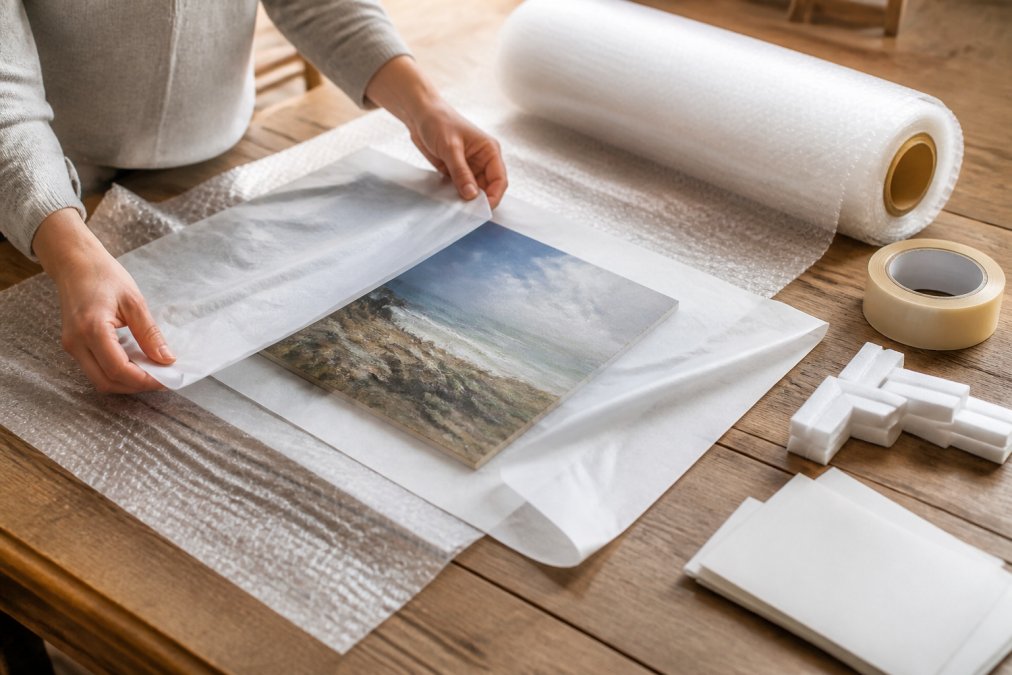
Add another sheet of foam board on top of the glassine. You now have a sandwich: foam board, canvas, glassine, foam board. This rigid assembly prevents flexing. Secure with tape, but do not pull it so tight that it bends the foam board.
Wrap the entire sandwich in bubble wrap, with bubbles facing inward. Use at least two full layers. Pay special attention to corners and edges, adding extra strips of bubble wrap or foam corner protectors. The goal is a package that feels like a solid block with no give.
Step 4: Box or Crate for Transit
Place the cushioned package inside your rigid box. The fit should be snug. If there is any room left, fill it with crumpled paper or extra bubble wrap so the package cannot slide.
For highly valued artworks or long-distance shipping, double-boxing is the gold standard. Place your packed box inside a second, larger box with at least 5 cm of packing material on all sides. The outer box absorbs the first impact of any drop.
If shipping a canvas without a frame, you may consider removing it from its stretcher bars and rolling it. However, this is only advisable for very large works or when a rigid package is impossible. Rolling can crack the paint, so we only recommend it for pieces specifically designed to be rolled.
Shipping Insurance for Original Paintings
Shipping insurance for original paintings is not optional; it is a necessity. A standard carrier's liability is usually limited to a small fraction of an artwork's value. Declare the full value and purchase additional coverage from your carrier or a third-party insurer.
Document the artwork thoroughly before packing. Take high-resolution photos of the front, back, corners, and any existing flaws. Keep a record of the certificate of authenticity if one exists. This documentation is critical if you need to file a damage claim.
When filing a claim, the carrier will typically require you to keep the original packaging for inspection. Do not discard the box or wrapping until the claim is resolved. Many claims are denied simply because the packaging was thrown away.
How to Calculate Shipping Costs for Original Art
Shipping costs for original art are rarely about actual weight. Carriers bill for the larger of actual weight or dimensional weight ("dim weight"). For a painting, dimensional weight is almost always the deciding factor.
The Dimensional Weight Formula
Dimensional weight is calculated by multiplying length, width, and height (in centimetres) and dividing by a carrier-specific divisor. The two most common divisors are:
- 5000 for most international shipments (UPS, FedEx International, DHL)
- 7000 for some domestic ground services (UPS Ground in the US, FedEx Ground)
A higher divisor means a lower dimensional weight, so the same package costs less under a 7000 divisor than a 5000 divisor. Always check which divisor your carrier applies.
A Worked Example
Imagine a 60 cm x 80 cm canvas (a standard 24" x 32" painting) that weighs 3 kg. Two box options:
- Option A (Oversized): 80 cm x 100 cm x 20 cm = 160,000 cubic cm. Divide by 5000 = 32 kg dimensional weight. You are billed for 32 kg, not 3 kg.
- Option B (Snug): 65 cm x 85 cm x 12 cm = 66,300 cubic cm. Divide by 5000 = 13.3 kg dimensional weight. You are billed for 13.3 kg.
That is a 58% reduction in billable weight simply by choosing a smaller box. For a fragile, high-value item, the difference can be $30 to $80 per shipment.
The 10 cm Rule vs. The Cost Trap
Most packing guides tell you to leave at least 10 cm of cushioning on every side. That is good for protection but terrible for your wallet if applied blindly. A 10 cm gap on all sides of a 60 cm x 80 cm painting means your box is 80 cm x 100 cm, and that extra 20 cm can push you into a higher dimensional weight bracket.
The professional approach is to use rigid foam board as the primary cushioning layer instead of a thick air gap. A 2 cm sheet of high-density foam board on the front and back can provide good impact protection, and allows a box only 4-5 cm larger than the painting on each side. This can reduce dimensional weight without compromising safety.
Carrier-Specific Surcharges
Beyond dimensional weight, three surcharges commonly apply:
- Declared Value Surcharge: Most carriers charge a fee for declared value above their standard liability limit (usually $100 or $500). The fee is typically 1-2% of the declared value.
- Oversize Surcharge: If any single side exceeds a carrier threshold (often 120 cm for UPS or FedEx), you pay an oversize fee on top of dimensional weight. This fee is flat (often $30-$50).
- Remote Area Surcharge: Shipping to a rural or less-accessible location adds a surcharge that can be 20-30% of the base rate.
How to Optimize Your Box
- Measure the painting with its frame or stretcher bars. Add 4-5 cm per side for foam board cushioning, not 10 cm.
- Use the smallest standard box size that fits. Custom-cut a box if necessary, a few minutes with a box cutter can save you $20.
- If your package is close to an oversize threshold (e.g., 119 cm vs. 121 cm), trim the box slightly to stay under the limit.
- Compare rates between carriers. DHL often has a higher divisor (5000) than UPS Ground (7000), which can make them cheaper for lightweight but bulky art.
Final Checks Before Dispatch
Before you seal the box, shake it gently. If you hear or feel movement, open it and add more packing material. A silent, solid package is a safe package. Confirm the artwork is facing the correct way and no tape touches the painted surface.
Seal the box with strong packing tape along all edges and seams. Write "FRAGILE" and "HANDLE WITH CARE" on at least two sides, include an arrow indicating the correct upright orientation, and attach the shipping label in a clear plastic sleeve.
Choose a carrier with a track record for handling fine art, and consider climate-controlled shipping for long journeys. Extreme heat can soften oil paint, while humidity can cause canvas to sag or warp. Faster transit can reduce the window of risk.
Once dispatched, track the package closely. Provide the tracking number to the recipient and request delivery confirmation. Ask the recipient to inspect it immediately and note any damage on the delivery receipt before signing. This protects both sender and receiver.
Shipping original paintings is a skill that rewards patience and attention to detail. At Cairngorm Artists, we apply these same principles to every piece we ship, ensuring that the wild beauty of the Scottish Highlands arrives at your door ready to hang. Our safe-arrival promise means we handle the packing, insurance, and logistics so you can focus on finding the perfect spot for your new artwork. UPS guidelines on packaging artwork and FedEx packaging tips for framed art both confirm that rigidity and immobilisation are the cornerstones of safe transit. For more on protecting your investment, consult the Smithsonian's guidelines on transporting art.
Shipping a one-of-a-kind painting carries real risk, but the right preparation removes nearly all of it. By following these steps, you protect your financial investment and the artist's creative work. Cairngorm Artists makes this easy for collectors: every original work we ship is professionally packed, fully insured, and backed by our safe-arrival promise, so you can buy with confidence. Explore original Highland paintings and bring the spirit of Scotland into your home.
Frequently Asked Questions
Do I need to crate original paintings for international shipping?
For international transit, a rigid crate offers the best protection for original paintings. Wooden crates are recommended for pieces over 36 inches or those valued highly. For smaller works, a double-walled cardboard box with solid foam board inserts can suffice. Customs handling increases the risk of impact, so the extra rigidity of a crate is often worth the cost. Always use shipping insurance for original paintings when crossing borders.
Will UPS or FedEx pack and ship a painting?
Both UPS and FedEx offer packing services at many locations, but for a valuable original painting, you should pack it yourself or use a specialist fine art logistics company. Retail staff are not trained art handlers. Your own packing, using archival materials and rigid packaging, gives you full control. If you choose a carrier service, verify their packing standards and always purchase declared value coverage.
How much does it cost to ship a 24x36 painting?
Shipping costs vary based on the final parcel dimensions, weight, destination, and chosen service. The box will be larger than the canvas, so the dimensional weight often sets the price. A 24x36 painting in a double-boxed package might cost more than a smaller flat parcel. To calculate shipping costs for original art, measure the outer box and weigh it, then compare carrier quotes online.
What is the best way to wrap an original oil painting for shipping?
Start with a dust cover of acid-free glassine paper, never plastic, which can trap moisture and stick to the paint. Protect the corners with rigid corner protectors. Then wrap the piece in a layer of bubble wrap with the bubbles facing outward, away from the painted surface. This creates a cushion without pressing against the varnished surface. Finally, sandwich it between two sheets of rigid foam board or cardboard.


