

How to Ensure Safe Art Shipping: A Complete Guide
Sep 02, 2026
Table of Contents
- Preparing Your Artwork for Safe Shipping
- Best Packaging Materials for Shipping Art
- How to Crate a Painting for Shipping
- Art Shipping Insurance Requirements and Coverage
- Protecting Artwork from Environmental Damage
- Selecting a Reliable Shipping Carrier
- Critical Do's and Don'ts for Art Transit
- Frequently Asked Questions
Last Updated: September 2, 2026
Preparing Your Artwork for Safe Shipping
Before your artwork leaves your hands, preparation is everything. The difference between a piece that arrives pristine and one that sustains damage often comes down to how thoroughly you ready it for transit.
Start by assessing your piece honestly. Is it an oil painting on canvas? A delicate watercolor? A framed print? Each requires different protective strategies. Canvas paintings need support to prevent sagging and punctures. Watercolors are vulnerable to moisture and require sealed protection. Frames can shift within boxes if not secured properly.
Document everything before packing begins. Take high-resolution photographs of your artwork from multiple angles, including close-ups of any existing damage, the back of the frame, signature, and any certificates of authenticity. Store these photos securely in cloud storage. This documentation protects you if the piece arrives damaged.
At Cairngorm Artists, we understand that preparing original artwork for safe art shipping demands precision and care. Our Highland artists create pieces that deserve protection equal to their artistic value. The preparation phase sets the foundation for everything that follows.
Best Packaging Materials for Shipping Art
The materials you select determine whether your artwork survives transit intact. Quality packaging materials are investments in protection, not expenses to minimize.
Archival-quality materials form your first line of defense. Acid-free tissue paper and lignin-free materials prevent chemical degradation and yellowing (peer-reviewed research). Ordinary materials contain acids that migrate into artwork, causing permanent damage. When shipping original pieces, these are essential.
Bubble wrap provides shock absorption during transit. Use thinner bubble wrap (3/16 inch) for delicate pieces, thicker (1/2 inch) for heavily framed work. Wrap in multiple layers, starting with acid-free tissue as a barrier between the bubble wrap and artwork. Never let bubble wrap contact your painting directly.
Corner protectors shield vulnerable corners and edges where frames take the most impact. Custom corner protectors fit your frame's exact dimensions and prevent slipping during transit.
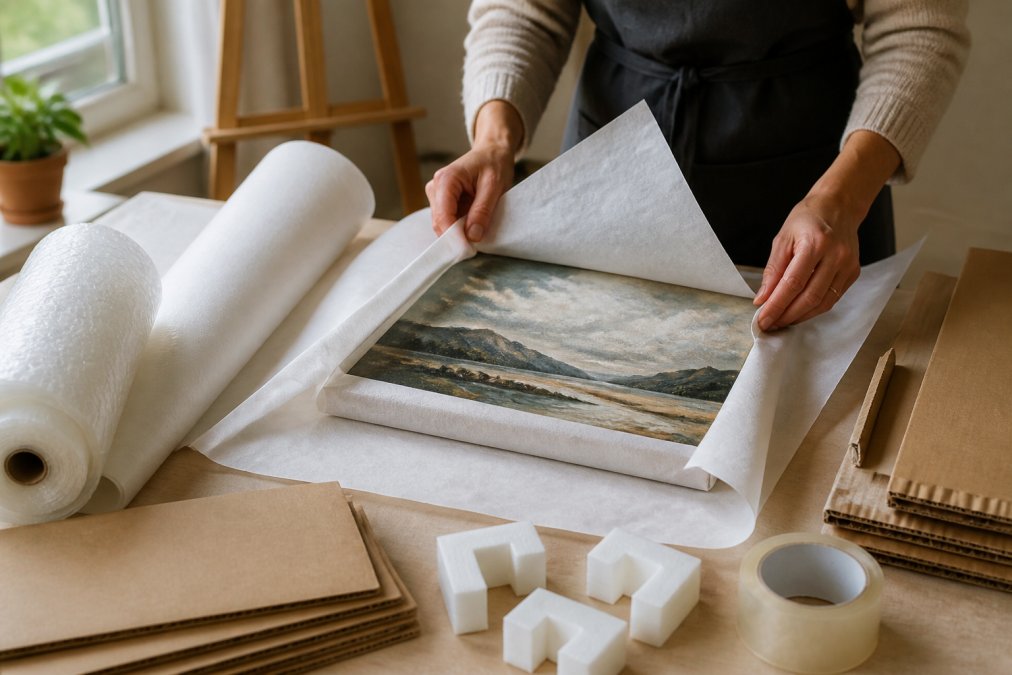
For paintings without frames, glassine paper creates a protective barrier that won't stick to canvas or paint. Foam padding provides cushioning inside your shipping box. Specialized art shipping boxes have reinforced corners and thicker walls than standard boxes.
Moisture barriers are critical for long-distance or international shipping. Polyethylene sheeting creates a sealed environment protecting against humidity fluctuations. Desiccant packets absorb moisture inside sealed packages, preventing warping, mold, and paint cracking.
Use acid-free, archival-quality packing tape. Standard shipping tape can degrade artwork if it contacts the piece directly. For sealing boxes, heavy-duty packing tape is appropriate as long as it doesn't touch the artwork.
How to Crate a Painting for Shipping
Crating represents the gold standard for shipping original artwork, particularly for high-value pieces or long-distance transit. A custom-built crate provides protection that standard boxes cannot match.
The process begins with precise measurements of your artwork's exact dimensions, including frame depth and any protruding elements. These measurements determine crate specifications. A crate built too loosely allows movement; too tightly risks pressure damage.
Custom crating involves building a wooden frame around your artwork with protective spacing. The frame should be constructed from kiln-dried wood that won't warp or introduce moisture. The interior space between the artwork and crate walls gets filled with foam padding or shock-absorbing materials. This buffer zone absorbs vibration and impact during transit.
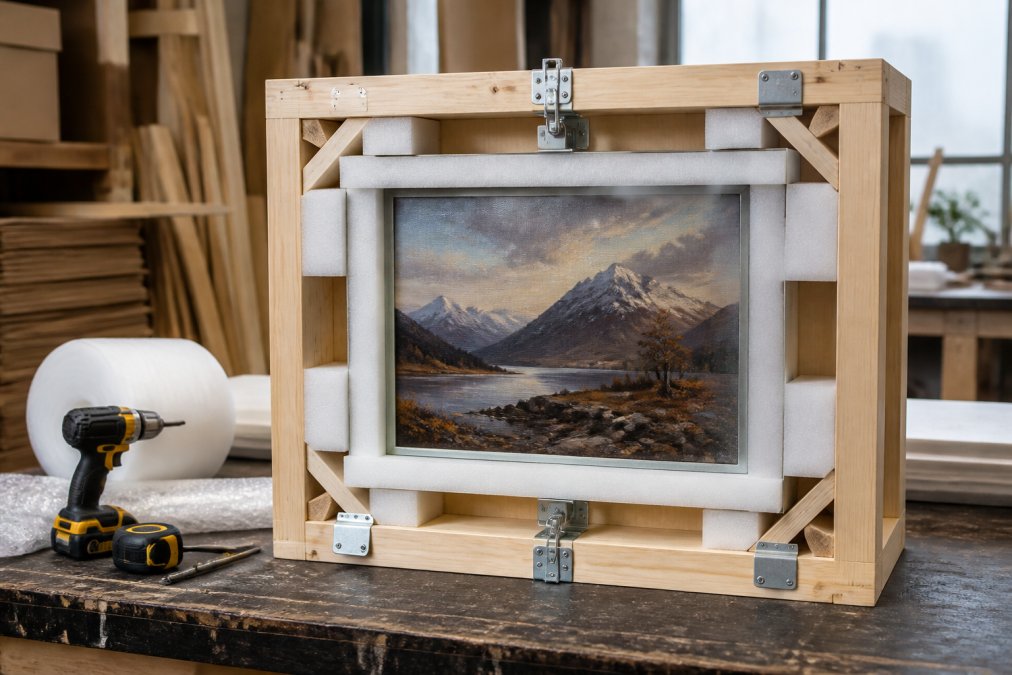
Layer protection inside the crate in sequence: first the wrapped artwork, then a cushioning layer of foam or bubble wrap, then foam blocks or custom-cut supports that hold it stable without pressure. Secure everything so nothing shifts during transit.
Ventilation holes drilled into the crate allow air circulation, preventing moisture accumulation. The crate's exterior needs clear labeling: "FRAGILE," "THIS SIDE UP," and "HANDLE WITH CARE" in multiple orientations, with your contact information and destination address in waterproof ink.
Professional crating services are worth considering for high-value pieces. These specialists understand weight distribution, materials that withstand rough handling, and documentation requirements for insured transit. For artwork valued above a certain threshold, professional crating often costs less than the risk of damage.
Art Shipping Insurance Requirements and Coverage
Insurance isn't optional for valuable artwork, it's essential. Damage happens despite perfect preparation. Insurance ensures you're financially protected when it does.
Transit insurance covers your artwork during shipping and differs from homeowner's insurance, which typically doesn't cover items in transit. You need specific art shipping insurance covering the full declared value of your piece. Valuation is critical, declare the artwork's actual replacement value.
Insurance companies require documentation: photographs, certificates of authenticity, appraisals for high-value pieces, and proof of purchase. For original artwork from artists like those at Cairngorm Artists, include artist information and provenance documentation. This supports your claim if damage occurs.
Coverage typically includes damage from impact, crushing, water, and environmental exposure during transit. Some policies include theft coverage. Read your policy carefully to understand what's covered and excluded. Damage resulting from inadequate packaging might not be covered.
If your artwork arrives damaged, document the damage immediately with photographs before opening the package further. Notify the shipping carrier and insurance company within 48-72 hours (the FDA). Provide all documentation: damage photos, original shipping photos, the insurance policy, and carrier tracking information.
For international shipping, customs insurance covers customs delays or damage during inspection. Understand your coverage before shipping crosses borders. Work with your insurance provider and customs broker to declare the correct value, as this affects customs duties and tariffs.
Protecting Artwork from Environmental Damage
Temperature and humidity fluctuations cause damage that doesn't appear immediately. A painting might arrive looking fine, then develop cracks or warping weeks later because it experienced environmental stress during transit.
Moisture barriers seal your artwork against humidity. Polyethylene sheeting wraps around packaged artwork, creating a moisture-proof envelope. This matters most for paintings traveling through humid climates or across ocean routes. Desiccant packets inside sealed packages absorb excess moisture and should be replaced for long shipments.
Temperature sensitivity varies by medium. Oil paintings tolerate temperature swings better than watercolors or pastels. Canvas is vulnerable to rapid temperature changes, which cause expansion and contraction that stresses the paint layer (peer-reviewed research). Sealed packaging minimizes these swings by slowing interior temperature changes.
For shipments traveling through extreme climates, climate-controlled shipping logistics become worth the investment. Your artwork travels in temperature and humidity-controlled environments rather than standard shipping containers. For truly valuable or sensitive pieces, it's insurance against environmental damage.
Vibration during transit can crack paint or loosen canvas from stretchers. Shock-absorbing materials and foam padding dampen vibrations. Professional crating with foam padding inside provides significantly better vibration dampening than standard boxes.
Protect against direct sunlight during storage before and after shipping. Keep pieces in dark, climate-controlled spaces. Once arrived, don't immediately hang artwork in direct sunlight. Let it acclimate to its new environment for a few days before final placement.
Selecting a Reliable Shipping Carrier
Not all shipping carriers handle artwork equally. Your choice of carrier affects how your piece is treated during transit.
Specialized art shippers understand artwork handling. Companies focusing specifically on fine art shipping have trained staff, appropriate equipment, and experience with high-value, fragile items. They know how to load artwork safely, handle crated pieces, and navigate customs for international shipments. For valuable original artwork, specialized carriers can offer peace of mind.
General carriers like major parcel services offer tracking and insurance options, but handlers aren't trained specifically for artwork. Some general carriers offer fine art shipping services through specific divisions, ask about these options.
International shipping requires carriers experienced with customs documentation and international handling standards. They should understand export paperwork, duties, tariffs, and destination country customs processes. Mistakes in documentation can delay shipments or result in additional charges.
Compare carriers on experience with artwork, tracking systems, insurance options, customs documentation handling, and reputation for care. Read reviews from other artists and collectors. A carrier that's handled thousands of artworks safely is worth more than one that's slightly cheaper.
Shipping manifest documentation matters. The carrier should provide a detailed manifest listing the artwork, its description, value, and packing materials used. This documentation supports insurance claims and provides a record of what was shipped and how.
Critical Do's and Don'ts for Art Transit
Do use adequate padding. Under-padding is the most common cause of preventable damage. Every surface that could contact another surface needs cushioning. Every corner needs protection.
Don't use newspaper or standard packing material. Newspaper is acidic and can transfer ink to artwork. Standard packing peanuts offer poor protection and can degrade in humid environments.
Do secure everything so nothing shifts during transit. Movement causes friction, which damages surfaces. Vibration loosens connections.
Don't leave air pockets inside packed boxes. Empty spaces allow the artwork to move. Fill every gap with cushioning material.
Do label your package clearly. "FRAGILE," "THIS SIDE UP," and "HANDLE WITH CARE" are instructions that handlers follow.
Don't assume the carrier will handle your package gently. Rough handling happens. Your packaging must protect against it anyway.
Do get insurance. Even with perfect packaging, accidents happen. Insurance protects your financial investment.
Don't declare a false value for insurance purposes. Undervaluing means you won't be fully covered if damage occurs. Overvaluing raises red flags with customs.
Do photograph everything before shipping. These photos prove the artwork's condition before transit and are invaluable for damage claims.
Don't pack artwork when rushed or tired. Mistakes happen when hurrying. Take your time. Proper packing takes hours for valuable pieces.
Do use acid-free, archival-quality materials throughout. These materials protect your artwork's long-term condition, not just during shipping.
Don't let moisture contact your artwork. Seal everything. Protect against humidity. Moisture causes swelling, warping, mold, and permanent damage.
Do consider professional packing services for high-value pieces. Specialists have the materials, experience, and equipment to pack properly.
Shipping original artwork safely requires attention to detail at every stage. From the materials you choose to the carrier you select, each decision affects whether your piece arrives in perfect condition. At Cairngorm Artists, our safe-arrival promise reflects our commitment to ensuring that every original Highland artwork reaches collectors worldwide ready to hang and display. When you understand the proper techniques for safe art shipping, you protect not just the physical piece, but the artistic vision it represents. Take the time to prepare properly, choose your materials carefully, and select carriers who respect the value of what you're sending. Your artwork deserves nothing less.
Step |
Purpose |
Critical Detail |
|---|---|---|
Document condition |
Establish baseline for claims |
High-resolution photos from multiple angles |
Select archival materials |
Prevent chemical degradation |
Acid-free, lignin-free products only |
Wrap with protection layers |
Cushion against impact |
Multiple layers: tissue, bubble wrap, foam |
Build or obtain crate |
Provide structural support |
Custom-fit with interior padding |
Secure insurance |
Protect financial investment |
Declare accurate artwork value |
Choose specialized carrier |
Ensure expert handling |
Verify experience with fine art |
Label clearly |
Guide handler behavior |
"Fragile," "This Side Up," contact info |
Monitor transit |
Track delivery status |
Request delivery confirmation |
Frequently Asked Questions
Q: What is the safest way to ship artwork?
A: The safest approach combines multiple protective layers: start with archival-quality, acid-free wrapping directly on the painted surface, add corner protectors, surround the piece with bubble wrap for shock absorption, and place it in a sturdy cardboard box or custom-built crate. Include a moisture barrier to prevent humidity damage during transit. Use a reputable shipping carrier that offers tracking and damage prevention protocols. Always declare the artwork's value for insurance purposes and request handling instructions be marked prominently on the package.
Q: How can I insure my art for shipping?
A: Most shipping carriers offer transit insurance options, but coverage limits vary. Document your artwork's value through appraisals, photographs, and condition reports before shipping. Purchase insurance that covers the full replacement value, not just a fraction. Some carriers require declared valuation at the time of shipment. For high-value pieces, consider specialist fine art shippers who provide comprehensive coverage. Keep all documentation, receipts, and shipping manifests to file claims if damage occurs during delivery.
Q: Do I need a custom crate for shipping original paintings?
A: For valuable original artwork, a custom-built crate offers superior protection compared to standard cardboard boxes. Custom crates provide better shock absorption, vibration dampening, and structural integrity for long-distance shipping. Standard boxes work for smaller, lower-value pieces if properly padded. The decision depends on the artwork's value, size, and shipping distance. High-value pieces or international shipments benefit significantly from custom crating, which includes climate considerations and professional handling instructions.
Q: How do I protect the surface of an oil painting during transit?
A: Oil paintings require specialized care: never wrap directly against the painted surface with materials that can stick. Use glassine paper as a protective layer between the painting and other materials—it's archival-quality and won't damage the finish. Add corner protectors to prevent edge damage, then wrap with acid-free tissue and bubble wrap for cushioning. Ensure the piece is secured firmly inside its box or crate to prevent shifting. Include a moisture barrier to protect against humidity changes that can affect paint stability during shipping.

