

Is That Signature Real? Signs of a Forged Artist Signature
Oct 25, 2026
Last Updated: October 24, 2026
Quick Summary
A forged artist signature usually fails on execution, not spelling: look for awkward letterforms, shaky lines with no natural pressure change, overworked areas, and a signature that floats on top of the paint instead of sitting in the same layer as the surrounding brushwork. Under magnification, a genuine signature shows lines that start firm, taper and change speed, while a fake often looks flat and stops and restarts.
- The full signature check takes about fifteen minutes with a loupe or phone camera zoom.
- A floating signature sits on top of the finished surface and is the single clue that catches more fakes than any other.
- Compare signatures from the same period, since an artist's signature changes over a career in size, confidence and spelling.
- On a print, the signature is often in pencil below the image with the edition number beside it.
- Technical analysis can establish whether signature paint is contemporary with the work but cannot prove who held the brush.
Table of Contents
- Why a Signature Is the Most Forged Part of a Painting
- How to Identify an Artist Signature: A Numbered Visual Checklist
- Visual Signs of a Suspicious Signature: What a Forger Gets Wrong
- Artist Signature Examples: Comparing With Authenticated Work
- Signature Placement, Known Habits, and Media Differences
- Artist Signature Authentication: What Expert Examination Can Establish
- AI Signature Forgery Detection and the Limits of Visual Inspection
- What to Do After Finding a Warning Sign
- Frequently Asked Questions
Why a Signature Is the Most Forged Part of a Painting
A forged artist signature is the cheapest lie in the art world. Anyone can copy a name; copying a painting takes skill, time, and nerve. That imbalance explains why the signature is the most forged part of any artwork.
At Cairngorm Artists, we work with ten talented Highland artists, so we see signatures every day. Buyers, dealers, and auction houses use the signature as the first filter for artist attribution; get past it, and a fake can travel a long way before anyone asks harder questions.
That makes the signature both the easiest thing to fake and the easiest thing to check. A forger can copy a name in minutes.
How to Identify an Artist Signature: A Numbered Visual Checklist
Learning how to identify an artist signature starts with slow, close looking. Work through these steps in order, noting what you see at each; the full check takes about fifteen minutes with a loupe or phone camera zoom.
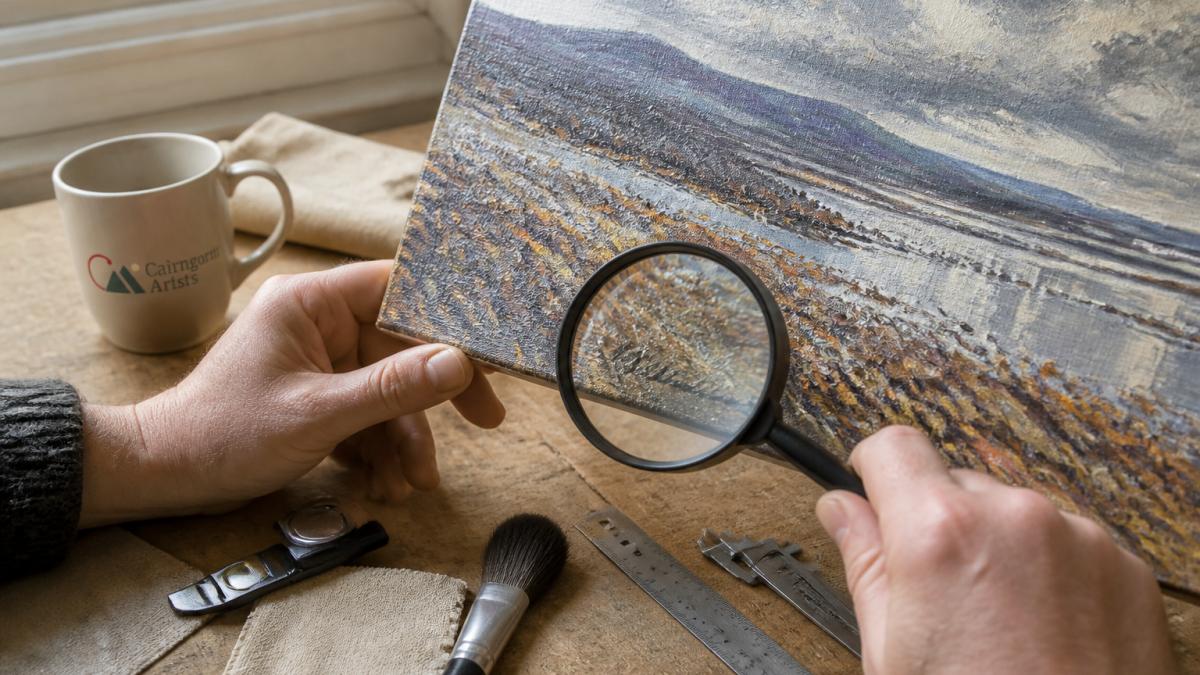
- Find the signature first. Scan all four corners, the lower edge, and the back of the canvas.
- Check the placement. Does it sit where this artist usually signs?
- Look at magnification. Use a loupe or zoom in with your phone camera.
- Study the edges of the paint. Does the signature sit in the paint or on top of it?
- Follow the line quality. Look for pressure changes, speed, and natural movement.
- Compare the color. Does the signature pigment match the rest of the painting?
- Check the brush. Does the signature use the same tool as the main work?
- Look for hidden marks. Check the stretcher, the back, and the frame for labels or dates.
- Compare with authenticated examples. Use a known genuine signature as your reference.
- Write down your findings. Date your notes and keep photographs.
Step-by-step: examining the signature under magnification
Under magnification, a genuine signature shows life: lines start firm, taper, and change speed, and paint builds where the brush paused. A fake often looks flat, with lines that stop and restart. Check where the signature meets the paint beneath it: real signatures sit in the same layer as the surrounding brushwork, while forged ones often sit on top, like a sticker.
Visual Signs of a Suspicious Signature: What a Forger Gets Wrong
A fake signature usually fails on execution, not on spelling. Forgers get the letters right and the movement wrong. Look for these warning signs:
- Awkward letterforms that look drawn rather than written
- Shaky or uneven lines with no natural pressure change
- Overworked areas where paint has been re-applied or scraped
Signature in the paint versus a floating signature
The most reliable visual test is depth. A signature in the paint sits within the same layer as the surrounding brushwork. The paint edges blend, and the texture continues through the letters. A floating signature sits on top of the finished surface, like a later addition. Under raking light, a floating signature casts a slight shadow or shows a different sheen.
Brushstroke patterns, color, and pigment in the signature
Brushstroke patterns in a signature should match the rest of the work: a painter who loads a brush heavily in the landscape usually loads it heavily in the signature too. Signature pigment should match the palette used elsewhere, and a shade that appears nowhere else deserves a second look. Under UV light, later paint often glows differently from the original layer.
Artist Signature Examples: Comparing With Authenticated Work
Comparison is the heart of how to identify an artist signature. A signature means little on its own but a great deal next to a known genuine example. Start with authenticated examples from catalogues raisonnés, museum collections, or dealer records, photograph the signature at the same angle and lighting, then compare letter shape, spacing, pressure, and placement.
How to compare signatures responsibly
Compare like with like. Signatures change over a career, so match the period. An early signature may differ from a late one in size, confidence, and even spelling.
Never judge from a single photo. Lighting, angle, and lens distortion all change how a signature looks. Use several reference images, and note the source of each. Treat any single mismatch as a question, not a verdict.
Signature Placement, Known Habits, and Media Differences
Placement is evidence.
Learn the artist's placement pattern from authenticated examples: the lower right corner, the lower left, the reverse of the canvas, or a monogram worked into the composition.
| Medium | Where signatures usually appear | What is normal | What deserves a second look |
|---|---|---|---|
| Oil or acrylic on canvas | Lower corner, in the paint layer; sometimes on the reverse of the canvas or stretcher | Signature painted wet-in-wet, picking up canvas texture; same brush and pigment family as the image | Signature floating on top of varnish; pigment that appears nowhere else; a clean signature on a heavily worn surface |
| Watercolour or gouache on paper | Lower corner or margin, in the same medium or in ink | Signature applied with the same brush family; slight bleed into the paper fibres | Signature in a different medium that sits on top of the paper surface; signature that does not follow the paper's texture |
| Etching, lithograph, or screenprint | Below the image, usually in pencil; edition number beside it | Pencil signature that sits in the paper grain; edition number and title in the same hand | Painted signature on a print; pencil signature that floats above the paper; edition number in a different hand from the signature |
| Photograph | Verso, on the mount, or in the margin | Ink or pencil signature consistent with the photographer's known habits; estate stamps where relevant | Signature that appears printed rather than hand-written; stamp that does not match known estate marks |
| Sculpture or ceramic | Base, underside, or reverse | Incised, stamped, or painted mark consistent with the maker's workshop | Mark that sits on top of glaze or patina; stamp that does not match known workshop marks |
A few medium-specific traps are worth memorising.
Placement also interacts with working habits: some painters sign first and paint around the signature, others sign last, and some use a dedicated signature colour.
Finally, placement is a prompt, not a verdict. An unusual position is a reason to gather more evidence, not to declare a forgery. Artists break their own habits for innocent reasons: an awkward commission, a damaged corner, a change of framer, or a rushed day in the studio.
Artist Signature Authentication: What Expert Examination Can Establish
Artist signature authentication combines visual examination with technical checks and provenance research. No single test proves a signature genuine; together they build a case.
- Magnification and raking light. Magnification shows how the signature was applied: whether the paint sits in the layer beneath, whether lines start and stop naturally, and whether the surface has been abraded or overpainted. Raking light reveals a floating signature as a slight shadow or a different sheen. What it establishes: application and surface condition. What it cannot establish: who held the brush.
- Ultraviolet (UV) light. UV fluorescence often distinguishes later paint from original paint, because aged varnish and older pigments fluoresce differently from fresh additions. What it establishes: whether the signature paint is likely contemporary with the rest of the work. What it cannot establish: authorship, or whether an old signature was added shortly after the work was finished.
- Infrared reflectography. Infrared can reveal underdrawing and changes beneath the visible surface, which sometimes shows whether a signature was planned as part of the composition or added later. What it establishes: the sequence of layers. What it cannot establish: intent.
Provenance matters as much as the technical checks: a clean technical report with no history is still an open question, and a strong history with an odd signature is worth a closer look rather than immediate rejection.
The practical takeaway: authentication is a weight-of-evidence exercise. Each method narrows the possibilities, but none closes the question alone. Treat a technical report as one input among several, alongside provenance, comparison with authenticated examples, and a second opinion from a specialist.
AI Signature Forgery Detection and the Limits of Visual Inspection
AI signature forgery detection is improving fast. New tools can flag odd stroke patterns, mismatched pigments, and statistical anomalies in handwriting, but they are useful filters, not judges.
Visual inspection has clear limits. A skilled forger can fool the eye, and a cautious artist can produce a signature that looks odd for innocent reasons: age, illness, a new brush, or a rushed session all change a signature.
What to Do After Finding a Warning Sign
Stop and slow down. A warning sign is a reason to gather more evidence, not to walk away in a panic. Original vs reproduction Scottish landscape prints explains the difference before you decide what you own. Work through these steps:
- Photograph the signature, the back of the canvas, and any labels
- Ask for provenance: receipts, letters, exhibition records
- Compare with authenticated examples from the same period
Watch out: buying on a signature alone is the most common and most expensive mistake in art buying. Benefits of buying original Scottish paintings makes the case for choosing originals instead. A name is not a provenance.
Frequently Asked Questions
How can you tell if an artist's signature is forged?
Look for a signature that sits on top of the paint rather than inside it, shaky or overworked lines, color that does not match the rest of the painting, and placement that ignores the artist's known habits. A forged signature often reads as tentative or awkward under magnification, while a genuine one shows the same pressure, movement, and brushstroke patterns as the rest of the work. No single clue proves forgery, so treat each sign as a reason to look further and seek expert examination.
Does a signature that looks different from an artist's usual style mean a painting is fake?
Not on its own. Artists change their signatures over a career, use monograms on smaller works, and sign more loosely on some media than others. Signature variation is normal, especially across decades or between oil painting and works on paper. Compare against authenticated examples from the same period and medium before drawing conclusions, and remember that a different signature is a prompt for closer study rather than proof of art forgery.
Can AI detect a forged artist signature?
AI signature forgery detection is developing, and some tools compare line quality, pressure, and movement patterns against known samples. It is not a substitute for expert examination. AI models can be confused by signature variation, age, and different materials, and they cannot assess provenance or how the paint sits on the canvas. Use AI results as one signal among several, and have anything valuable reviewed by a qualified authenticator before you buy or sell.
What should I do if I suspect an artist's signature has been forged?
Stop, document everything, and do not clean or alter the artwork. Photograph the signature under magnification, gather provenance such as receipts, gallery labels, and previous sales records, and contact a qualified art authenticator or the artist's estate or foundation. If you bought the piece from a dealer, raise it with them in writing. For a Cairngorm Artists piece, contact us directly and we will help verify the work and its documentation.
A forged signature can fool a quick glance, but it rarely survives a slow, careful look. At Cairngorm Artists, every piece comes from one of our ten Highland artists, with original art inspired by the Scottish Highlands and a safe-arrival promise behind every order. Each work arrives ready to hang, shipped worldwide. Get started with Cairngorm Artists and bring a genuine piece of the Highlands into your home.


