

Original vs Reproduction Scottish Landscape Prints
Sep 18, 2026
Table of Contents
- Original vs Reproduction Scottish Landscape Prints: What You're Really Buying
- Defining Original Artwork and Reproduction Prints
- How to Identify Original Art Prints vs Mass-Produced Copies
- Investment Value and Resale Potential
- Benefits of Buying Original Highland Art
- Investing in Local Wildlife Artists: Why It Matters
- Materials, Quality, and Long-Term Maintenance
- Choosing Art for Your Home: Aesthetic and Budget Considerations
- Frequently Asked Questions
Last Updated: September 18, 2026
Original vs Reproduction Scottish Landscape Prints: What You're Really Buying
When you're shopping for Scottish landscape art, the choice between an original and a reproduction print fundamentally changes what you own. Original vs reproduction scottish landscape prints represents more than a price difference, it's the distinction between owning a unique work of art created by a living artist and purchasing a mechanically replicated image. At Cairngorm Artists, we work with ten Highland-based artists whose original paintings capture the raw beauty of Scotland's wild landscapes and wildlife in ways that mass-produced reproductions simply cannot replicate.
The real question isn't which is objectively "better." It's understanding what each option delivers, what it costs, and whether the investment aligns with your goals. If you're buying for your living room wall, the decision matters less than if you're building a collection with potential resale value. This guide breaks down the practical differences so you can make an informed choice based on what actually matters to you.
Defining Original Artwork and Reproduction Prints
What Makes a Print Original
An original artwork is a singular piece created directly by the artist. In the context of Scottish landscape art, this typically means a watercolor, oil painting, or mixed-media work on canvas or paper that the artist completed by hand. Each brushstroke, color choice, and compositional decision belongs to that one piece alone.
Originals carry inherent uniqueness. No two pieces are identical, even if an artist paints similar subjects. The variations in brushwork, color intensity, and texture make each original distinct. This uniqueness is what drives collector interest and long-term value appreciation.
Understanding Reproduction Prints and Mass Production
A reproduction print is a mechanically created copy of an original artwork. The process typically involves scanning or photographing the original, then using printing technology, such as giclée printing or traditional lithography, to produce multiple identical copies. Reproductions are manufactured, not handcrafted.
Mass-produced reproductions flood the market because they're economical to create at scale. Once the initial artwork is scanned, producing 100 or 1,000 copies costs relatively little per unit. This is why you see identical Scottish landscape prints available from multiple retailers. They're often printing from the same source image.
The key distinction: a reproduction print is not created by the original artist. It's created by a printer using the artist's image. This matters for authenticity, value retention, and the emotional connection collectors often feel to original work.
| Characteristic | Original Artwork | Reproduction Print |
|---|---|---|
| Creation Method | Hand-painted by artist | Mechanically printed copy |
| Uniqueness | One-of-a-kind piece | Identical copies produced |
| Artist Involvement | Direct creation | Image only, no creation involvement |
| Provenance Documentation | Certificate of authenticity | Print run information |
| Resale Value Potential | Appreciates over time | Depreciates or holds flat |
| Price Range | Higher initial cost | Budget-friendly |
| Tactile Experience | Visible brushwork and texture | Smooth, uniform surface |
How to Identify Original Art Prints vs Mass-Produced Copies
Physical Inspection Guide
The first thing to examine is the surface. Run your hand across the artwork. An original painting has texture, you can feel the buildup of paint, the direction of brushstrokes, and variations in thickness. A reproduction print feels uniformly smooth because ink sits flat on paper or canvas.
Look at the edges of the frame or canvas. Originals often show signs of the artist's process: paint that extends slightly beyond where it was intended, variations in how the edges are finished, or visible canvas texture at the borders. Mass-produced reproductions have perfectly uniform edges because machines control the printing process.
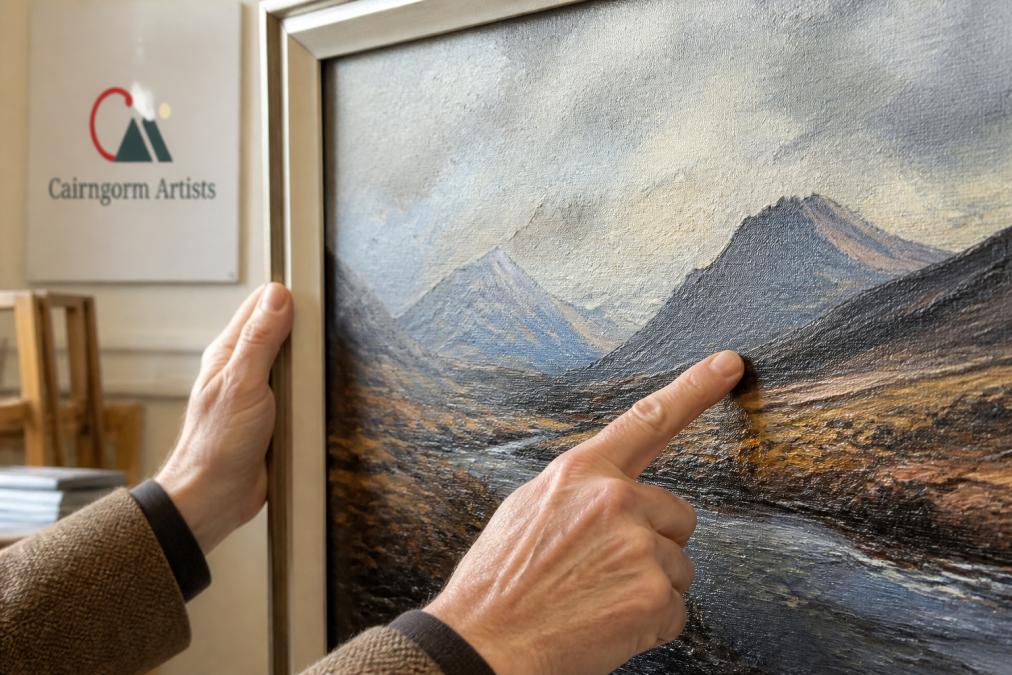
Examine the color depth. Originals typically display rich color variation because the artist layered pigments, allowing colors to interact and shift depending on viewing angle and light. Reproductions show consistent, flat color because the ink layer is uniform. Hold the piece up to different lighting angles. Original paintings often reveal subtle color shifts that reproductions don't have.
Check for the artist's signature. Originals are signed directly on the work, the signature is part of the painting itself. On reproductions, the signature is printed as part of the image, meaning it looks identical on every copy. If you see the exact same signature in the exact same position on multiple pieces, you're looking at reproductions.
Certificates of Authenticity and Provenance
A genuine certificate of authenticity includes specific details: the artist's name, the title of the work, the date of creation, dimensions, medium (watercolor, acrylic, oil, etc.), and often a unique identification number. The certificate should be issued by the artist or a recognized gallery representing the artist.
Provenance is the documented history of ownership and exhibition. For original artwork, this chain is traceable. You can confirm where the piece came from, who has owned it previously, and whether it's been exhibited in galleries or collections.
Reproductions typically come with information about the print run, how many copies were produced and whether it's a limited edition. Limited edition prints (say, 250 copies out of 1,000 total) have slightly more perceived value than unlimited reproductions, but they're still mechanically produced copies, not originals.
Investment Value and Resale Potential
Original artwork can appreciate. Not every piece becomes valuable, but works by established artists with strong exhibition histories and collector followings tend to increase in value over time. This is especially true for contemporary Highland artists whose work captures the region's unique character and appeal to both Scottish heritage collectors and international buyers seeking authentic landscape art.
The resale market for originals exists because collectors actively seek specific artists and styles. Galleries, auction houses, and private collectors purchase original artwork as investments.
Scottish Glen - Fine art print from →
Reproductions, by contrast, depreciate. The moment you purchase a mass-produced print, its resale value drops significantly. Why would someone pay you what you paid if they can buy a fresh copy from the printer for less? The reproduction market has no secondary value because supply is unlimited, the printer can always make more copies.
This is the fundamental investment difference. Originals are scarce; reproductions are infinite. Scarcity drives value appreciation.
Benefits of Buying Original Highland Art
Owning an original connects you directly to the artist's vision and effort. You're supporting a working Highland artist whose livelihood depends on selling their work. When you purchase from Cairngorm Artists, you're investing in the creative community that sustains the region's artistic culture.
Originals function as conversation pieces. Visitors notice them. They ask about the artist, the subject, the story behind the work. A reproduction print generates polite acknowledgment; an original generates genuine interest. This intangible quality, the presence and authenticity that original art brings to a space, is something many collectors value beyond the financial aspect.
Original artwork holds personal meaning in ways reproductions don't. You know the piece is unique. You know the artist created it with intention. You have documentation of its authenticity. These factors combine to create a deeper emotional investment in the work.
For collectors, originals offer the possibility of building a meaningful collection.
Investing in Local Wildlife Artists: Why It Matters
Supporting local Highland artists preserves the region's artistic heritage and ensures that future generations have access to creators who understand the landscape intimately. These artists live in the Highlands, paint the Highlands, and draw inspiration directly from the environment they depict.
Materials, Quality, and Long-Term Maintenance
Archival Quality and Lightfastness
Original artwork created with professional-grade materials lasts for decades or centuries with proper care. Artists working with archival-quality paints, pigments, and papers ensure their work won't fade, yellow, or deteriorate rapidly.
Environmental Impact and Sustainability
Original artwork has a smaller environmental footprint than mass-produced reproductions. A single painting requires materials for one piece. Reproductions, by contrast, require energy for scanning, printing, framing, and shipping potentially thousands of identical copies.
Choosing Art for Your Home: Aesthetic and Budget Considerations
Budget is often the primary consideration. Original artwork costs more upfront. The Scottish Glen fine art print from Cairngorm Artists, for instance, starts at £60. Canvas versions begin at £44. These prices reflect the artist's time, materials, and the unique nature of each piece.

Original artwork: collectors, investors, those seeking unique pieces with appreciation potential, and anyone wanting to support local artists directly.
Frequently Asked Questions
How can I tell an original print from a reproduction?
Original art prints feature visible brushstrokes, texture variation, and unique imperfections that reflect the artist's hand. Examine the surface under light, originals show depth and dimensional layering. Reproductions appear flat and uniform, with consistent ink coverage. Ask the seller about the print run size and whether the work is hand-signed and numbered, which indicates limited edition status rather than mass production.
What are the benefits of buying original highland art?
Original Highland art connects you directly to the artist's vision and captures the authentic character of Scottish landscapes through unique brushwork and texture. Original works support independent artists and local communities, and each piece is one-of-a-kind, ensuring your home decor is truly distinctive.
Why is investing in local wildlife artists a better choice for collectors?
Local Highland artists bring intimate knowledge of the landscape and wildlife they depict, resulting in authentic, emotionally resonant work. Supporting local artists strengthens creative communities and ensures your purchase directly benefits the creator. These original pieces have potential investment value, making them both meaningful decor and a sound investment. You also gain the story behind the work, the artist's inspiration, technique, and connection to the Highlands, which mass-produced prints cannot offer.
What is the difference between a limited edition print and an original painting?
An original painting is a one-of-a-kind work created directly by the artist on canvas or paper. A limited edition print is a reproduction made from the original artwork, produced in a controlled quantity (e.g., 100 or 500 copies). Both can hold value. Limited edition prints offer affordability.


