

How to Authenticate Original Scottish Oil Paintings
Oct 12, 2026
Table of Contents
- Before You Begin: Safe Handling and a Practical Authentication Workflow
- Original Oil Painting vs Print: What the Surface Tells You
- How to Verify an Artist Signature on a Scottish Painting
- Painting Provenance and Authenticity: Documents, Labels, and Scottish Records
- Certificate of Authenticity for Paintings: What It Proves and What It Doesn't
- When to Call a Specialist: Choosing and Verifying an Authenticator
- Authentication Costs, Timelines, and Levels of Examination
- Conclusion
- Frequently Asked Questions
Last Updated: October 12, 2026
Before You Begin: Safe Handling and a Practical Authentication Workflow
Learning how to authenticate original Scottish oil paintings starts with one simple rule: handle the work as little as possible and never touch the painted surface. Skin oils and salts damage a canvas in ways that cannot be reversed.
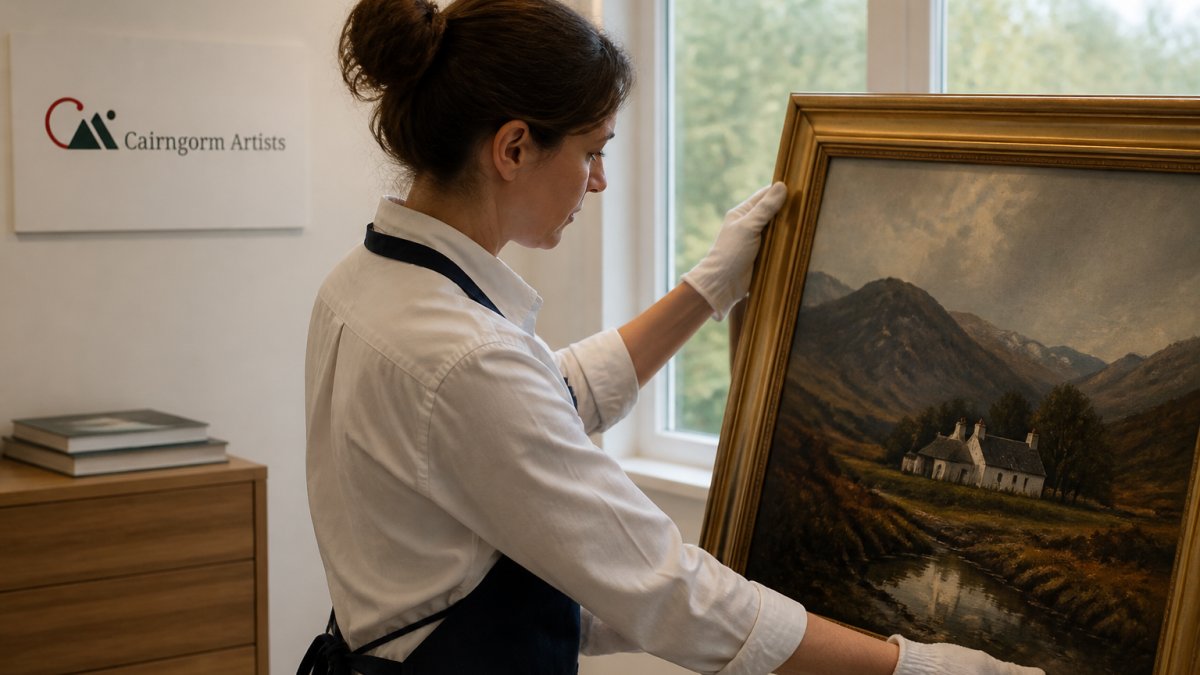
Before you inspect anything, set up properly:
- Work on a clean, padded table, never on a hard floor
- Wear nitrile or cotton gloves and hold the frame only, never the canvas
- Photograph the front, the back, and the frame before you move it
- Keep drinks, pens, and tape away from the painting
- Write nothing on the canvas or the backing board
Then follow a fixed order. Check the surface first, then the signature, then the back, then the paperwork, and only then the ownership history.
Original Oil Painting vs Print: What the Surface Tells You
The surface answers the biggest question first: is this an original oil painting or a print? An original oil painting is a work painted by hand in oil, where the paint sits on top of the canvas in raised layers.
Tilt the painting toward a light and look across the surface at a low angle. Here is what separates the two:
- Originals: visible brush marks, ridges, and slight differences in paint thickness
- Prints: a flat, uniform surface with no texture at all
- Giclée and digital prints: tiny dot patterns or a fine grid under a magnifier
- Textured prints: fake brush ridges, often too regular and evenly spaced
Look closely at where two colours meet. On a real oil painting, the boundary is usually soft and uneven. On a print, the edge is sharp and mechanical.
How to Verify an Artist Signature on a Scottish Painting
To verify an artist signature, compare it against known, documented examples of that artist's work rather than judging it on its own. A signature proves nothing by itself. It proves something when it matches the artist's hand, their usual placement, and their known period.
Work through these checks:
- Position: where does the artist normally sign? Most sign bottom right or bottom left
- Style: does the lettering match the artist's known hand?
- Medium: is it painted into the surface, or does it sit on top, as if added later?
- Date or title: does any inscription match the artist's working years?
- Consistency: does the signature look like the same paint and age as the rest of the work?
A common mistake is trusting a confident-looking signature. Forgers practise signatures. The rest of the painting is usually where the truth shows.
Painting Provenance and Authenticity: Documents, Labels, and Scottish Records
Provenance is the documented chain of ownership: who owned a work, when, and how it passed from one hand to the next.
Start by turning the painting over and recording everything you find.
- Gallery and framer labels, including older labels hidden under newer ones
- Auction lot numbers, sale stubs, and bidding slips
- Handwritten names, dates, titles, or prices on the stretcher, backing board, or canvas verso
- Exhibition labels and loan tags from museums or public galleries
- Old newspaper cuttings, receipts, or letters tucked behind the board
For Scottish work, provenance research goes further than a generic label check.
Key Scottish resources to check
- National Records of Scotland (nrscotland.gov.uk): holds archive material useful for confirming names, dates, places, and family estates. Wills, inventories, and estate papers can sometimes show that a painting was owned by a particular family.
- National Library of Scotland: newspaper archives and published exhibition catalogues can help match a work to a documented show or sale.
- Public gallery catalogues: the National Galleries of Scotland, Glasgow Museums, and Aberdeen Art Gallery have published collection catalogues and exhibition lists that may include the artist or a comparable work.
- Artist catalogues raisonnés: for major Scottish artists, a catalogue raisonné is the single most useful reference. These books list known works, dimensions, signatures, and provenance. If your painting is not listed, that is not proof of a fake, but it is a signal to look harder.
- Auction house archives: major Scottish auction houses and international salerooms keep searchable archives of past lots. A match on title, size, and photograph can confirm a sale history.
How to run a Scottish provenance check
- Record every mark on the back before you move the painting.
- Search the artist's name plus the title, size, and any exhibition label text in the National Library of Scotland newspaper archive and auction archives.
- Check the artist's catalogue raisonné, if one exists, for a matching entry.
- Contact the relevant public gallery or archive with clear photographs and a written summary of what you have found.
- Ask the artist's estate or foundation whether the work appears in their records.
- Keep a dated file of every reply, even negative ones. A documented search is itself part of provenance.
A common pattern is a painting with a strong gallery label but no sale history, or a strong sale history but no exhibition record.
If the provenance trail leads to a Scottish institution, be patient and specific. Archivists and curators respond best to a short email with clear images, the artist's name, the title, dimensions, and the exact question you need answered.
Certificate of Authenticity for Paintings: What It Proves and What It Doesn't
A certificate of authenticity for paintings is a written statement from a seller, gallery, or artist confirming what a work is. It is useful, but it is not proof on its own.
Treat a certificate as one piece of the puzzle, not the answer. Ask yourself:
- Who issued it, and are they independent of the seller?
- Does it name the artist, title, medium, size, and year?
- Does it describe the evidence used, or just make a claim?
- Can the issuer be contacted and verified?
A certificate from the artist or their estate carries real weight. A certificate from an unknown dealer with no supporting detail carries almost none. The same applies to any statement of authenticity you are handed.
Loch Morlich Chill . Fine art print from original oil painting →
When to Call a Specialist: Choosing and Verifying an Authenticator
Match the specialist to the question
- Artist specialists know one artist's work in depth. Best when you have a single named artist and need an attribution opinion.
- Art conservators assess materials, condition, and age. Best for physical questions about canvas, pigment, or later restoration.
- Auction house specialists advise on sale and market value. Best if you plan to sell and want a realistic estimate.
- Independent appraisers provide written valuations. Best for insurance, estates, and tax purposes.
How to verify an authenticator before you pay
- Check membership of a recognised professional body. In the UK, relevant bodies include the Royal Institution of Chartered Surveyors (RICS) for valuers and the Institute of Art and Law (ial.uk.com) for legal and ethical guidance on art authentication.
- Ask whether the specialist has handled work by your artist before. A generalist appraiser may be excellent, but an artist specialist usually carries more weight for attribution.
- Ask for references from two recent clients with similar work.
- Confirm the fee structure in writing before any work begins. Fees may be hourly, flat, or a percentage of value. A percentage-of-value fee can create a conflict of interest if the same person is both authenticating and selling.
- Ask whether the specialist has any financial interest in the painting or in the sale. Independent opinion should be independent.
- Confirm what you will receive: a verbal opinion, a written letter, or a full report with images and technical data.
What a written authentication opinion should contain
A useful written opinion is more than a one-line statement. It should include:
- The authenticator's name, qualifications, and professional body membership
- A clear description of the work: artist, title, medium, dimensions, and any inscriptions
- The date and location of examination
- The evidence considered: surface, signature, materials, provenance, and comparative works
- The conclusion, stated with appropriate qualification (for example, "consistent with the artist's known work" rather than an absolute claim)
- Any limitations, such as inability to examine the verso or missing provenance
Conflicts of interest to watch for
A specialist who authenticates a painting and then offers to sell it for you has a built-in conflict.
Practical next steps
If you are unsure where to start, contact a public gallery or museum with a relevant collection and ask for a referral.
A good specialist will tell you what they can and cannot conclude from the evidence. Be cautious of anyone who offers a definitive answer without examining the painting in person.
Authentication Costs, Timelines, and Levels of Examination
Costs and timelines depend entirely on how deep you go. A quick visual opinion from a dealer may take minutes and cost nothing. A full technical examination with materials analysis can take weeks and run into real money.
| Level of examination | What it involves | Typical timeline | Best for |
|---|---|---|---|
| Visual inspection | Surface, signature, and back checked by eye | Same day | Ruling out obvious prints |
| Expert opinion | Named specialist reviews the work in person | Days to weeks | Uncertain attribution |
| Technical analysis | Imaging, pigment and canvas study | Weeks | High-value or disputed works |
| Full authentication | All of the above plus documented provenance | Weeks to months | Major sales and estates |
Start at the lowest level that answers your question. Most owners never need technical analysis. If a painting turns out to be a print, the surface check settles it for free.
Conclusion
Authenticating a Scottish oil painting is a process, not a single test. Check the surface, verify the signature, record the back, read the paperwork, and research the ownership history in that order.
At Cairngorm Artists, we make that confidence simple. If you want original Scottish work with a clear origin, browse our collection. Our Loch Morlich Chill fine art print from an original oil painting starts at £29, and the canvas version is £218.


For deeper background on materials and care, the British Museum's conservation guidance is a solid reference.
Frequently Asked Questions
How can you distinguish an original Scottish oil painting from a print or reproduction?
Look at the surface under angled light. Original oil paintings show raised texture, visible brushwork, and paint that sits above the canvas. Prints have a flat, uniform surface and often show a regular dot pattern under magnification. Check the edges too: an original may show paint wrapping or irregular edges where the artist worked, while a print usually has a clean, mechanical border.
How can I check whether a Scottish artist's signature is genuine?
Compare the signature against known examples from the same artist, checking letterforms, the way the name is placed, and whether the paint used for the signature matches the rest of the work. A signature added later often sits on top of varnish or shows a different texture. Scottish gallery records and exhibition catalogues can help confirm how an artist typically signed their work.
What documents help establish a painting's provenance and authenticity?
Gallery receipts, sales records, exhibition history, previous auction listings, and written statements from prior owners all help build a chain of ownership. Labels on the reverse of the canvas or frame, including gallery stickers or framer's marks, add useful evidence. A gap in the chain does not prove a painting is fake, but it does mean you should rely more heavily on physical examination.
Should I ask an art appraiser to authenticate a Scottish oil painting?
For any painting of significant value or uncertain origin, yes. A qualified appraiser or artist specialist can carry out a visual inspection, compare the work against known examples, and where needed arrange imaging or materials analysis. Choose someone with direct experience in Scottish art, ask for their credentials, and get the scope and cost of the examination in writing before you proceed.
Buying original art should feel exciting, not risky. Cairngorm Artists brings the spirit of the Scottish Highlands to collectors worldwide, with original work from ten Highland artists, pieces that arrive ready to hang, and a safe-arrival promise for peace of mind. Get started with Cairngorm Artists and bring a genuine piece of the Highlands into your home.


