

Benefits of Buying Original Scottish Paintings
Sep 17, 2026
Table of Contents
- Why Original Scottish Paintings Are More Than Just Wall Art
- The Benefits of Buying Art Directly from the Artist
- How to Choose Original Art for Your Home
- Original Paintings vs. Mass-Produced Prints: What You Actually Get
- Investment Potential and Long-Term Value of Scottish Art
- Protecting Your Investment: Insurance, Valuation, and Archival Care
- Bringing the Highlands Home: A Piece That Tells a Story
- Conclusion
- Frequently Asked Questions
Last Updated: September 16, 2026
Why Original Scottish Paintings Are More Than Just Wall Art
Original Scottish paintings are one-of-a-kind handmade artworks, each carrying the artist's brushwork and texture in a way no reproduction can copy. They serve as decoration, cultural memory, and a store of value at once.
At Cairngorm Artists, our collective of ten Highland artists paints landscapes and wildlife from the places we walk weekly.
Below, we break down what you gain when you buy an original scottish paintings piece rather than a print, how to choose one for your home, and how to protect it.
The Benefits of Buying Art Directly from the Artist
Buying directly from the artist removes the gallery markup, gives you a direct line to the maker, and usually comes with documentation of authenticity.
A gallery takes a commission on every sale, pushing the price up without adding anything to the painting. Buy direct, and more of your money reaches the studio.
Supporting the Local Creative Economy
Every purchase from an independent Highland artist keeps money inside the region. Studios stay open, materials get bought locally, and the next body of work gets made.
The Scottish Government's culture and creative industries policy treats the creative economy as a core part of Scotland's national identity and economy, not a hobby sector. When you buy from a working artist, you're participating in that directly.
There is also an environmental dimension most buying guides ignore. A single canvas, artist-grade pigments, and a handmade frame involve far less manufacturing, shipping, and packaging than a print run of hundreds or thousands of copies.
Authenticity, Provenance, and a Signed Certificate
Provenance is the documented history of an artwork: who made it, when, and how it has changed hands. With a direct purchase, that chain starts with you.
Ask for a signed certificate of authenticity naming the artist, title, medium, and date, and keep it with the painting. If you ever sell, insure, or pass the work on, that document proves it is genuine.
But provenance is more than a certificate. In the Scottish art market, authenticity can be verified through several channels.
First, the artist's signature and any studio stamp or monogram. Most professional artists sign their work consistently, and a signature that matches known examples is a basic check. For older or deceased artists, a catalogue raisonné, a comprehensive list of known works, is the standard reference. The National Galleries of Scotland and the Royal Scottish Academy maintain archives that can help with attribution for historical work.
Second, exhibition history. A painting shown in a recognised gallery or group exhibition gains credibility and value. Ask the artist for a list of exhibitions where the piece or similar work has appeared.
Third, the medium and materials. Scottish artists have worked in oil, watercolour, and more recently acrylic and mixed media. Materials should be consistent with the artist's known practice and the period, a watercolour claiming to be from the 1920s but using modern synthetic pigments is a red flag.
Fourth, the frame and backing. Original frames, especially handmade ones, often carry labels or stamps from the framer or gallery that first sold the work, confirming its history. Do not remove old labels or backing boards; they are part of the provenance.
Questions to Ask Before You Buy
Ask these questions before you commit:
- Is the piece an original or a print, and what medium was used?
- Does it come with a signed certificate of authenticity?
- What are the exact dimensions, including the frame?
- How will it be packed, and what happens if it arrives damaged?
- Can you see a photo of the work in a real room, not just a studio shot?
How to Choose Original Art for Your Home
Choose the room first, then the painting. Size, light, and existing colour determine whether a piece belongs or fights everything around it.
Scottish Glen - Fine art print from →
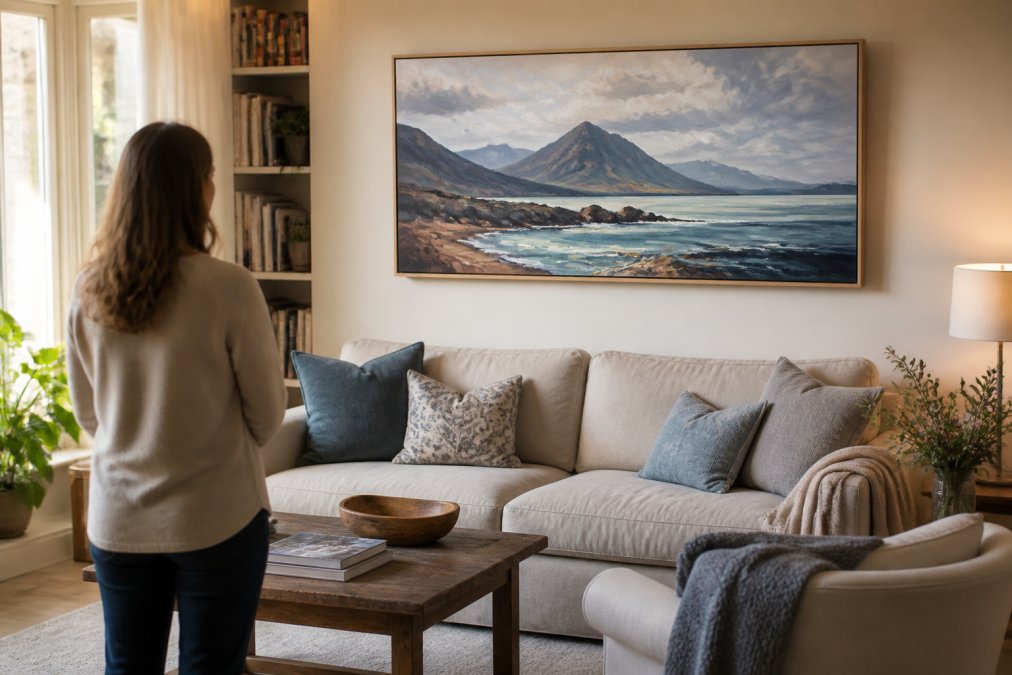
Measure the wall before you fall in love with a canvas online. A painting that looks generous in a product photo can dominate a narrow hallway, and a modest one can vanish above a wide sofa.
Matching the Piece to the Room: Size, Light, and Frame
A useful rule for hanging above furniture: the artwork should span roughly two-thirds to three-quarters of the width of the sofa, sideboard, or bed it sits over. Any narrower and it floats; any wider and it crowds.
Questions to Ask Before You Buy
Ask these questions before you commit:
- Is the piece an original or a print, and what medium was used?
- What are the exact dimensions, including the frame?
- How will it be packed, and what happens if it arrives damaged?
- Can you see a photo of the work in a real room, not just a studio shot?
Original Paintings vs. Mass-Produced Prints: What You Actually Get
An original painting is made once, by hand, and cannot be reproduced. A print is a copy, produced in multiples, and its value reflects that difference.
| Feature | Original Painting | Mass-Produced Print |
|---|---|---|
| Uniqueness | One of a kind | Produced in multiples |
| Surface | Visible brushwork and canvas texture | Flat, uniform finish |
| Pigment longevity | Artist-grade pigments, decades of stability | Varies widely by printer |
| Resale potential | Can appreciate with the artist's career | Typically depreciates |
| Emotional connection | Direct link to the artist's hand | Decorative only |
Investment Potential and Long-Term Value of Scottish Art
Original Scottish art can hold or grow in value, but only when the artist's career develops, the work is well documented, and the market for that style or region remains active. Treat appreciation as a possible bonus, not a guaranteed return.
Tax and Inheritance Implications for Collectors
Art has financial and legal dimensions most buyers never consider until it matters. In the UK, artwork forms part of your estate for inheritance tax purposes, and the rules are specific enough that general advice is not enough.
How Scottish Art Appreciates: What Actually Drives Value
Appreciation in Scottish art is not random. It follows a few observable patterns.
Insurance and Valuation Logistics
Insurance is where most collectors discover a gap between what they think they have and what they actually have. Standard home contents policies often cap single-item payouts well below what an original painting is worth, and may exclude art altogether unless it is scheduled separately.
Protecting Your Investment: Insurance, Valuation, and Archival Care
Insure original art under a specialist policy or a scheduled item on your home contents, and get a written valuation before you need one.
Bringing the Highlands Home: A Piece That Tells a Story
The strongest reason to buy an original has nothing to do with money: the connection to a place.
A few pieces that tend to resonate with buyers:
- Scottish Glen - Fine art print from original artwork (£60.00), a loose watercolour of rolling hills in warm reds and ochres, framed in handmade Italian wood.
- Storm over Glencoe - canvas print from original abstract art (£44.00), an atmospheric abstract built from layered indigos, greens, and flashes of red.
- Curly Highlander - canvas print from original artwork (£46.00), a shaggy Highland cow portrait in loose, flowing brushwork.
- Highland Croft - canvas print from original artwork (£156.00), a weathered cottage with a red roof against rolling moorland.
Conclusion
Choosing between a print and an original comes down to what you want the piece to do: fill a wall, or hold a place and a memory for decades. The buyers who get the most out of collecting measure first, ask about provenance, and insure what they bring home.


Frequently Asked Questions
Why is original art a better investment than prints?
Original Scottish paintings hold value in a way that mass-produced prints cannot. Each piece is unique, signed, and carries provenance that documents its origin. While prints are reproduced in large numbers, an original painting is a one-off, and its scarcity supports long-term value. Beyond financial return, original art offers aesthetic value, emotional connection, and a tangible link to the artist's technique and cultural heritage that reproductions simply cannot match.
How do I ensure the authenticity of an original Scottish painting?
Authenticity starts with provenance. Buy directly from the artist or a gallery that provides a signed certificate and a clear record of the work's origin. When buying from a collective like Cairngorm Artists, every piece is created by a named Highland artist, so you know exactly who made it and where it came from.
What are the emotional benefits of owning original Highland art?
Original Highland art creates a daily connection to a place and a memory. For anyone who has visited the Scottish Highlands, a painting of a glen, a coastal seascape, or a shaggy Heilan Coo brings that experience back every time you walk past it. Unlike mass-produced decor, an original piece carries the artist's expression and the story of its making, which makes it feel personal rather than generic.
How does buying art directly from Scottish artists support local culture?
When you buy directly from the artist, more of your money goes to the person who made the work, not to a middleman or a marketplace. That income supports local talent and sustains the creative economy in the Highlands. It also encourages contemporary Scottish artists to keep working in the region, which in turn preserves regional styles and cultural heritage for future generations.


