

Is Original Art Worth the Investment? A 2026 Guide
Sep 14, 2026
Table of Contents
- Original Art vs Prints Value: What Actually Holds Up
- Factors Affecting Art Investment Value
- The Real Risks and Costs of Treating Art as an Asset
- How to Start an Art Collection on a Budget
- When Is Original Art Worth the Investment for You?
- Emotional Dividend vs Financial Return
- Conclusion
- Frequently Asked Questions
Last Updated: September 14, 2026
Original Art vs Prints Value: What Actually Holds Up
Ask whether original art is worth the investment and most guides answer with auction records for canvases you will never afford. That misses the point. This guide from Cairngorm Artists looks at what actually holds value, what quietly loses it, and how to judge a piece you plan to live with for years. The honest answer sits somewhere between the auction headlines and the print bin.
The Reproduction Ceiling
A reproduction is a copy of an existing artwork, usually printed in an open or limited run. It delivers the image, not the object.
That distinction drives everything. A print can be beautiful, well made, and archival, but thousands of identical copies exist. Scarcity is what separates a collectible object from wall decor. A limited edition of 150 signed prints is scarcer than an open run, yet it still shares its image with every other copy (Edition). An original shares its image with nothing.
Where Originals Win
An original painting is a single object. No second copy exists, which means no second copy can undercut it later.
That singularity supports three things prints cannot match: rarity, direct evidence of the artist's hand, and a physical history that can be documented. Original art also carries what collectors call the emotional dividend. You are not buying a picture of a place; you are buying the only version of it. For a Highland landscape or a study of local wildlife, that difference is the whole point.
Factors Affecting Art Investment Value
Value in art is not one number. It is the sum of several moving parts, and most of them have nothing to do with how much you like the piece.
Provenance and Authentication
Provenance is the documented history of an artwork: who made it, when, and every owner since. A clean chain from the studio to your wall supports both authenticity and resale.
Authentication confirms the work is genuinely by the named artist. For a living artist, this is usually straightforward, since the artist or their gallery can confirm the piece directly. What most guides miss is that provenance matters most for older or unsigned work. If you buy from the artist or a gallery representing them, you are starting the paper trail correctly, and that paperwork becomes part of the object's story.
Rarity, Market Cycle, and Liquidity
Rarity sets the ceiling on value; the market cycle decides when that ceiling is tested.
The art market moves in long waves. Interest in a genre, a region, or a single artist can rise for years, cool, and return. Liquidity is the harder constraint: selling a painting takes time. An auction house takes a commission fee, and the whole process can run for months. Fine art is a slow asset. Treat any holding period in years, not weeks.

The Real Risks and Costs of Treating Art as an Asset
Owning art costs money after the purchase. Buyers who ignore this discover it at the worst moment: when they try to sell and find that years of carrying costs have eaten the gain.
Transaction Costs and Insurance
Every sale carries friction. Auction houses charge seller's commission, often plus photography, cataloguing, and shipping fees. A private sale avoids commission but narrows your buyer pool. On the buy side, transaction costs include framing, delivery, and any buyer's premium if you purchase at auction. A common pattern is that round-trip transaction costs on a mid-priced work can consume a meaningful share of any short-term gain, which is one reason art rewards long holding periods.
Insurance is the ongoing cost. Fine art policies typically cover theft, fire, and accidental damage, and many require a professional appraisal or a recent valuation to set the sum insured (abi.org.uk). Premiums vary by value, location, and whether the work is hung in a private home or stored. Review that valuation every few years, because replacement cost changes and under-insuring a rising work leaves you exposed.
Tax Treatment: The Gap Most Guides Skip
Tax treatment of art varies by country and by whether you are buying as a private individual or through a business. Some jurisdictions treat art as a wasting asset or apply different capital gains rules than they do to shares and property (Capital Gains Tax: what you pay it on, rates and allowances: Overview). Others offer relief for works of national significance or for donations to public collections. Estate planning adds another layer: art held in a collection may be valued for inheritance tax purposes, and gifting rules differ from those for financial assets.
Rather than guess, check the current guidance from your own tax authority before you buy, and keep every receipt, certificate, and valuation on file. If the sums are significant, a specialist art advisor or tax professional is worth the fee. This is the single most overlooked line item in art investment guides, and it can swing net returns more than the sale price itself.
Storage, Climate, and Conservation
Storage is the other quiet cost. Original work needs stable conditions: away from direct sunlight, away from damp, and out of rooms with wild temperature swings. A conservator can advise on preservation, but the basic rules are simple. Hang art on an interior wall, keep it out of steamy bathrooms and bright conservatories, and handle it with clean hands or gloves.
For higher-value works, climate-controlled storage or a museum-standard hanging environment becomes a real annual expense. Framing with UV-filtering glass, acid-free mounts, and backing boards protects the work and preserves resale value. A work that has faded, foxed, or warped loses both aesthetic and financial value, and restoration is expensive.
Liquidity: The Hardest Constraint
Liquidity is the constraint that catches new investors. Selling a painting takes time. An auction house takes a commission fee, and the whole process can run for months from consignment to settlement. Private sales can be faster but depend on finding a buyer who wants that specific work. Fine art is a slow asset. Treat any holding period in years, not weeks.
How to Start an Art Collection on a Budget
You do not need a wealth manager to begin. You need a plan, a spending limit, and an honest sense of which entry point matches your budget.
Three Entry Points at Different Budgets
Under £500. Original works on paper, small studies, and pieces bought directly from emerging artists or artist collectives. At this level you are buying the object and the relationship, not a track record. The financial upside is speculative, but the emotional dividend is immediate and the provenance file starts clean because you bought from the maker.
£500 to £5,000. Signed limited-edition prints, mid-career artists with gallery representation, and small oils or acrylics from regional makers. This is the band where resale becomes plausible. Gallery representation matters here because it creates a secondary market record.
£5,000 and up. Established artists with auction history, primary-market works from galleries, and, increasingly, fractional shares in blue-chip pieces. At this level, treat the purchase like any alternative asset: get a condition report, confirm provenance in writing, and budget for insurance and storage before you commit.
Fractional Ownership: The Modern Entry Point
Fractional ownership platforms let multiple investors hold shares in a single high-value artwork. You buy a fraction, the platform handles storage, insurance, and eventual sale, and you receive a proportional share of any proceeds. The barrier to entry drops from tens of thousands to hundreds.
The trade-offs are real. You do not get to hang the work on your wall. You pay platform fees that eat into returns. Liquidity depends on the platform's own secondary market, which may be thin. And you are trusting the platform's valuation and authentication process rather than your own eye. For investors who want exposure to the art market without the logistics of ownership, fractional platforms solve a genuine problem. For collectors who want to live with the work, they solve nothing.
A Practical Starting Framework
Start with one piece you genuinely want to live with. Then set a rule: never spend more on art in a year than you can comfortably leave untouched for five years. A workable checklist:
- Set an annual art budget and write it down
- Choose one theme, such as Highland landscapes or wildlife, so the collection has coherence and a resale story
- Buy from the artist or a gallery representing them, and keep the certificate
- Ask about the medium, the year, and whether the frame is included
- Photograph the piece and store the paperwork with your other documents
- Review the collection once a year before adding to it
- Decide upfront whether you are collecting to keep or collecting to sell, the two paths diverge fast
Buying original work from a collective of Highland artists is one route: you support named makers directly, and the piece arrives ready to hang. Cairngorm Artists works this way, with pieces such as Loch Morlich Chill . Fine art print from original oil painting at £29, which keeps the entry point low while the artist relationship stays direct.
When Is Original Art Worth the Investment for You?
Original art is worth the investment when you can hold it for years, you love the piece itself, and you have the paperwork to prove where it came from. If any of those three is missing, treat the purchase as decoration rather than an asset.
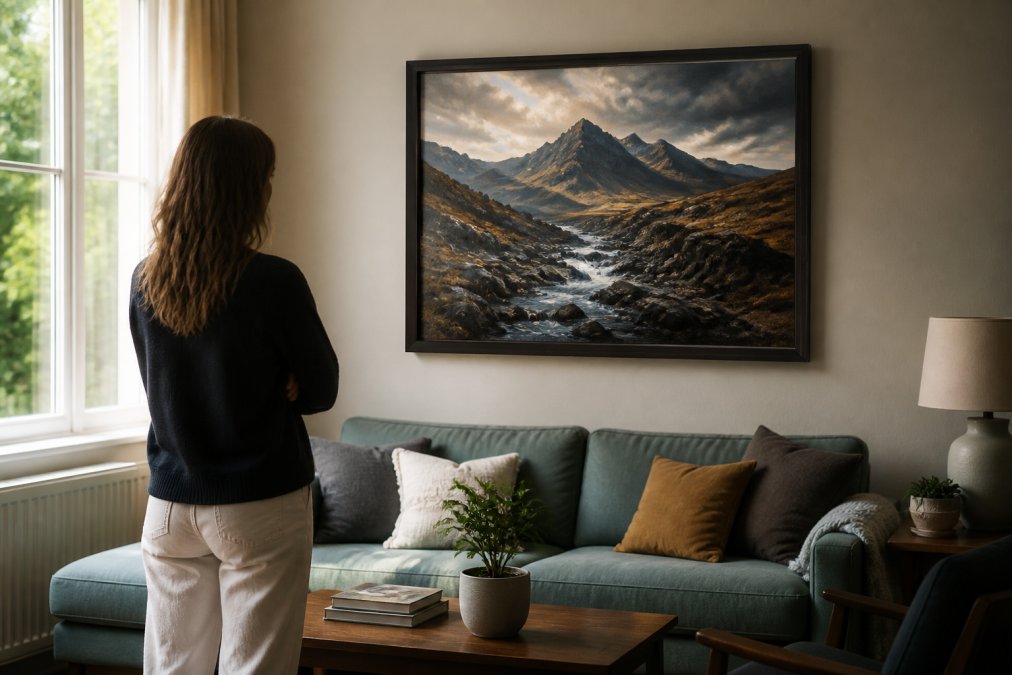
Run the honest version of the test. Would you still want this painting if it never rose a penny in value? If yes, the financial question becomes a bonus rather than a condition. If no, you are speculating, and the art market is a hard place to speculate without deep knowledge of a specific artist or genre.
For collectors with Scottish heritage or a connection to the Highlands, the case is stronger still. A piece tied to a place you know carries meaning that a generic print never will, and that meaning does not depend on the market at all.
Emotional Dividend vs Financial Return
The emotional dividend is the return you collect every day: the view from your sofa, the memory of a place, the pleasure of owning something made by hand.
Financial return is uncertain, slow, and partly outside your control. The emotional dividend is immediate and guaranteed. That asymmetry is why experienced collectors talk about both. They buy work they want to keep, and they treat any capital appreciation as a welcome extra rather than the reason for buying.
What most guides miss is that these two returns are not in competition. A piece you love is easier to hold through a slow market, and holding is what gives any asset time to appreciate. The collector who panics and sells early rarely does well. The collector who bought something they wanted to keep has no reason to.
Conclusion
The hard part of buying art is not choosing a painting. It is deciding honestly whether you are collecting or speculating, because the two demand different patience and different budgets. If you want work that carries real meaning and arrives ready to display, Cairngorm Artists brings the spirit of the Scottish Highlands to your wall, with original pieces from ten Highland artists, worldwide shipping, and a safe-arrival promise for peace of mind. Start with one piece you would keep regardless of the market, and let the rest follow.
Frequently Asked Questions
Is art a good investment in 2026?
It depends on what you expect from it. Art can deliver capital appreciation over a long holding period, but it is not a liquid asset like shares. Auction results vary, transaction costs are high, and market cycles matter. For most buyers, original art works best as part of a diversified portfolio where the emotional dividend of living with the piece is as valuable as any financial return.
Does original art hold its value better than prints?
Generally, yes. A print or reproduction can be produced in unlimited numbers, so its resale value is capped by supply. An original is a one-off, which makes it scarcer and often more resilient in the secondary market. That said, not every original appreciates. Provenance, the artist's reputation, and demand for the style all affect whether a piece holds or grows in value.
How do I determine the investment potential of a landscape painting?
Look at four things: the artist's track record, the rarity of the work, its provenance, and current demand for that style. Authentication and condition also matter. A landscape painting from an established artist with documented sales will typically be easier to value than an unknown piece. If you cannot verify these factors, treat the purchase as a lifestyle choice rather than an investment.
What is the 70/30 rule in art?
The 70/30 rule is a rough guideline some collectors use to split their art budget: around 70% toward established, blue-chip art with a track record, and 30% toward emerging artists with growth potential. It is not a formal standard, but it helps balance risk. Emerging work costs less and may appreciate more, while established pieces tend to hold value with less volatility.


