

Graystone Gallery Alternative for Collectors: 2026 Guide
Sep 15, 2026
Table of Contents
- Why Collectors Look for a Graystone Gallery Alternative
- What to Look for in a Curated Online Gallery
- Buying Original Scottish Art Online: What Changes
- How to Start an Art Collection Without Gallery Overwhelm
- Physical Gallery Visits vs Digital Browsing: An Honest Comparison
- Tax and Insurance Implications for Alternative Collection Methods
- Conclusion: Choosing the Right Graystone Gallery Alternative
- Frequently Asked Questions
Last Updated: September 15, 2026
Why Collectors Look for a Graystone Gallery Alternative
Collectors seek a graystone gallery alternative for collectors when they want broader access to original Scottish art without the constraints of a single physical showroom. This guide from Cairngorm Artists examines what actually matters when you compare options.
The shift is practical, not ideological. A traditional gallery building limits you to whatever hangs on its walls during opening hours, while a curated online platform can present work from a wider circle of artists across the Highlands and beyond.
A curated online gallery is a digital platform where a select group of artists present original work for sale, with each piece vetted for quality and provenance before listing. That definition matters because it separates genuine curation from open marketplaces where anyone can upload anything.
Art UK's guide to exploring British art collections documents how digital cataloguing has changed the way buyers research artists and verify exhibition history before committing to a purchase.
Below, we break down the criteria that separate a well-run alternative from a poorly managed one, and show you exactly how to evaluate both.
What to Look for in a Curated Online Gallery
The best curated online gallery offers four things: verifiable artist identity, clear provenance, accurate colour representation, and a returns policy that protects your money. Everything else is presentation.
Start with artist identity. A collective model, where named artists work under one roof, gives you a traceable maker rather than an anonymous supplier.
Then examine how the platform presents each piece. High-resolution photography, stated dimensions, and material details tell you whether the seller respects the buyer.
Vetting Criteria for Alternative Art Platforms
Use this checklist before you buy from any platform:
- Are the artists named, with a stated location or studio?
- Is the medium specified (canvas, paper, board) and the size given in centimetres?
- Does the listing state whether the work is original, a print, or a reproduction?
- Is there a clear returns window and a written shipping policy?
- Does the platform describe how work is packed for transit?
A platform that answers all five is worth your attention. One that dodges two or more is not.
Buying Original Scottish Art Online: What Changes
Buying original Scottish art online changes one variable: you cannot stand in front of the work before purchase. Everything else, including provenance, condition, and price, remains fully verifiable if the seller does their job.
That single change drives every other difference. Colour shifts between screens. Scale is hard to judge without a reference object. Texture, which matters enormously in an abstract landscape, disappears entirely in a flat photograph.
Reputable sellers compensate in three ways:
- They photograph work in natural light and state that they have not altered the colours
- They list dimensions in centimetres and often show the piece in a room setting
- They offer a returns window long enough for you to live with the work
Cairngorm Artists addresses this by sending every piece ready to hang, so there is no framing decision to make after delivery. The Storm over Glencoe canvas print from original abstract art arrives ready to hang.

How to Start an Art Collection Without Gallery Overwhelm
Starting a collection is simpler than the art world makes it sound: pick one theme, set a budget, and buy the best example you can afford within it. The overwhelm comes from trying to understand the entire market at once.
A workable approach for a new collector:
- Choose a single subject. Highland landscapes, coastal scenes, or wildlife. One thread makes every future decision easier.
- Set a per-piece ceiling. Decide what you will spend before you browse, not after.
- Buy one piece and live with it for a month. Your reaction to it on the wall teaches you more than any guide.
- Add slowly. Two or three considered pieces beat ten impulse buys.
If you are not a seasoned collector, that is not a barrier. Most people buying original work today are decorating a home, not building an investment portfolio, and the same rules apply to both.
Arts Council England guidance on buying art responsibly notes that buyers should always confirm what they are purchasing, original work or reproduction, since the two carry very different values.
Physical Gallery Visits vs Digital Browsing: An Honest Comparison
Most comparisons stop at a table. That is the least useful part. The real question is not which channel is better in the abstract, but which parts of the physical gallery experience you can reconstruct online, and which parts you genuinely cannot.
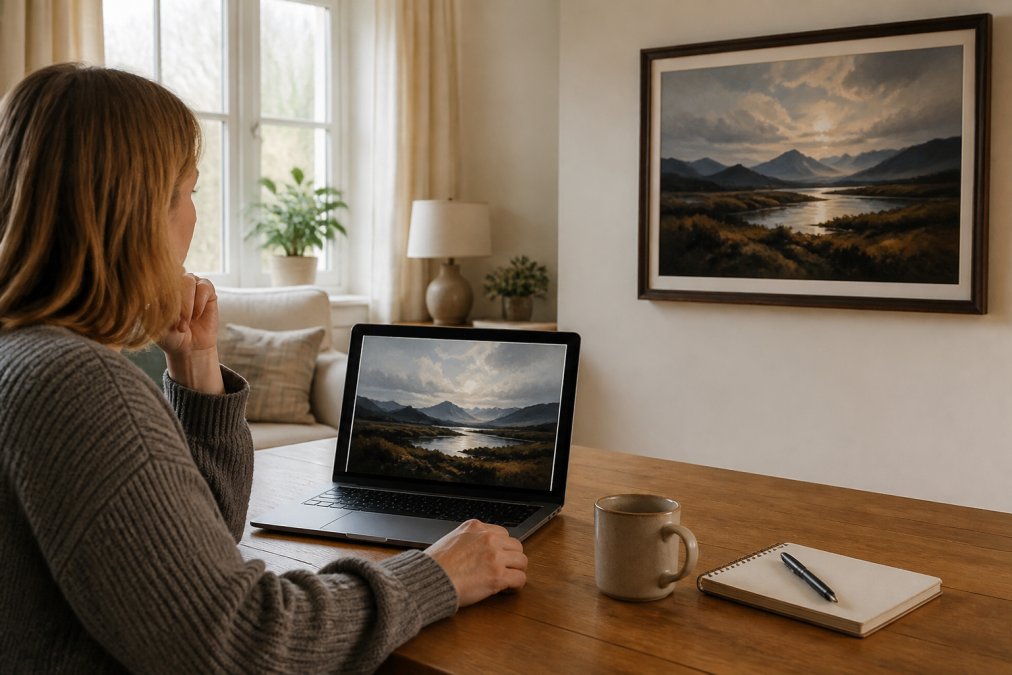
Here is the honest trade-off, with the mechanism behind each row rather than a verdict:
| Factor | Physical Gallery | Curated Online Gallery |
|---|---|---|
| Seeing true colour | Direct, no screen distortion | Depends on photography quality and monitor calibration |
| Judging scale | Immediate, body-relative | Requires stated dimensions or a reference photo |
| Reading texture | Full surface, raking light | Limited; raking-light photos help but do not replace it |
| Range of artists | Limited to current exhibition | Wider, often a full collective |
| Price visibility | Often on request | Usually listed openly |
| Buying from abroad | Requires travel | Available worldwide |
| Returns | Usually restricted | Varies by seller policy |
| Time cost | Travel, opening hours | Browsable at any hour |
What You Can Replicate Online
The gallery experience has four working parts, and three of them transfer cleanly to a well-run online platform.
1. Curation. A physical gallery has already filtered the market for you. A curated collective does the same job when it limits its roster and vets each piece. The signal to look for is a named, bounded group of artists rather than an open upload feed.
2. Context. Galleries hang work at eye level, lit from the side, with space around it. Online, the equivalent is a room-setting photograph, a stated hanging height, and a note on the frame or mount. If a listing shows only the canvas on a white background, you are seeing the artwork but not the object.
**3.
What You Cannot Replicate
A Worked Example
Tax and Insurance Implications for Alternative Collection Methods
The Tax Side: What Actually Applies
The Insurance Side: Where Policies Fail
Two Questions to Ask Before You Pay
Conclusion: Choosing the Right Graystone Gallery Alternative
Frequently Asked Questions
What are the benefits of buying art directly from artist collectives?
Artist collectives pool the work of several makers under one roof, so you see a wider range of styles without visiting multiple studios. Buying direct usually means more of your money reaches the artist, and you often get background on how each piece was made. With a collective like Cairngorm Artists, ten Highland artists contribute, and every canvas arrives ready to hang with a safe-arrival promise, which removes much of the logistics risk that puts collectors off buying online.
Is it better to buy art from a gallery or directly from the artist?
Galleries offer curation, established provenance records, and a physical space to view work in person. Buying direct or through a collective often means lower prices, closer contact with the maker, and access to pieces that never reach a gallery floor. For collectors outside Scotland, a curated online gallery removes travel costs entirely. The trade-off is that you cannot stand in front of the work first, so check the returns policy and request extra photographs before committing.
How do I find authentic Scottish Highland art online?
Start by checking who made the piece and where they are based. A collective that names its artists and describes its Highland roots gives you something to verify. Look for clear material details too. Those specifications tell you more about quality than a marketing tagline. Cairngorm Artists lists all of this on each product page.
What should I look for when purchasing original landscape paintings?
Check four things: the artist's location and background, the materials and framing, the shipping and returns terms, and whether the scale suits your wall. For abstract landscapes such as Storm over Glencoe or Loch Lomond Flow, ask for a photo of the piece in a room setting so you can judge colour against your own decor. Fine art paper prints start at £31 and canvas prints at £44, so you can begin with a smaller piece before investing more.
How does buying from a collective differ from traditional gallery experiences?
A traditional gallery visit gives you immediate scale and texture, plus staff who can talk you through provenance and valuation on the spot. A collective works differently: you browse online, the range rotates as artists produce new work, and prices tend to sit lower because there is no gallery overhead. What you lose in atmosphere you gain in range and convenience. Many collectors now do both, viewing locally and buying from Highland collectives for pieces they cannot find nearby.


