

Unique Scottish Themed Home Decor Ideas for 2026
Sep 13, 2026
Table of Contents
- 1. Tartan and Plaid Textiles: Where Heritage Meets Modern Comfort
- 2. Earthy Color Palettes and Scottish Inspired Color Palettes
- 3. Highland Landscape Wall Art: Bringing the Outdoors In
- 4. Highland Wildlife Motifs: Stags, Highland Cows, and Thistles
- 5. Traditional Wood Panelling and Celtic Knotwork Accents
- 6. Vintage and Antique Furniture with Stone and Masonry Elements
- 7. How to Style Scottish Decor: Layering, Lighting, and Small Spaces
- Conclusion
- Frequently Asked Questions
Last Updated: September 13, 2026
1. Tartan and Plaid Textiles: Where Heritage Meets Modern Comfort
Tartan is the fastest route to unique Scottish themed home decor ideas that still feel current. One wool throw in a muted clan sett over a neutral sofa beats a wall of themed accessories, restraint keeps the pattern reading as heritage, not costume.
Velvet cushions in deep green or rust work alongside tartan without competing, and vintage wool blankets from charity shops add irreplaceable texture.
For similar warmth through art, Cairngorm Artists offers original Highland landscape canvases from £44, ready to hang on arrival.

Scottish Tartans Authority guidance on tartan setts and registration
2. Earthy Color Palettes and Scottish Inspired Color Palettes
Scottish inspired color palettes pull from the landscape: heather purple, moss green, peat brown, granite grey, and the deep indigo of a Highland loch before rain. Build a room around three, then let one accent, thistle purple or warm ochre, do the talking.
A common mistake is treating every earthy tone as interchangeable: cool greys and warm browns fight under artificial light. Pick a temperature and stay with it.
| Palette | Core Tones | Best Room | Accent |
|---|---|---|---|
| Highland Moor | Moss green, peat brown, cream | Living room | Ochre |
| Coastal Bothy | Slate blue, driftwood grey, white | Bedroom | Rust |
| Autumn Glen | Deep red, olive, charcoal | Hallway | Pale teal |
Paint a large sample patch and check it at three times of day before committing.
3. Highland Landscape Wall Art: Bringing the Outdoors In
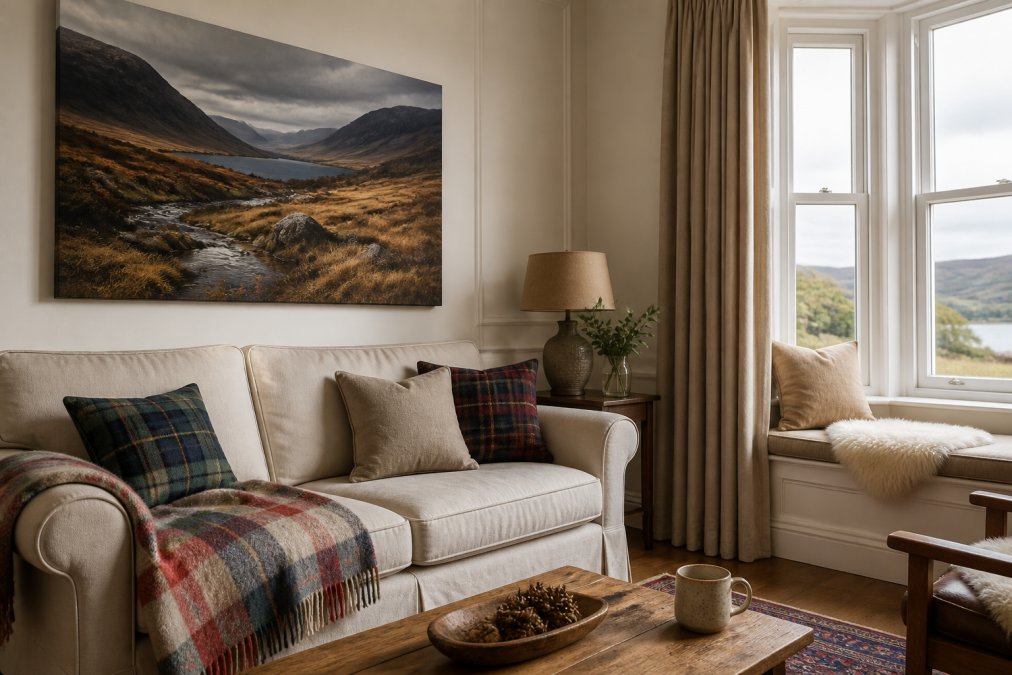
Highland landscape wall art is the most effective way to anchor a Scottish-themed room. One strong piece above a sofa or mantel beats six small scattered prints.
Choosing the Right Piece for Your Room
Scale matters more than subject: a canvas should span roughly two-thirds the width of the furniture beneath it. Hang moody, storm-lit scenes where evening light hits, since dark indigos deepen after dusk.
Cairngorm Artists' Storm over Glencoe canvas captures that shifting, wind-driven atmosphere, while Misty Highland Croft suits a quieter study or hallway. Fine art paper prints start at £16, canvas prints at £30.

4. Highland Wildlife Motifs: Stags, Highland Cows, and Thistles
Wildlife motifs give unique Scottish themed home decor ideas their storytelling layer. A stag silhouette cushion, a highland cow print, or a thistle motif on a vase nods to the landscape without tipping into novelty.
Mix scales deliberately: keep the big motif dominant and let smaller references sit on soft furnishings. A large stag head above a fireplace clashes with small thistle prints on the same wall.
Where to look:
5. Traditional Wood Panelling and Celtic Knotwork Accents
Wood panelling brings instant heritage weight without a full renovation. A single panelled accent wall behind a bed or sofa in a deep earthy tone adds the architectural character Scottish interiors are known for. Traditional versions are raised-and-fielded panelling (formal, Georgian-influenced) or simple tongue-and-groove (croft-house, more rustic and easier to install). For a modern flat, tongue-and-groove in deep moss green or peat brown reads as Scottish without feeling like a stately home.
Celtic knotwork belongs in the details: a carved mirror frame, a wrought-iron curtain rail, a knotwork picture-frame border. Keep it ornamental, not dominant. The same applies to clan crest and heraldry decor, a single framed crest or heraldic cushion nods to ancestry; a wall of crests, shields, and mottoes tips into theme-park territory.
Clan Crest and Heraldry Decor: Doing It With Restraint
Clan crest decor is the most personal Scottish motif you can use, and the easiest to overdo. The crest, a stag's head, boar, galley, or plant badge, usually sits within a belt and buckle with the clan motto on the strap. Use it once per room as the focal point of a small arrangement.
Where heraldry works well:
- A single framed crest print above a desk or in a hallway, paired with a plain wall and one other texture.
- A carved or cast crest on a mirror frame or door knocker, small, functional, and easy to live with.
- A heraldic cushion on a neutral sofa, using the clan's two main colours rather than the full achievement.
- A plant badge, the specific plant associated with a clan, such as heather, thistle, or rowan, used as a subtler alternative to the full crest.
Mixing several clans' crests in one room reads as a souvenir shop rather than a family home. Without a clan connection, a plant badge or regional motif (a stag for the Highlands, a saltire for the nation) is more honest than borrowing someone else's crest.
DIY Scottish Decor: Knotwork, Panelling, and Crest Crafts You Can Make
Most Scottish decor guides are product round-ups. Here is how to make the key pieces yourself, keeping costs down and giving you control over scale, colour, and authenticity.
Celtic knotwork on a picture frame or mirror. Start with a pre-cut MDF or wooden frame, a stencil of a single continuous knot (triquetra or four-corner knot are easiest), and acrylic paint in a metallic or deep earthy tone. Stencil the knot, let it dry, seal with matte varnish. Stencil set and frame typically cost under £20 combined.
A DIY tartan-inspired cushion. No loom needed. Take a plain linen or cotton cushion cover in a neutral tone and use fabric paint or embroidery floss to lay down a simple sett, two crossing bands of colour, one wide and one narrow. It reads as tartan at a distance and costs far less than woven wool. A 5 cm repeat is the sweet spot: smaller and the pattern disappears, larger and it stops reading as tartan.
A reclaimed timber accent panel. Reclaimed Scottish pine or locally milled oak cut into tongue-and-groove strips, mounted vertically on one wall, is a weekend project with a circular saw, nail gun, and spirit level. Seal with hard-wax oil rather than polyurethane varnish, it ages better and suits the matte, lived-in look of a Scottish interior.
A stencilled thistle border. Thistle stencils work along the top of a panelled wall, a shelf edge, or a plain linen curtain border. Use a single colour, deep purple or charcoal, rather than a multi-colour stencil, which looks crafty rather than considered.
Reclaimed Scottish pine and locally milled oak age better than imported softwood and carry a smaller footprint. Architectural salvage yards, reclamation centres, and local sawmills are the best sources, many will cut to size for a small fee.
6. Vintage and Antique Furniture with Stone and Masonry Elements
Antique furniture and exposed stonework make a Scottish room feel genuinely old rather than styled. A Victorian chest of drawers, worn leather armchair, or reclaimed stone fireplace surround carries authenticity new pieces rarely achieve.
Pair stone with softness. Raw masonry walls need wool, velvet, and linen to stop a room feeling cold. A stone fireplace flanked by a tartan armchair and a heavy wool rug gets the balance right.
Where to source:
- Auction houses and estate sales for genuine antiques
- Architectural salvage yards for stone lintels, flagstones, and fireplace surrounds
- Local reclamation centres for reclaimed timber and slate
7. How to Style Scottish Decor: Layering, Lighting, and Small Spaces
Styling Scottish decor comes down to layering: textiles over stone, art over panelling, warm light over cool surfaces. Build in three passes: the base (paint, panelling, flooring), the anchor (one large artwork or statement furniture piece), then texture through cushions, throws, and small ornaments. The third pass should add no more than three new textures.
Lighting does more than most people expect. Moody, earthy palettes need warm bulbs (2700K) to avoid looking drab. Use three light sources at different heights: a low table lamp, a mid-height wall sconce or picture light, and a dimmable ceiling fixture. Picture lights above Highland landscape art mimic the low, angled light of a Highland afternoon and stop dark indigos going flat after dusk.

Small-Space Scottish Styling Tips
Most Scottish decor guides assume a manor house with a spare wing. In a flat or compact urban home the principles still work, they just need compressing. Suggest Scotland through one or two strong signals rather than reproducing a Highland lodge in 60 square metres.
- Choose one large artwork over several small pieces. A single canvas spanning two-thirds the width of your sofa makes a compact room feel considered. Several small prints read as clutter and shrink the space.
- Use a single tartan throw rather than tartan on every surface. One authentic wool throw on a neutral sofa or armchair carries more weight than tartan cushions, curtains, and a rug combined.
- Mount panelling vertically to add perceived ceiling height. Horizontal panelling widens a narrow room; vertical panelling lifts a low one. Pick based on which dimension you want to correct.
- Keep stone and wood elements to one focal point per room. A reclaimed stone lintel above a doorway or a single exposed brick panel is enough. Multiple raw surfaces in a small room make it feel like a building site.
- Store out-of-season textiles to prevent visual clutter. Wool throws and heavy tartan cushions are seasonal in feel; rotating them keeps a small room from feeling permanently midwinter.
- Use a mirror with a Celtic knotwork frame to bounce light and add heritage detail without occupying floor space.
- Swap heavy curtains for a Roman blind in a small room, it preserves the window's light and still allows a tartan or thistle-print fabric.
For small flats, a canvas print from £30 delivers the Highland mood without the space demands of heavy furniture. A single well-chosen piece, a stag silhouette print, a thistle-embroidered cushion, or a small Highland landscape, is enough to set the tone.
Balancing Dark Scottish Tones Without Shrinking the Room
Dark, moody tones, peat brown, deep indigo, charcoal, are central to the look, but used badly they make a small room feel like a cave. The fix is not to avoid them; it is to control how much light they absorb.
- Use dark tones on one plane only. A deep green accent wall behind a bed or sofa works; four dark walls in a small room do not. Let the other three walls stay in a lighter neutral drawn from the same palette, cream, oatmeal, or pale granite grey.
- Keep the darkest tone below eye level. Dark skirting boards, a dark floor, or a dark lower wall panel ground a room without pressing down on it. Dark ceilings do the opposite.
- Pair every dark tone with a reflective or light-catching surface. A mirror, a glazed ceramic vase, a brass picture light, or a linen lampshade in cream all stop dark walls from swallowing the room.
- Choose warm undertones over cool ones. A peat brown with a red undertone reads as cozy; a cool grey-brown reads as cold and cramped. Test both on a large sample patch at three times of day before committing.
- Let one accent colour do the work. A flash of thistle purple or warm ochre against a dark base adds energy without adding visual weight.
Dark Scottish tones do not shrink a room, uncontrolled contrast does. Keep one plane dark, keep the rest of the palette in the same temperature family, and add one reflective surface. That is the whole formula.
Historic Environment Scotland guidance on traditional Scottish interior colours and finishes
Conclusion
Building a Scottish-themed room that feels authentic rather than themed is difficult, because most available decor is mass-produced and loses the character that makes the Highlands worth referencing. Cairngorm Artists works with a collective of ten Highland artists to create original landscape and wildlife artwork, shipped worldwide and arriving ready to hang under a safe-arrival promise. Browse the collection and bring the spirit of Scotland to your wall.
Frequently Asked Questions
What are some ideas for Scottish home decor?
Scottish home decor often combines tartan textiles, earthy color palettes, and highland landscape wall art. You can layer a plaid throw over a sofa, add thistle-print cushions, or hang a canvas of a misty glen above a fireplace. Wood panelling, Celtic knotwork mirrors, and vintage furniture with stone accents also work well. The goal is to mix heritage pieces with modern comfort so the room feels warm and personal, not like a museum.
How can I incorporate Scottish Highland style without using too much tartan?
Tartan is just one part of Scottish decor. To avoid overdoing it, use tartan in small doses: a single cushion, a lampshade, or a table runner. Balance it with solid earthy tones like moss green or heather purple. Add texture through wool throws, leather, or a stone-effect vase. Highland landscape wall art or a stag motif can bring the theme in without a single plaid pattern. The key is layering different Scottish elements so no single one dominates.
What items best represent the natural beauty of the Scottish Highlands?
Original highland landscape wall art captures the mood of the Highlands better than mass-produced prints. Look for pieces showing glens, lochs, or dramatic skies in earthy colors. A canvas print of a misty croft or a storm over Glencoe brings that atmosphere home. Pair it with natural materials like wool, wood, and stone. Cairngorm Artists offers original artworks from ten Highland artists, with prices starting at £16 for a fine art print.
How do I style original landscape art in a Scottish-themed room?
Hang highland landscape wall art where it gets good light but not direct sun. Above a sofa, a sideboard, or a fireplace are classic spots. Keep the surrounding decor simple so the art stands out. Use a frame that matches your room's wood tones. Layer in a tartan cushion or a wool throw nearby to tie the theme together. If you have a small space, a single statement piece works better than a gallery wall.
What are the key elements of modern Scottish interior design?
Modern Scottish interior design blends traditional motifs with clean lines. Expect tartan or tweed in muted colors, natural wood and stone, and highland landscape wall art as a focal point. Celtic knotwork appears in subtle details like hardware or mirrors. Furniture is often vintage or antique, mixed with contemporary pieces. The overall look is cozy and layered, using Scottish inspired color palettes of heather, moss, and slate. It feels authentic without being overly rustic.
The hardest part of Scottish-themed decor is finding pieces with real character rather than factory reproductions. Cairngorm Artists solves that with original artwork from ten Highland-based artists, each piece inspired by local wildlife and wild coastal landscapes, delivered ready to hang with a safe-arrival promise and worldwide shipping. Get started with Cairngorm Artists and give your home a genuine piece of the Highlands.

