

How to Write a Professional Art Return Policy
Oct 13, 2026
Table of Contents
- Start With the Decisions That Shape Your Art Return Policy
- What Your Artwork Return Window Should Be
- Conditions Artwork Must Meet to Be Eligible for Return
- How to Handle Damaged Artwork and Shipping Claims
- An Art Return Policy Example You Can Adapt
- Artwork Refund Policy Template: Copy, Edit, Publish
- Art Return Policy Best Practices for Fewer Disputes
- Frequently Asked Questions
Last Updated: October 13, 2026
Start With the Decisions That Shape Your Art Return Policy
Knowing how to write a professional art return policy starts with one hard truth: most disputes begin long before a buyer asks for a refund.
An art return policy is a written set of rules explaining when a buyer can return a piece, what condition it must be in, who pays return shipping, and how refunds are issued.
That definition matters because art is not a mass-produced product. Every piece is one of a kind, which changes how returns work.
Original Art, Prints, and Commissions Need Different Rules
Not every piece on your site should follow the same terms. A limited-edition print can often be replaced. A one-off original painting cannot.
- Original art: Usually final sale or limited returns, because reselling a unique piece is hard.
- Art prints: Easier to accept back if the print run allows a replacement.
- Commissioned artwork: Typically non-returnable once work begins, since it was made to order.
Grouping these together under one blanket rule is the fastest way to create disputes.
The Three Questions to Answer Before You Write a Word
Before drafting, settle three things:
- What can come back? Decide which categories are eligible for return.
- How long do buyers have? Pick a return window you can actually honor.
- Who pays? Decide who covers return shipping in each scenario.
Answer these first, and the policy practically writes itself.
What Your Artwork Return Window Should Be
The most common artwork return window is 14 to 30 calendar days from the delivery date.
Shorter windows suit high-value originals. Longer windows build trust with new buyers.
- 7 days: High-value originals, final-sale leaning
- 14 days: Standard for most original art
- 30 days: Prints and lower-priced pieces
Count from the delivery date, not the order date. Buyers need time to receive and inspect the work.
Whatever you choose, print it clearly on the product page and the order confirmation.
Conditions Artwork Must Meet to Be Eligible for Return
Artwork must arrive back in its original condition to qualify for a refund. That means unused, undisplayed, and in the original packaging.
Set the conditions in plain language:
- The piece is unused and undisplayed
- It is in the original packaging
- The buyer has proof of purchase
- The buyer requested return authorization first
"Undisplayed" is the tricky one. Once a painting is hung, it may pick up marks, dust, or UV exposure. You cannot resell it as new. Say so directly.
How to Handle Damaged Artwork and Shipping Claims
Damaged artwork claims follow a different path than change-of-mind returns, and mixing them up costs sellers money. Handle shipping damage as a carrier claim, not a return. The two have different deadlines, different evidence requirements, and different outcomes.
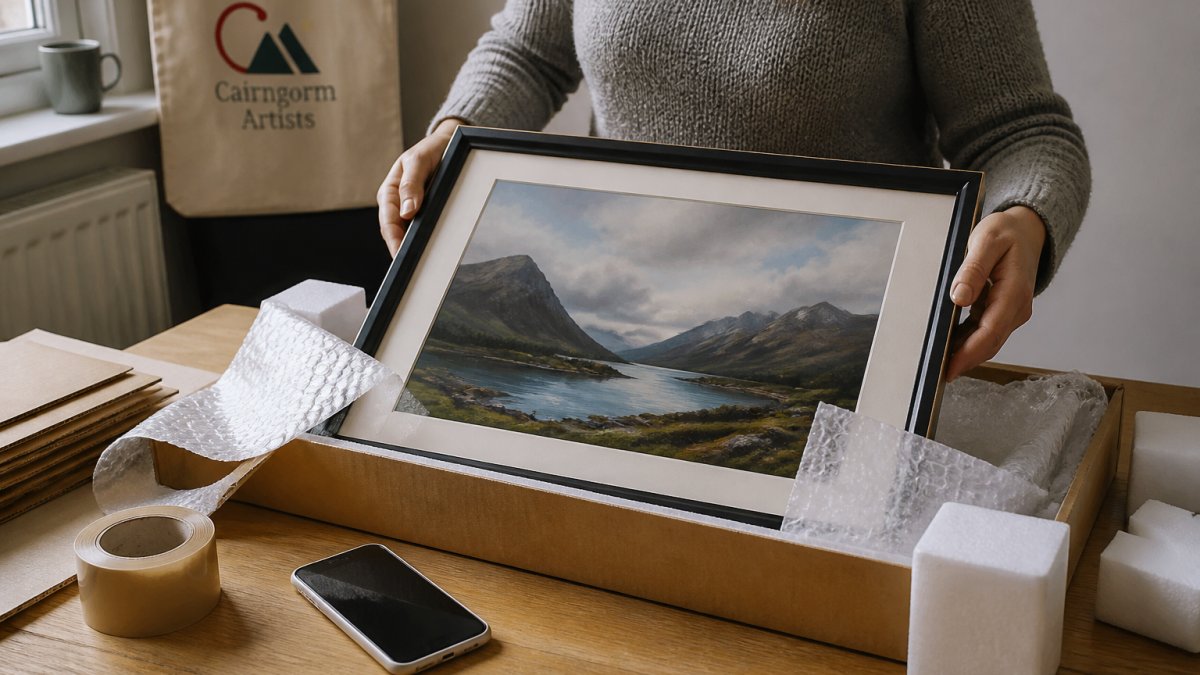
Distinguish Transit Damage From Buyer's Remorse
Before you open a claim, confirm which situation you are in:
- Transit damage: The box is crushed, punctured, water-stained, or the artwork is cracked, torn, or scratched on arrival. This is a carrier claim.
- Buyer's remorse: The piece arrived intact but the buyer changed their mind, misjudged the size, or dislikes the color. This is a return, governed by your return window and condition rules.
- Concealed damage: The box looked fine but the artwork was damaged inside. This is still transit damage, but it is harder to prove and usually has a shorter carrier reporting window.
Ask the buyer which situation applies before you promise a refund. Promising a refund on a transit-damage claim before the carrier approves it can leave you covering the loss yourself.
The Damage and Delivery-Claim Workflow
A step-by-step workflow that protects both sides:
- Ask for photos before full unpacking. Request images of the sealed box, all sides, the shipping label, and the packing materials. Carriers often deny claims without exterior photos.
- Request close-ups of the damage plus one photo of the entire artwork so the extent is clear.
- Set a reporting deadline. Most carriers require damage reports within 24 to 72 hours of delivery, and some require the original packaging to be retained for inspection. State your own deadline (for example, 48 hours) in the policy so buyers act quickly.
- File the carrier claim yourself. Use the tracking number, the photos, and the declared value. Keep the buyer informed of the claim number and status.
- Offer a remedy once the claim is approved. Replacement if the piece can be reproduced (prints), repair if feasible, or refund if neither is possible. For one-of-a-kind originals, refund is usually the only honest option.
- Document everything. Save the photos, emails, claim number, and outcome. Patterns of damage on a specific route or carrier are worth knowing.
What to Put in the Policy
Your policy should state, in plain language:
- That damage must be reported within a set number of hours or days of delivery
- That photos of the packaging and the artwork are required
- That the original packaging must be retained until the claim is resolved
- That the seller files the carrier claim and communicates the outcome
- That the remedy (replacement, repair, or refund) is issued after the claim is approved
This is where a safe-arrival promise earns its keep. At Cairngorm Artists, every piece ships ready to hang. A clear damage workflow turns a stressful event into a trust-building one.
An Art Return Policy Example You Can Adapt
Here is a short art return policy example you can copy and adjust:
Returns: Original artwork may be returned within 14 calendar days of delivery. The piece must be unused, undisplayed, and in its original packaging. Contact us for return authorization before shipping. Refunds are issued to the original payment method within 5 business days of inspection. Custom and commissioned pieces are final sale. Damaged items are handled as shipping claims.
That paragraph covers the essentials: window, condition, authorization, refund method, and exceptions.
Artwork Refund Policy Template: Copy, Edit, Publish
Use this artwork refund policy template and fill in the bracketed fields. The wording is deliberately plain so buyers understand it and so it holds up if a dispute escalates.
[Your Store] Art Return Policy Return window: [X] calendar days from delivery. Eligible items: [originals / prints / commissions]. Condition required: unused, undisplayed, original packaging. How to start a return: email [address] with your proof of purchase and photos. Return shipping: paid by [buyer / seller]. Refunds: issued to the original payment method within [X] business days. Exceptions: custom and commissioned artwork is final sale.
Legal Caveats You Cannot Ignore
A generic template is a starting point, not a legal shield. Consumer return rights vary by jurisdiction and by sales channel, and some rules override whatever you write.
- Online vs. in-person sales. Many jurisdictions give online buyers a statutory cooling-off period that does not apply to in-person gallery sales. If you sell both ways, your policy may need two sets of terms.
- Custom and commissioned work. Rules for made-to-order goods differ from rules for stock items. In some places, custom work is exempt from standard return rights; in others, it is not.
- Distance-selling rules. Regions such as the EU and UK have specific distance-selling regulations that can require a minimum cancellation window and clear pre-contract information. Verify what applies to your buyers before publishing.
- Your own terms cannot waive statutory rights. A "final sale" label does not override a buyer's legal right to return a defective item in most jurisdictions.
A common pattern among artists is to check their local small-business or consumer-protection authority, or a lawyer familiar with e-commerce, before publishing. Do not rely on a template alone.
Adapt the Template by Sales Channel
| Decision | Option A | Option B | Best For |
|---|---|---|---|
| Return window | 7 days | 30 days | High-value vs. prints |
| Return shipping | Buyer pays | Seller pays | Margin vs. trust |
| Refund type | Refund | Store credit | Cash flow vs. retention |
| Commissions | Final sale | Partial credit | Custom work |
| Channel | Online only | Online + in-person | Statutory rights differ |
Get Acknowledgment Before Purchase
A policy the buyer never saw is a policy that will be disputed. Build acknowledgment into the buying flow:
- Display the policy on the product page, not only in the footer.
- Link it at checkout with a required checkbox: "I have read and agree to the return policy."
- Include the policy in the order confirmation email.
- For commissions, send a short written summary of the terms and ask the buyer to reply confirming agreement before work begins.
Preventing Disputes Before They Start
The cheapest return is the one that never happens. Reduce avoidable returns by describing the work accurately before purchase:
- Color: Note that screen calibration varies and that the artwork's colors may differ slightly from the photo.
- Scale: State dimensions in both metric and imperial, and include a photo with a familiar object for scale.
- Framing: Specify whether the piece arrives framed, unframed, or ready to hang.
- Handmade variation: For prints and handmade pieces, note that minor variations are normal and not defects.
Art Return Policy Best Practices for Fewer Disputes
Good art return policy best practices come down to clarity and speed. The clearer your terms, the fewer disputes you field.
- Show the policy before checkout, not after
- Use plain words, not legal jargon
- State who pays for return shipping
- Process refunds within a set timeframe
- Keep a record of every return request
Frequently Asked Questions
Can original artwork be returned after purchase?
Yes, if your art return policy allows it. Many galleries and independent artists accept returns of original work within a set window, often 7 to 14 calendar days from the delivery date, provided the piece is unused, undisplayed, and in its original packaging. Some sellers mark original art as final sale, so the policy must state this clearly before purchase. A written return policy with defined deadlines and conditions removes guesswork for both buyer and seller.
What should an art return policy include?
A complete policy covers the return window, the condition artwork must meet, how to request return authorization, who pays return shipping, refund or exchange options, and how damaged artwork is handled. It should also address custom and commissioned pieces separately, since these often cannot be resold. Including a proof-of-purchase requirement and a refund timeframe gives buyers clear expectations and protects you from disputes later.
How long should customers have to return artwork?
Most art sellers set an artwork return window between 7 and 30 calendar days from the delivery date. A 14-day window is common because it gives buyers time to inspect the piece without leaving it open indefinitely. Whatever you choose, count from the delivery date, not the purchase date, and state it in calendar days. High-value or international sales may need a slightly longer window to account for shipping and inspection time.
How should an artist handle artwork damaged during shipping?
Ask the buyer to photograph the packaging and the damage before moving the piece, then report it within 48 hours of delivery. Keep the original packaging until the claim is resolved. File the claim with the carrier using the tracking number and proof of purchase, then offer a replacement, repair, or full refund. Stating this workflow in your policy, alongside a safe-arrival promise, reassures buyers and speeds up resolution.
A strict return policy is not the enemy of sales, but a vague one is. Cairngorm Artists brings the spirit of the Scottish Highlands to collectors worldwide, and we back every original with clear terms, a safe-arrival promise, and artwork that arrives ready to hang. Get started with Cairngorm Artists and collect Highland art with confidence.


