

7 Proven Steps to Document Art Provenance for Collectors
Oct 29, 2026
Last Updated: October 29, 2026
Quick Summary
To document art provenance, record the artist, title, date, medium and dimensions, then trace ownership backwards from your seller through galleries, dealers and auctions, keeping bills of sale, receipts and certificates. Photograph each work, back up files in two places, and note any gaps honestly.
- Record artist, title, date, medium and dimensions exactly as they appear on the work.
- Trace ownership backwards one owner at a time and write down where the trail stopped.
- A dated auction catalogue entry is primary evidence; an undated typed letter is secondary.
- A certificate of authenticity confirms a seller's claim and is not the same as authentication.
- Check Interpol's stolen art database and keep the seller's written answer in your file.
Table of Contents
- Why Every Collector Needs a Provenance Record
- Start with the Core Details: Artist, Title, Date, Medium
- Your Art Provenance Record Template and Artwork Provenance Checklist
- How to Research Art Provenance Through Galleries, Dealers and Auctions
- Gather the Paper Trail: Bills of Sale, Receipts and Certificates
- Photograph, Store and Back Up Your Provenance Files
- When to Use Art Collection Inventory Software
- Spot Provenance Gaps and Red Flags Before They Cost You
- Frequently Asked Questions
Why Every Collector Needs a Provenance Record
A provenance record is the documented ownership history of an artwork, from the studio to your wall. Without one, a painting is just a picture.
At Cairngorm Artists, we ship original Highland works to collectors worldwide.
Here is the uncomfortable truth: a gap in your records can shrink a piece's value and stall a sale. Documentation is the difference between "a painting we own" and "a painting with a verified history."
Start with the Core Details: Artist, Title, Date, Medium
Record the basics first, and record them exactly as they appear on the work itself. These five fields form the backbone of every collection record.
Write down:
- Artist: full name, plus signature location and style if signed
- Title: as the artist gave it, or "Untitled" if none
- Date: year of creation, or "circa" if uncertain
Check the back of the canvas or frame too. Artist biographies, such as Betty Lambie, can help confirm identity and history.
If you own a piece by an artist with a documented body of work, cross-reference it.
Your Art Provenance Record Template and Artwork Provenance Checklist
Use one template for every piece you own. Consistency is what makes a collection record useful years later.
Copy this structure into a spreadsheet or notebook:
| Field | What to Enter |
|---|---|
| Record number | Your own ID, e.g. CA-001 |
| Artist | Full name and dates |
| Title and date | Exactly as signed or catalogued |
| Medium and dimensions | In centimetres |
| Acquisition date | Day you bought or received it |
| Seller | Gallery, dealer or private owner |
| Price paid | Keep private, store securely |
| Documentation held | Receipt, certificate, catalogue |
| Condition notes | Any damage or restoration |
| Photographs | File names for front, back, signature |
Then run this artwork provenance checklist before you file anything:
- Signature and date photographed
- Back of canvas or frame photographed
- Receipt or bill of sale scanned
A common mistake is doing this months after purchase. Do it the week the work arrives, while the paperwork is still in one pile.
How to Research Art Provenance Through Galleries, Dealers and Auctions
Provenance research means tracing a work backwards, one owner at a time. Start with the person you bought from and work towards the artist. The goal is not a perfect chain, most older works have gaps, but a chain where every link is labelled by how strong the evidence is.
Work backwards in defined steps
- Start with your own acquisition. Record the seller, date, price and any documents they gave you.
- Ask the seller for their source. A gallery should be able to name the dealer, auction or collector they bought from.
- Contact each prior holder in turn. Ask for their purchase record, invoice, exhibition history and the name of the previous owner where they are willing to share it.
- Cross-check against published sources. Auction catalogues, exhibition catalogues and artist catalogues raisonnés are the standard reference points.
- Stop when the trail goes cold, and write down where it stopped. A documented gap is far better than a silent one.
Ask each gallery or dealer for the same five things
- Their own purchase record for the piece
- Any prior invoices or bills of sale
- Exhibition history and any catalogue entries
Auction catalogues are gold. For a broader comparison of where to buy and verify art, see this guide to gallery alternatives for collectors. They list titles, dimensions, provenance lines and sale dates, and the printed provenance line often names owners you would never find otherwise. Exhibition catalogues do the same for shows. Both are archival sources you can cite when you resell.
Distinguish primary from secondary evidence
Not every document carries the same weight. Sort what you collect into two piles:
| Evidence type | Examples | Weight |
|---|---|---|
| Primary | Dated bill of sale, gallery invoice, auction catalogue entry, signed correspondence from the artist | Strong, created at the time of the transaction |
| Secondary | Typed letters with no date, verbal claims, later-written family histories, undated certificates | Weak, created after the fact or by an interested party |
When records conflict, weigh them by type and date. A dated auction catalogue usually beats a typed letter with no date. A gallery invoice beats a verbal claim. A signed letter from the artist beats a dealer's recollection.
Document uncertainty instead of hiding it
This is where most collector records fail. If you cannot verify a link, say so in the record. Use plain language:
- "Seller states the work was purchased at auction in the 1980s; no catalogue reference supplied."
- "Previous owner name withheld at seller's request."
- "Attribution to the artist is based on signature only; no catalogue raisonné entry located."
A future buyer, insurer or researcher can follow that reasoning. An unqualified claim that later proves wrong is far more damaging than an honest gap.
Gather the Paper Trail: Bills of Sale, Receipts and Certificates
Paper is still the strongest ownership evidence you can hold. Keep every document that names the work and the transaction.
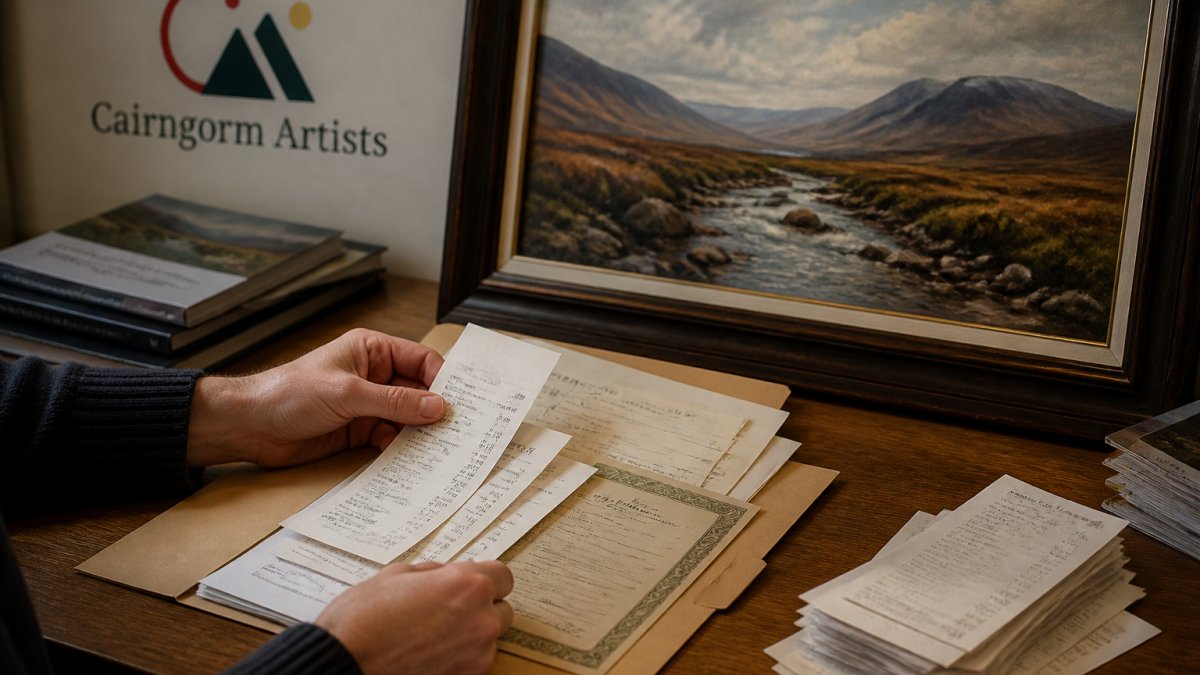
Your paper trail should include:
- Bill of sale: names buyer, seller, artwork and date
- Receipt or invoice: proof of payment and price
- Certificate of authenticity: the artist's or gallery's written confirmation
Store originals in a folder away from light and damp. Scan each one at high resolution and name the file with your record number.
Watch out: a certificate of authenticity is not the same as authentication. A certificate confirms what a seller says about a work.
Photograph, Store and Back Up Your Provenance Files
Photographs link your paperwork to the physical object. Without them, a receipt proves a purchase happened, not that it relates to the painting on your wall.
Photograph every work in four stages:
- Full front view in even daylight
- Close-up of the signature and date
- The back of the canvas, frame and any labels
- Any damage, restoration or framing detail
Name files with your record number so they match your template.
Privacy matters here. Your records include prices and seller names. Share redacted copies when you lend or exhibit a work, and keep the full file private.
When to Use Art Collection Inventory Software
Inventory software earns its place once your collection outgrows a single spreadsheet. Browse the photographic prints collection to see the kinds of works you might catalogue. That usually happens somewhere past a dozen works, or when you start lending, insuring or inheriting pieces.
Software helps you:
- Search records by artist, date or location
- Attach photos and scanned documents to each entry
- Track insurance values and loan history
For small collections, a well-built spreadsheet does the job. Do not buy software to solve a problem you do not have yet.
Spot Provenance Gaps and Red Flags Before They Cost You
A provenance gap is a missing link in the ownership chain. Every old work has one somewhere. The question is whether the gap is explainable or suspicious, and whether you have done enough due diligence to protect yourself if it turns out to be the latter.
Red flags worth pausing on
- A seller who cannot name where they got the work
- Documents that look freshly printed or photocopied
- A price far below the artist's usual market level
Run stolen-art and title checks before you buy
For any work of meaningful value, check the standard public databases before money changes hands. Interpol maintains a publicly accessible database of stolen works of art, and national police services in many countries publish similar lists. Ask the seller in writing whether the work appears on any such register, and keep their answer in your file. For higher-value pieces, a specialist art-loss register search or a lawyer's title check is money well spent.
Pay attention to wartime-era transfers
The period roughly spanning the late 1930s to the mid-1940s is the single most scrutinised window in art provenance, because of the volume of works displaced during the Second World War. If a work's ownership history passes through continental Europe in that period, expect buyers, auction houses and insurers to ask harder questions. A gap in those years is not automatically disqualifying, but it needs explaining, and you should record what you know and what you could not establish.
Check export and import restrictions
Many countries restrict the export of cultural property above certain age or value thresholds. If you are buying across borders, confirm the work can legally leave its current country and enter yours. Keep the export licence or customs paperwork with the provenance file, it is part of the ownership record and buyers will ask for it.
Know when to escalate
Some questions are too important to resolve yourself. Seek specialist or legal advice when:
- The work's value is high enough that a title problem would be a serious loss
- The ownership history passes through the wartime era with unexplained gaps
- Documents appear altered, inconsistent or incomplete
Due diligence protects you legally as well as financially. If a work turns out to be stolen or misattributed, your paper trail is your defence, and a documented, honest record of what you checked is worth more than a clean-looking file with no supporting evidence behind it.
Frequently Asked Questions
What information should an art provenance record include?
A complete art provenance record covers the artist's name, title, date, medium, dimensions and any inscriptions or signatures. Add every previous owner and dealer with dates of ownership, plus supporting documents such as bills of sale, invoices, receipts, auction and exhibition catalog entries, and correspondence. Record the acquisition date and source, an inventory number, and photographs of the front, back, frame and any labels. Keep the record updated whenever the work changes hands or is loaned, exhibited or revalued.
How do I document the provenance of a painting I already own?
Work backwards from what you have. Start with your own purchase receipt and any certificate of authenticity, then contact the gallery or dealer you bought from for their records. Photograph the front, back, signature and any labels or stamps. Search auction and exhibition catalogs for the artist and title, and note any gaps honestly rather than guessing. Use an artwork provenance checklist so nothing is missed, and file everything in one place, ideally backed up digitally.
Can a certificate of authenticity prove an artwork's provenance?
A certificate of authenticity supports provenance but does not prove it on its own. It confirms the seller's claim about the artist and work, and it is strongest when issued by the artist, their estate or a recognised gallery and paired with a bill of sale. Treat it as one piece of supporting documentation alongside receipts, catalog entries and correspondence. If a certificate is the only document you have, note that in your record and keep building the chain of ownership from other sources.
What should I do if an artwork's provenance has gaps?
Record the gap clearly and date it rather than leaving a blank space. Then try to close it: contact previous owners, dealers and galleries, check auction and exhibition catalogs, and look for labels, inscriptions or archival sources that place the work at a point in time. If a gap cannot be resolved, note what you tried and what you found. For higher-value pieces, a professional provenance researcher or art lawyer can help, particularly where ownership evidence or legal due diligence matters.
Documenting provenance takes an afternoon per piece, and it protects everything you have built. At Cairngorm Artists, we make that first step easier: every original arrives ready to hang, with worldwide shipping and our safe-arrival promise behind it. Our collective of ten Highland artists gives you a named maker and a story worth recording from day one. Get started with Cairngorm Artists and build a collection you can document, insure and pass on with confidence.


