

Are Digital Art Registries Worth It for Collectors?
Oct 28, 2026
Last Updated: October 27, 2026
Quick Summary
Digital art registries give collectors one authoritative, cloud-based record of every piece, covering artist, title, purchase price, provenance, condition notes and photographs. That dated evidence supports insurance claims, simplifies estate planning and protects provenance so future buyers can verify a piece's history.
- A registry entry is structured, timestamped and exportable, unlike a phone photo.
- Record eight fields per piece, including purchase details, provenance and location.
- Photograph works in indirect daylight to avoid glare and colour shifts.
- Keep invoices and certificates with the registry entry, not in a separate drawer.
- Under fifty pieces, a disciplined registry usually beats software subscriptions.
Table of Contents
- What a Digital Art Registry Actually Does for a Collector
- The Benefits of Digital Art Registries for Collectors
- Building an Art Collection Inventory Template That Works
- How to Digitize an Art Collection Without Losing Detail
- Art Provenance Records: The Part Collectors Skip and Regret
- Art Collection Management Software vs a Registry: What You Need
- Start Your Registry With Your Next Cairngorm Artists Piece
- Frequently Asked Questions
What a Digital Art Registry Actually Does for a Collector
A digital art registry is a secure, cloud-based record that documents every piece in your collection: the artist, title, medium, dimensions, purchase date, price paid, provenance, condition notes and photographs. Think of it as a passport for your artwork, one that travels with the piece through sales, inheritance and insurance claims.
The distinction matters more than most collectors realise. A photograph on your phone is not a record. A registry entry is structured, timestamped and exportable, which is exactly what insurers, estate lawyers and appraisers ask for when something goes wrong.
Below, we break down the real benefits of digital art registries for collectors, the parts most people skip, and how to build a system that survives a house move, a divorce or a death in the family.
The Benefits of Digital Art Registries for Collectors
The core benefit is continuity. A registry gives you one authoritative source of truth about your collection, accessible from anywhere, that does not depend on a filing cabinet or a memory.
Most collectors accumulate pieces gradually. A coastal scene bought on a trip to the Highlands, a wildlife print gifted at a wedding, an original oil picked up because it caught the light. Five years later, the details blur. Who was the artist? What did it cost? Was there a certificate?
A registry answers those questions in seconds. It also does three things a shoebox of receipts cannot:
- Supports insurance claims with dated evidence of ownership and value
- Simplifies estate planning by giving heirs a complete, legible list
- Protects provenance so a future buyer can verify the piece's history
Proof You Own It: Insurance, Estates and Disputes
When a pipe bursts or a piece is stolen, insurers want documentation, not recollection. A registry entry with a dated photograph, receipt and condition report turns a stressful claim into a straightforward one.
The same record carries weight in probate. Estates settle faster when the executor has a clear inventory rather than a house full of unlabelled frames. And in disputes over authenticity, a documented chain of ownership is often the difference between a piece holding its value and one that stalls.
Watch out: a forged signature is one of the most common problems in the art market, and it is far harder to challenge when you have no purchase documentation to fall back on. If you are buying secondary-market work, learn how to spot the signs of a forged artist signature before you hand over money.
A Record That Survives Moving House and Changing Hands
Art outlives addresses. A registry that lives in the cloud moves with you, which matters more than it sounds: pieces get separated from paperwork during house moves, and inherited works often arrive with no documentation at all.
Physical files get lost. Digital records, properly backed up, do not. That continuity is the quiet benefit collectors underrate until the day they need it.
Building an Art Collection Inventory Template That Works
A useful art collection inventory template captures eight fields per piece, no more:
| Field | What to Record | Why It Matters |
|---|---|---|
| Artist | Full name and contact | Verifies authorship |
| Title and year | Exact title, creation year | Identification |
| Medium and dimensions | Oil on canvas, 60 x 80 cm | Valuation and shipping |
| Purchase details | Date, seller, price paid | Insurance and estate proof |
| Provenance | Prior owners, gallery history | Authenticity chain |
| Condition notes | Existing wear, framed state | Claim evidence |
| Photographs | Full front, back, signature, frame | Visual record |
| Location | Room or storage | Inventory audits |
Keep it simple. A template nobody updates is worse than no template at all. If you are still growing your collection, our guide to building an affordable fine art collection covers how to buy well while keeping records from day one.
How to Digitize an Art Collection Without Losing Detail
Digitising an art collection means photographing each piece under even, natural light and recording its key details in a structured file, not simply snapping a quick phone photo.
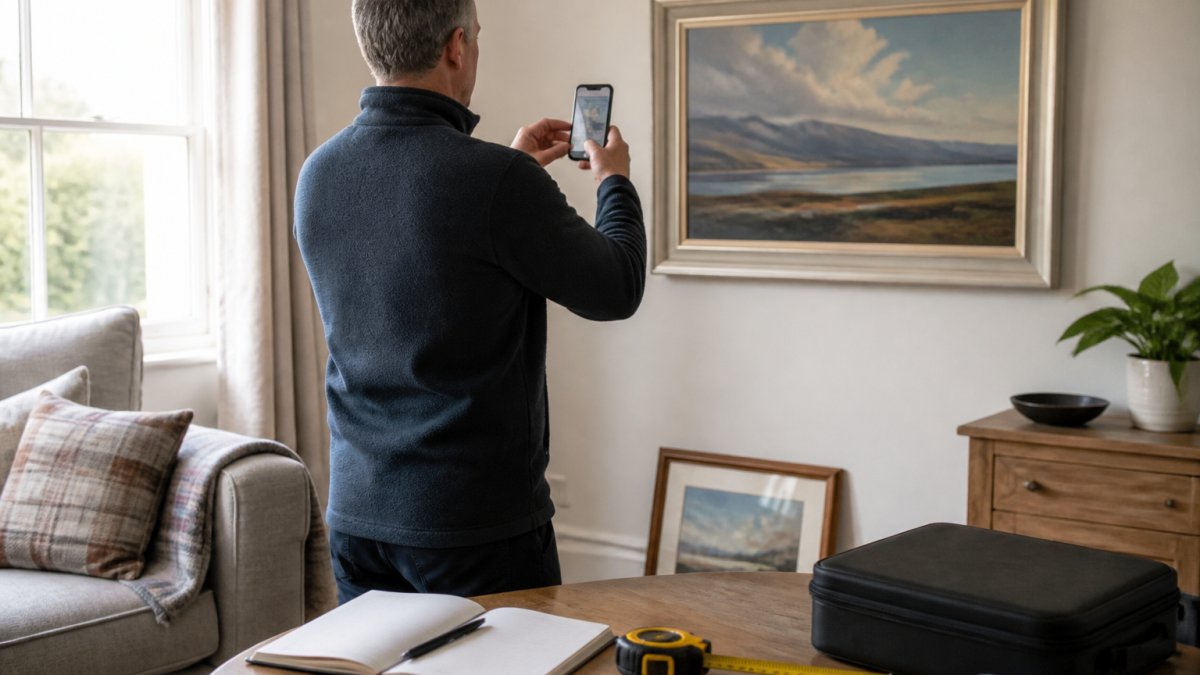
The practical sequence:
- Photograph the full front of the work in indirect daylight, avoiding glare on glass
- Capture the signature, the back of the frame and any labels or gallery stickers
- Measure height and width in centimetres and note the frame depth
- Record condition in writing, including any existing scratches or fading
- Upload everything to your registry and back it up
A common mistake is photographing under warm indoor lighting, which shifts colour and makes a future condition comparison unreliable. Daylight, a steady hand and a plain background do more than any expensive equipment.
Art Provenance Records: The Part Collectors Skip and Regret
Art provenance records document where a piece has been and who has owned it, and they are the single most neglected part of most collections.
Collectors record the purchase and stop there. But provenance is what a future buyer, insurer or appraiser actually wants: the exhibition history, the gallery invoice, the certificate of authenticity, the names of previous owners where known.
For living artists, provenance is easier to build than for historical work. Keep the invoice, the certificate and any correspondence with the artist or gallery. Store them alongside the registry entry, not in a separate drawer.
The gap shows up years later. An heir tries to sell, cannot prove the chain, and the piece is valued as unattributed. Ten minutes of record-keeping at purchase prevents that outcome entirely.
Art Collection Management Software vs a Registry: What You Need
Art collection management software and a digital registry overlap but are not the same thing. Software handles cataloguing, valuations, loans and location tracking at scale. A registry is the underlying record of ownership and provenance.
For most private collectors with fewer than fifty pieces, a well-structured registry is enough. Software becomes worth the subscription when you lend works, insure at high value or manage multiple locations.
Ask yourself three questions:
- Do I lend pieces to exhibitions or galleries?
- Do I need automated valuation updates?
- Am I tracking works across several properties?
Two yeses point to software. Otherwise, a disciplined registry does the job. Either way, the discipline of recording each purchase at the moment it happens is what separates a protected collection from an undocumented one.
Start Your Registry With Your Next Cairngorm Artists Piece
The best time to start a registry is before the next piece arrives. Set up your template, photograph what you already own, and add each new acquisition the week it lands.
Every original from Cairngorm Artists is created by one of our ten Highland artists, inspired by the wildlife and wild coastlines of the Scottish Highlands, and arrives ready to hang under our safe-arrival promise.
If you are drawn to the work of a particular maker, browse the collection of Highland artist Janet Anderson to find a piece worth recording. And if you want to understand the case for buying local, read why investing in local wildlife artists is worthwhile before you choose.
Frequently Asked Questions
What is a digital art registry?
A digital art registry is an online record of the works you own, held with a registry service rather than in a folder on your own laptop. Each entry typically holds photographs, dimensions, the artist's name, purchase details and provenance history. The point is that the record exists somewhere independent of you, so it can be checked by an insurer, a gallery or an heir.
What should collectors record for each artwork?
At minimum: artist name, title, year, medium, dimensions in centimetres, and a clear photograph of the front, back and any signature. Add the purchase date, seller, price paid and any certificate of authenticity. For an art collection inventory template, leave columns for condition notes and location in the house. If the work came with a story, such as a studio visit or a Highland gallery receipt, keep that too.
Can a digital art registry prove that an artwork is authentic?
No. A registry records what you say about a piece and when you said it. It does not authenticate the work itself. What it does is create a dated trail that supports your account if a question arises later. Authenticity still rests on the artist, the gallery or a specialist.
Should collectors keep physical records as well as digital art records?
Yes, keep both. Scan paper receipts, certificates and handwritten notes into your digital record, but store the originals somewhere dry and safe. A printed inventory kept with your household documents, plus a digital copy, covers both failure modes. Export your registry data once a year as a PDF and a spreadsheet so you are never dependent on one platform.
Building a collection is the easy part. Protecting it takes a system most collectors never set up until it is too late. Cairngorm Artists makes the first entry simple: original Highland artwork, made by ten local artists, shipped worldwide and ready to hang on arrival, backed by our safe-arrival promise. Start your registry with your next piece and give your collection the record it deserves.


