

Winter Landscape Art: Choose the Perfect Wall Piece
Oct 20, 2026
Table of Contents
- Start With the Wall: Measuring for Winter Landscape Art
- How to Choose Wall Art for a Living Room
- Winter Landscape Framed Prints: What to Look For
- Original Winter Landscape Paintings and Why They Differ
- Print Quality, Materials and Long-Term Care
- Seasonal or Year-Round: Displaying Winter Scenes at Home
- Frequently Asked Questions
Last Updated: October 19, 2026
Start With the Wall: Measuring for Winter Landscape Art
A common mistake is buying artwork before finding the wall space. Measure first, it prevents most returns, rehangs and regrets.
Winter landscape art works best when piece and wall are planned together.

Here is the simple measuring routine to use in any room:
- Width: measure the wall, then aim for art that covers about 60-75% of any furniture below it
- Height: leave at least 15-20 cm of clear wall above the frame
- Centre line: hang the middle of the piece at eye level, roughly 145-155 cm from the floor
Write those four numbers down before you browse; they turn a vague idea into a brief.
Viewing Distance and Scale
Scale follows distance: a large canvas overwhelms a small hallway; a small print looks lost on a big wall.
A useful rule: the art should fill roughly the same share of your view as a person at your natural viewing spot. For a sofa 2-3 metres away, go bigger than instinct suggests; for a narrow corridor, a smaller three-panel piece keeps the wall uncrowded.
Ask one question: will people stand back from this piece, or walk past it? That decides the size.
How to Choose Wall Art for a Living Room
Choosing wall art for a living room comes down to three things: colour harmony, lighting, and mood.
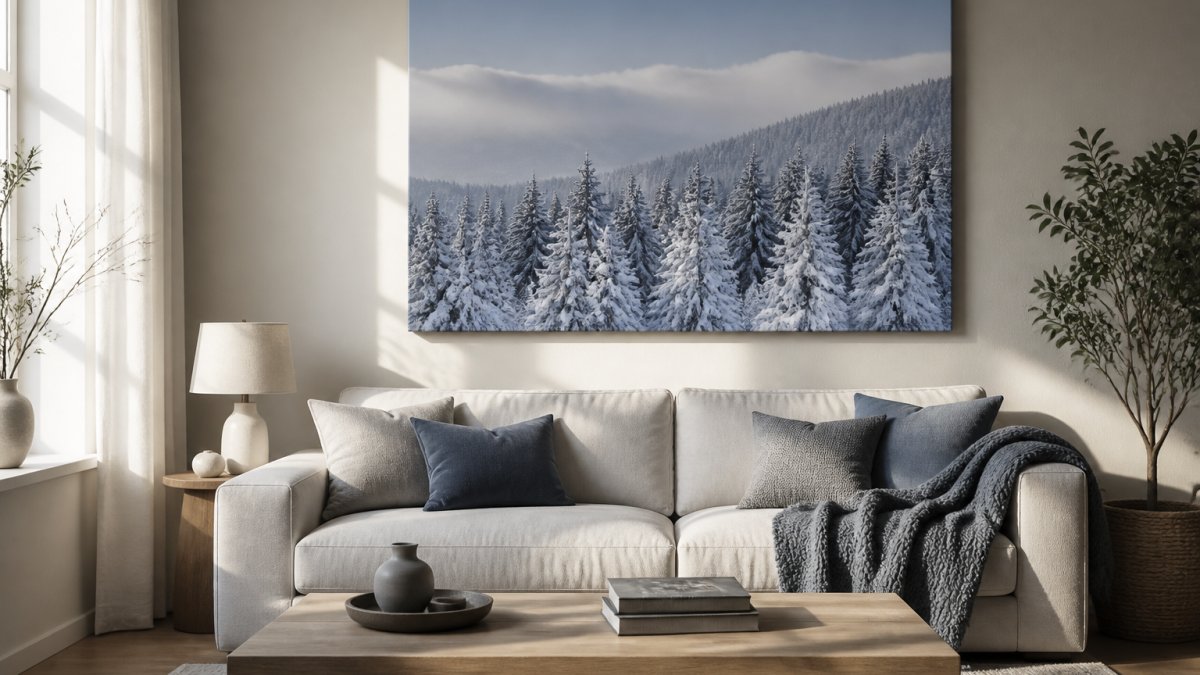
Living rooms are where winter landscape art earns its keep: a snow-covered mountain or frosted field brings calm to a busy room. Coordinate the piece with the room, not as a standalone object.

Step 1: Build a Three-Colour Brief From the Room
Before you browse, note three colours already in the room: the dominant wall colour, the largest soft furnishing (sofa, rug or curtains), and one accent (cushion, throw, wood furniture). That trio is your brief.
- Dominant wall: the artwork's background or sky should sit one or two steps away from this colour, lighter or darker, not identical, or the piece disappears.
- Largest furnishing: look for a winter scene that repeats this colour somewhere in the midground, a grey-blue shadow on snow, a taupe tree line, a slate roof.
- Accent: this is where you can be bolder. A band of amber low sun, a rust-coloured barn, or a deep pine green gives the eye a focal point that ties back to the room.
Interior stylists often use the 60-30-10 rule: 60% dominant tone, 30% secondary, 10% accent. Winter landscapes fit naturally, snow scenes are mostly one cool tone with a smaller band of trees or sky and a small warm highlight.
Step 2: Read the Light on That Wall
Light decides whether a winter scene reads as crisp or muddy. Check the wall at three times of day before committing.
- North-facing wall: stays in cool, indirect shadow. A bright, high-contrast scene, dark pines against pale snow, lifts it. A muted, low-contrast piece will look flat here.
- South- or west-facing wall: takes direct sun for part of the day. A quieter, softer scene holds up; a very high-contrast print can glare and lose detail in bright light.
- Wall opposite a window: receives bounced light and can handle almost any palette, but watch for reflections if the piece is framed under glass.
If you cannot observe the wall all day, photograph it at midday and evening, then compare the artwork against both.
Step 3: Match the Frame to the Room, Not the Picture
The frame is the piece's handshake with the room. Match it to the room's metals, woods and trim, not the artwork's colours.
- Modern room with black metal, glass, or white walls: a slim black or dark charcoal frame sharpens the piece and echoes the room's lines.
- Traditional room with warm wood, brass, or patterned textiles: a light oak or walnut frame softens the transition and picks up the room's warmth.
- Coastal or pale Scandinavian room: a white or natural ash frame keeps the wall airy and lets the winter scene carry the colour.
Step 4: Decide the Mood Before the Image
Ask what the room needs to do. A busy family living room wants a calm, low-detail winter scene, a wide field, still lake or soft tree line. A formal sitting room can carry a dramatic mountain or high-contrast forest; a reading nook suits a smaller, intimate scene with a strong focal point.
Write one sentence before you shop: "I want this wall to feel ______." If a piece does not serve that sentence, it is not the right piece, however beautiful.
A Quick Coordination Check
Before you buy, run this five-point check:
- Does the piece repeat at least one colour already in the room?
- Does its contrast level suit the light on that wall?
- Does the frame match the room's dominant metal or wood?
- Does the mood match the sentence you wrote?
- Does the size fit the measuring brief from the first section?
If all five are yes, the piece will settle in. If two or more are no, keep looking, the right winter landscape will not need to be talked into the room.
Winter Landscape Framed Prints: What to Look For
Winter landscape framed prints give you a finished, gallery-ready look without the wait of a custom build. The frame separates the image from the wall and sets the mood before you even look at the scene. But framed prints are only one format, the right choice depends on the wall, the light, and how long you want the piece to last.

Compare the Formats Before You Commit
Most buyers compare images, not formats. That is backwards. The same winter scene looks and behaves very differently depending on how it is produced.
| Format | Appearance | Durability | Best For | Watch Out For |
|---|---|---|---|---|
| Framed paper print under glass | Crisp, flat, gallery-like; glass adds a slight sheen | Good indoors; paper can yellow over decades; glass protects from dust | Living rooms, studies, hallways away from direct sun | Reflections near windows; glass can break in transit |
| Framed canvas | Texture of canvas with the structure of a frame; no glass glare | Strong; canvas resists tearing; frame protects edges | Bright rooms, above sofas, anywhere glare is a problem | Frame adds weight; canvas can sag if poorly stretched |
| Gallery-wrapped canvas | Contemporary, frameless, image wraps around the sides | Strong; light and easy to hang | Modern rooms, large walls, rental-friendly | Edges must be clean; less formal than a framed piece |
| Original painting | Unique surface, visible brushwork, shifts with light | Excellent if cared for; can last generations | Feature walls, collectors, rooms where the piece is the focal point | Highest cost; needs climate care; one of a kind |
| Metal or acrylic print | Glossy, high-contrast, very modern | Very durable; scratch-resistant | Contemporary interiors, kitchens, high-traffic walls | Can look cold; reflections on glossy acrylic |
Rule of thumb: if the wall gets direct sun or faces a window, favour canvas or matte finish over glass. If the room is formal and the piece is the focal point, a framed print or original earns the wall.
What to Check on a Framed Print
When you compare framed options, check these points:
Loch Morlich Chill - canvas print from original oil painting →
| What to Check | Why It Matters |
|---|---|
| Frame depth and profile | A deeper frame reads as premium; a thin one suits minimal rooms |
| Glazing type | Standard glass is clear but reflective; anti-reflective or acrylic glazing reduces glare |
| Mat width | A wide mat lifts a small print and adds formality; a narrow or no mat suits modern rooms |
| Colour accuracy | Cool winter blues are the hardest to print well; ask about the inks |
| Hanging hardware | Ready-to-hang pieces save a second trip to the shop |
| Backing and sealing | A sealed back keeps dust and damp out of the frame |
Framed canvas is a strong middle ground: canvas texture with frame structure, suiting living rooms, hallways and studies where a bare canvas feels too casual.
One limitation: glass frames catch reflections near windows. If your wall faces a bright window, framed or gallery-wrapped canvas serves you better.
A Format Decision in Three Questions
- Is the wall in direct sun or opposite a bright window? If yes, choose canvas or matte glazing. If no, a framed print is fine.
- Is the piece the focal point of the room, or part of a group? Focal point: framed print or original. Part of a group: gallery-wrapped canvas keeps the wall light.
- Do you want to own something unique? If yes, an original. If no, a well-made print will serve you for years.
Answer those three and the format chooses itself, the image is the heart of the decision, but the format makes it survive the room.
Original Winter Landscape Paintings and Why They Differ
Original winter landscape paintings are one-of-a-kind works made by an artist's hand, not reproduced from a file.
The difference shows in the surface. Brushwork catches light in a way a flat print cannot.
Originals also carry a story.
That said, originals are not for every wall or every budget.
If you are new to collecting, start with one piece you love.
Print Quality, Materials and Long-Term Care
Print quality decides whether a winter scene stays crisp for years or fades into a pale ghost.
Look for these markers of a well-made print:
- Inks: water-based latex or pigment inks hold colour far longer than dye inks
- UV protection: a coating that resists sunlight fading, especially near windows
- Canvas base: a poly-cotton blend resists cracking, warping and scratching
Our canvas prints use water-based HP Latex inks with UV protection on a poly-cotton canvas, stretched over a solid wooden frame.
Care is simple. Keep art out of direct sun where you can. Dust canvas with a soft, dry cloth, never a wet one.
Seasonal or Year-Round: Displaying Winter Scenes at Home
Winter scenes do not have to come down in spring. A snow-covered mountain or frosted pine forest works all year because it is about mood, not calendar.
Here is how to think about it:
- Year-round: cool, quiet scenes suit rooms you use daily; they read as calm, not cold
- Seasonal: rotate a winter piece in from late autumn and swap it out in spring for a lighter scene
- Pairing: hang two pieces from the same landscape and change which one leads by season
A seasonal approach suits collectors who like change. A year-round approach suits anyone who wants one wall, one decision, and years of quiet enjoyment.
Either way, the piece should feel like part of the room, not a decoration you tolerate for three months.
Frequently Asked Questions
How do I choose the right size of winter landscape art for a wall?
Measure the wall first, then aim for artwork that fills roughly 60 to 75 percent of the width of the furniture below it. For a sofa around 2 metres wide, a canvas of 120 to 150 cm works well. Also check viewing distance: a piece seen from 2 to 3 metres can carry more detail than one above a hallway console. Tape the outline on the wall before buying so you can judge the scale in your own light.
What colours work best in winter landscape art?
Cool palettes dominate: frost whites, slate greys, deep blues and muted greens. The strongest pieces add a small warm counterpoint, such as amber low sunlight or a band of colour on the horizon, which stops the scene feeling cold. If your room already has warm wood or terracotta tones, a winter landscape art piece with cool blues creates a useful contrast. In a grey or white room, look for saturated colours in the sky or reflections to give the wall focus.
Should I choose a framed print, canvas or original winter landscape painting?
Canvas prints arrive ready to hang, resist scratching and warping, and suit relaxed, modern interiors. Winter landscape framed prints add a defined edge and work well in traditional or gallery-style rooms. Original winter landscape paintings carry texture and brushwork no reproduction can match, and they hold their value as one-off pieces. Decide by budget, by how much texture you want on the wall, and by whether you want a piece that exists only once.
Where should I hang a large landscape painting?
Hang it at eye level, with the centre of the artwork roughly 145 to 150 cm from the floor, unless furniture below changes that line. A large landscape suits the wall above a sofa, a dining sideboard or a stairwell where there is room to step back. Keep it out of direct sunlight to protect colours, and avoid spots above radiators or open fires where heat and moisture fluctuate. Check the fixing suits the wall type before drilling.
Choosing the right piece is easier when the artwork comes from people who know the landscape. Cairngorm Artists brings together original works from ten Highland artists, each inspired by the wild scenery and wildlife of Scotland. Every piece arrives ready to hang, ships worldwide, and is covered by our safe-arrival promise. Start with one wall, measure it, and let the Highlands settle into your home.


