

Tips for Lighting Large Canvas Paintings
Oct 21, 2026
Table of Contents
- Why Lighting Large Canvas Paintings Matters
- Choosing a Suitable Fixture for Your Artwork
- Positioning Your Artwork Before Selecting Lighting
- Art Lighting Color Temperature Guide
- How to Avoid Glare on Oil Paintings and Glazed Canvases
- Achieving Even Illumination Across a Wide Canvas
- Protecting Your Artwork from Direct Sunlight and UV Exposure
- Installation and Room Layout Considerations
- Frequently Asked Questions
Last Updated: October 20, 2026
Why Lighting Large Canvas Paintings Matters
Getting the lighting right transforms how your artwork looks every single day. A beautiful painting can disappear into shadow or glow unnaturally under the wrong fixture. The difference between poor lighting and excellent lighting isn't subtle, it changes whether people notice your art or walk right past it.
At Cairngorm Artists, we understand that lighting large canvas paintings requires more thought than just pointing a light at the wall. When you invest in original artwork, especially pieces that capture the wild beauty of the Scottish Highlands, you want them displayed the way the artist intended. Good lighting brings out texture and reveals subtle brushwork.
The stakes are higher with large canvases. A small painting might survive mediocre lighting. A large canvas that dominates your wall needs precision. You're lighting a significant focal point in your room, one that either anchors the space beautifully or becomes an eyesore. This guide walks you through the exact decisions you need to make to get it right.
Choosing a Suitable Fixture for Your Artwork
The fixture you select determines everything that follows. Not all lights work equally well for large canvas paintings.
Picture lights vs. track lighting vs. ceiling spotlights
Picture lights mount directly above the frame and shine downward onto the canvas. They're traditional, elegant, and work beautifully for single large paintings. The downside: they only illuminate one piece effectively.
Track lighting runs along a ceiling-mounted rail and lets you aim individual spotlights wherever you want. This system is flexible and professional-looking. You can adjust angles and positions without rewiring.
Ceiling spotlights mount flush to the ceiling and shine straight down. They're minimalist and clean-looking, but they often create harsh shadows and uneven illumination on large canvases.
For lighting large canvas paintings, picture lights and track lighting outperform ceiling spotlights. Picture lights are ideal if you have one dominant artwork.
Why LED is the best choice for large canvases
LED lights have become the clear winner for artwork illumination. They produce minimal heat, which protects paint and canvas from UV damage and fading. They're energy-efficient, so you can leave them on longer without guilt.
Traditional halogen and incandescent bulbs generate heat. They also consume more energy and burn out frequently. For large canvases you want to display for years, LED is the only sensible choice.
Look for LED fixtures designed specifically for art lighting. These produce the right color temperature and beam quality to make artwork look its best.
| Fixture Type | Best Use | Flexibility | Installation |
|---|---|---|---|
| Picture Light | Single large canvas | Low | Above frame |
| Track Lighting | Multiple pieces or rearrangement | High | Ceiling rail |
| Ceiling Spotlight | Ambient lighting | Low | Flush to ceiling |
Positioning Your Artwork Before Selecting Lighting
Placement comes before lighting. Move your canvas to its final position before you buy fixtures or install anything.
Walk around the room at different times of day. Notice where natural light falls. Check sight lines from where people actually sit. A painting that looks perfect at eye level from one angle might disappear into shadow from your sofa. Stand back and view it from across the room, then from up close.
Consider the wall itself. Is it textured or smooth? Does it have other artwork nearby? Are there windows that let in direct sunlight? All of these affect how your lighting plan needs to work.
Once you've chosen the spot, measure the distance from the wall to where you'll sit most often. Measure the canvas height and width. Note whether the wall is load-bearing or has obstacles behind it (pipes, wiring, studs in awkward places). This information determines which fixtures will actually work in your space.
The best lighting setup fails if the canvas is in the wrong spot. Get the position right first.
Art Lighting Color Temperature Guide
Color temperature changes how colors in your painting appear. It's measured in Kelvin (K). The wrong temperature makes artwork look cold and unwelcoming or overly warm and muddy.
Warm white (3000K) vs. cool white (3500K) for different paintings
Warm white light (3000K) has a golden, soft quality. It flatters paintings with earthy tones, warm ochres, reds, and browns. Landscapes with sunset colors or autumn scenes benefit from warm white. It creates an inviting, intimate feeling in the room.
Cool white light (3500K) is closer to daylight. It's neutral and clean. Cool white works well for paintings with blues, greens, and purples. It prevents colors from looking too muddy or yellowed. Many galleries use cool white because it's closest to the neutral light where artists typically paint.
For Cairngorm Artists' landscape paintings, which often feature the moody blues and greens of Highland scenery, cool white (3500K) usually produces the most accurate color rendition. But if your painting has significant warm tones, you might prefer 3000K.
The best test is to view your canvas under both temperatures and see which one makes the colors feel true to life. What matters is your preference and what the painting looks like in that light.
How to Avoid Glare on Oil Paintings and Glazed Canvases
Glare is the enemy of large canvas displays. It happens when light bounces directly off the surface and into your eyes instead of being absorbed by the paint.
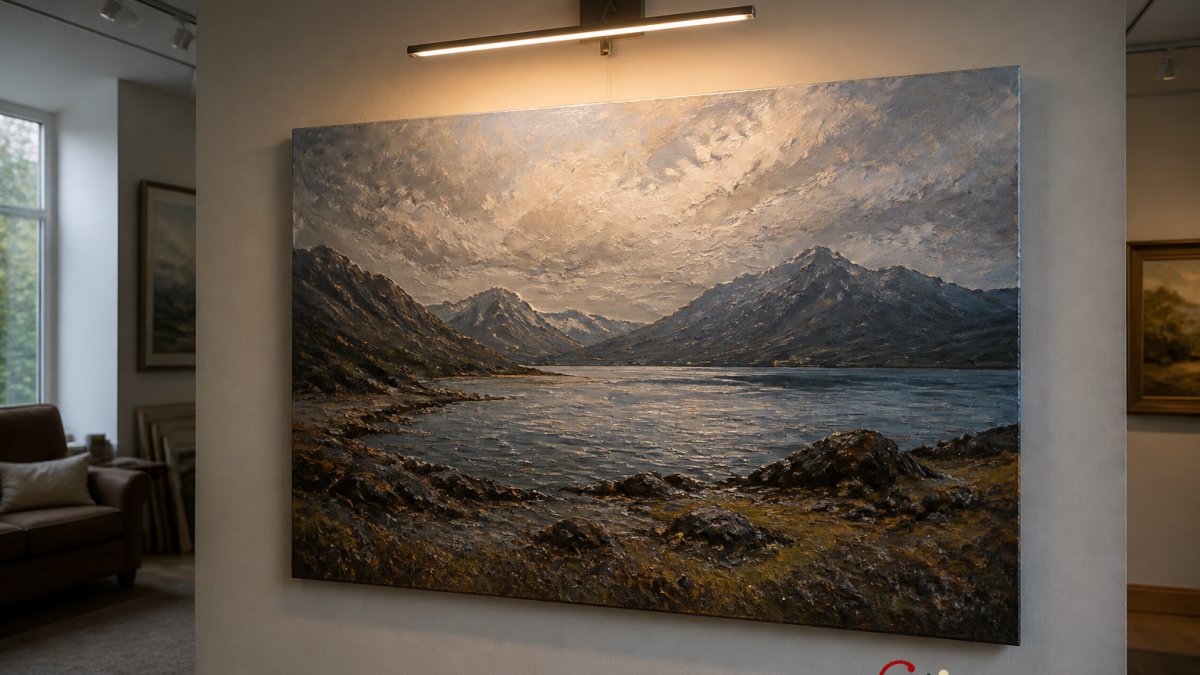
The 35-degree angle rule and beam spread techniques
The magic number is 35 degrees. When you position a light so it hits the canvas at a 35-degree angle from horizontal, the reflected light travels away from the viewer's eye instead of bouncing straight back.
To achieve this: mount your fixture so the light beam travels downward and forward at roughly 35 degrees.
Beam spread matters too. A narrow beam (15-20 degrees) concentrates light in a small area and creates hot spots. A wider beam (40-50 degrees) spreads light more evenly across the canvas.
Troubleshooting glossy finishes and reflective surfaces
Mountain View - canvas print from original artwork →
Some paintings have glazing or varnish that creates extra reflection. If you're still seeing glare even with the 35-degree angle, try these fixes:
Increase the distance between the light and the canvas. The farther away the fixture, the more diffuse the light becomes. Move it back 6 inches to 1 foot and see if glare reduces.
Reduce the brightness. Sometimes lowering the intensity makes glare less noticeable because the reflected light is dimmer. You might need to add a second fixture to maintain even illumination while reducing glare from each one.
Use a diffuser. Some picture lights come with diffuser panels that soften the beam and scatter light in multiple directions. This reduces the sharp reflection that causes glare.
Angle the canvas slightly. Tilting the canvas a few degrees away from the viewer can redirect reflected light upward instead of into your eyes.
Achieving Even Illumination Across a Wide Canvas
Large canvases need even light from edge to edge. Uneven lighting makes one side look bright and the other dark, destroying the artist's intended composition.
Bar width and light spread for different canvas sizes
Picture lights come in different widths. A 24-inch picture light works for canvases up to about 30 inches wide. A 36-inch light handles canvases up to 48 inches.
The rule is simple: the fixture should be roughly 75-80% of the canvas width. A fixture that's too narrow leaves the edges dark.
Light spread (beam angle) also affects coverage. A 50-degree beam spread covers a wider area than a 30-degree beam. For a 48-inch canvas, use a wider fixture with a 45-50 degree spread.
Brightness targets and illumination levels
Artwork typically looks best with 150-300 lux of illumination. That's roughly equivalent to the light level in a well-lit office or gallery. Too dim and details disappear.
A simple test: stand in front of your lit canvas. You should be able to see all the brushwork and texture clearly. You shouldn't squint or see harsh shadows.
If you can't see texture or if the painting looks washed out, increase brightness. If you see glare or harsh shadows, reduce brightness or adjust the angle.
For very large canvases (over 48 inches wide), consider using two fixtures instead of one. Position them symmetrically so they meet in the middle.
Protecting Your Artwork from Direct Sunlight and UV Exposure
Direct sunlight fades paintings. UV radiation can yellow varnish over time.
Never position a large canvas in direct sunlight, even if natural light looks beautiful at first. Within months or years, colors will fade noticeably.
If your room gets significant natural light, hang your artwork on a wall that doesn't receive direct sun. Use window treatments like curtains or UV-filtering film to block harsh afternoon light. If the canvas must be near a window, keep it out of the direct beam.
Your artificial lighting should never include UV-emitting bulbs. LED lights produce virtually no UV. Halogen and some fluorescent bulbs do emit UV, so avoid these for artwork display.
The best setup combines LED fixtures positioned to avoid glare with a location that stays out of direct sunlight. This keeps your artwork looking vibrant for decades.
Installation and Room Layout Considerations
Real-world constraints often complicate ideal lighting setups. You might not have a ceiling rail where you want it. The wall might be plaster instead of drywall. Electrical outlets might be in inconvenient locations.
Start by identifying where you can actually install fixtures. If you're renting, you might be limited to picture lights that mount with adhesive strips. If you own, you have more options but still need to work around studs, wiring, and structural elements.
Measure twice. Know the exact height and width of your canvas and the wall space around it. Sketch the room layout with dimensions. This prevents buying a fixture that's too small or too large.
Consider room lighting overall. If the room is very dark, your artwork lighting will feel isolated and theatrical. If the room is brightly lit, your artwork lighting needs to be proportionally brighter to compete.
Think about access. Can you reach the fixture to change bulbs or adjust the angle? Is it positioned so you can clean the canvas without moving the light?
When you display artwork from Cairngorm Artists, these practical details matter. Our pieces arrive ready to hang, but they deserve display conditions that honor the artist's work. Take time to plan your lighting properly, and your canvas will look stunning for years to come.
Displaying large canvas paintings beautifully comes down to choosing the right fixture, positioning it precisely, and protecting your artwork from damage. Start with our collection of ready-to-hang canvas prints, including pieces like Mountain View and Lochside Whisper, and apply these lighting principles to make them the focal point of your space.


Frequently Asked Questions
What is the best way to illuminate paintings?
The best approach combines three elements: positioning your fixture at a 35-45 degree angle to reduce glare, selecting LED lights with a color temperature between 3000K and 3500K for warm, flattering illumination, and ensuring even light coverage across the entire canvas. For large paintings, picture lights or track lighting work best. Test your setup by viewing the artwork from different angles to confirm no reflections appear on glossy or oil-painted surfaces.
How do you light a large canvas without glare?
Position your light source at least 35 degrees away from perpendicular to the canvas surface. This angled approach prevents direct reflection. For oil paintings and glazed finishes, choose matte or satin-finish canvases when possible, and avoid placing lights directly above or straight-on. LED fixtures with adjustable beam angles give you precise control. Test from multiple viewing positions and adjust the fixture height or angle if you notice hotspots or reflections.
What color temperature is best for displaying landscape paintings?
Landscape paintings typically look best under warm white lighting at 3000K, which enhances earth tones, greens, and golden hues common in nature scenes. If your painting features cooler blues or mountainous terrain with mist, 3500K offers a balanced, slightly crisper appearance. Highland landscape artwork like those from Cairngorm Artists benefits from warm white (3000K) to emphasize the natural warmth of autumn foliage, golden light, and earthy textures.
Should I use LED or halogen lights for original artwork?
LED is the superior choice for original artwork. LED lights produce minimal heat, which protects canvas and paint from damage over time. They're also energy-efficient and long-lasting. Halogen lights generate significant heat. LEDs with water-based inks and UV protection, like those used in Cairngorm Artists canvas prints, maintain color vibrancy while keeping your investment safe for decades.


