

Highland Art Sizing: A 2026 Guide
Oct 15, 2026
Table of Contents
- Why Art Size Matters in Highland-Themed Rooms
- How to Size Art Above a Sofa
- How to Measure a Wall for Artwork
- Sizing Large Highland Landscape Wall Art
- Gallery Wall Layout and Spacing
- Matching Art Size to Room Colour and Style
- Common Mistakes to Avoid When Sizing Highland Art
- Frequently Asked Questions
Last Updated: October 14, 2026
Why Art Size Matters in Highland-Themed Rooms
Scale transforms a room: the wrong size art looks awkward, while the right size anchors the space.
Highland-themed rooms call for bold artwork that matches their dramatic landscapes.
At Cairngorm Artists, we work with collectors who want their Highland art to feel at home.
This guide covers the formulas that work, the mistakes to avoid, and how to choose between landscape and portrait orientations.
How to Size Art Above a Sofa
The sofa is your anchor. Art above it should feel balanced with the furniture, not competing with it or shrinking away.
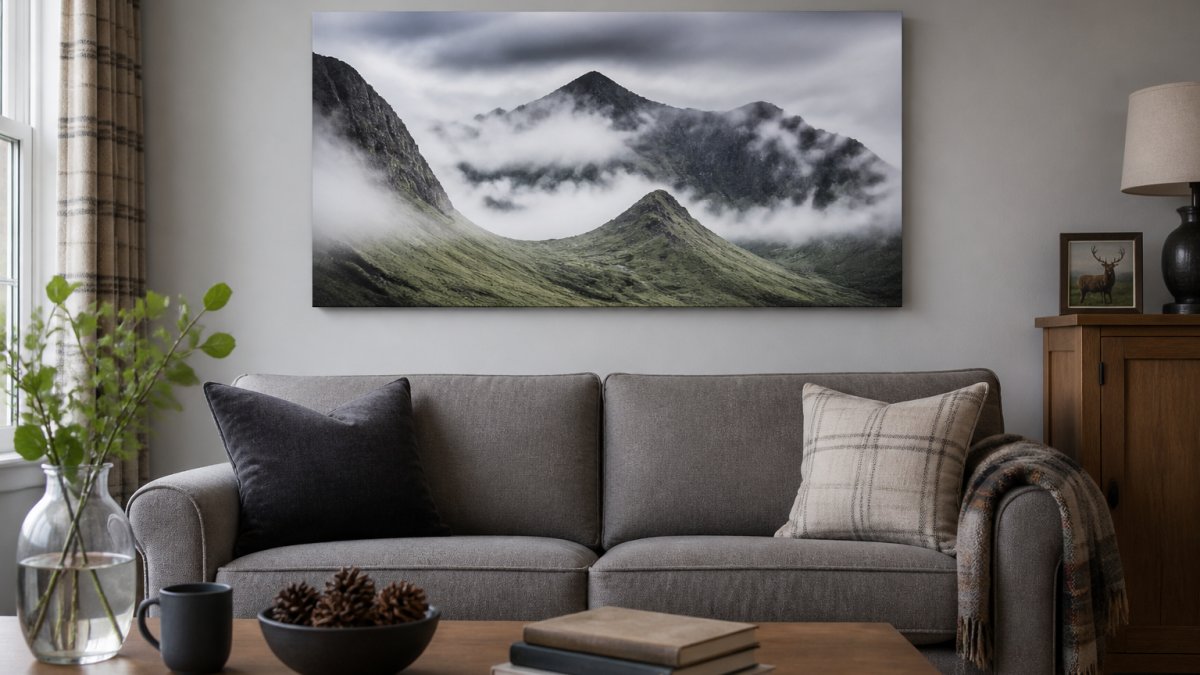
The Two-Thirds Rule
The two-thirds rule is your starting point for art sizing Highland rooms: measure your sofa width, and your artwork should be roughly two-thirds of it.
An 84-inch sofa calls for art around 56 inches wide.
Two-thirds is the sweet spot: too narrow looks timid, matching the sofa width feels aggressive.
This rule works for a single canvas or a gallery wall.
Measuring Distance from Floor
Height matters as much as width: the center of your artwork should sit at seated eye level.
Most seated eyes sit 57-60 inches from the floor, so center your art at that height.
A 30-inch-tall piece should have its bottom edge 42-45 inches from the floor.
For Highland artwork above a sofa, this lets viewers take in misty mountains and dramatic skies without craning their necks.
How to Measure a Wall for Artwork
Before you buy, measure your wall. This section gives a repeatable formula and worked examples to translate wall and furniture dimensions into print sizes.
The Core Measurement Formula
Use this three-step formula for any Highland-themed room:
- Measure the anchor furniture width (FW). For a sofa, console, bed, or dresser, measure the full width of the piece.
- Set your target artwork width (AW). For a single piece, AW = FW × 0.67 (the two-thirds rule). For a multi-piece arrangement, AW is the total width of all frames plus the gaps between them.
- Check wall coverage. AW should cover 40-60% of the wall width for most Highland-themed rooms. If AW falls below 40%, size up; if it exceeds 60%, size down or split the art into a multi-piece arrangement.
This formula works for one large canvas or a gallery wall, replacing guesswork with a number you can take to any art seller.
Worked Examples for Common Walls and Furniture
Here are four worked examples; adjust the numbers to your space.
Example 1: Sofa wall
- Sofa width (FW): 84 inches
- Target artwork width (AW): 84 × 0.67 = 56 inches
- Wall width: 120 inches
Example 2: Bed wall
- Bed width (FW): 60 inches (queen)
- Target artwork width (AW): 60 × 0.67 = 40 inches
- Wall width: 100 inches
Example 3: Console or entryway table
- Console width (FW): 48 inches
- Target artwork width (AW): 48 × 0.67 = 32 inches
- Wall width: 72 inches
Example 4: Empty wall (no furniture anchor)
- Wall width: 96 inches
- Target artwork width (AW): 96 × 0.5 = 48 inches (use 50% as a starting point when there is no furniture)
- Coverage check: 48 ÷ 96 = 50%
The same formula adapts to any anchor: measure the anchor, calculate AW, then verify wall coverage.
Accounting for Furniture Width
If you have a sofa, console, or dresser below your art, the artwork shouldn't exceed that furniture's width by more than 8-12 inches per side, so your maximum artwork width is FW + 16 to 24 inches.
An 84-inch sofa allows a maximum artwork width of 100-108 inches, so the two-thirds rule's 56 inches sits well within that limit. The furniture-width rule is a safety check, not the primary method.
For Highland landscape wall art, sweeping vistas benefit from generous space but must anchor to the furniture below.
Printable Sizing Tools and Visual Mockups
Before you commit, preview the scale with two low-tech methods:
- Paper mockup: Cut brown craft paper or newspaper to the exact dimensions of the artwork you are considering. Tape it to the wall at your planned hanging height. Live with it for a day. This reveals whether the size feels right in the room's actual light and layout.
- Painter's tape outline: For a gallery wall, tape the outer boundary of the entire arrangement on the wall. Then tape the individual frame positions inside. This shows you the total footprint and the gaps before you put any holes in the wall.
A printable measuring guide can record FW, AW, wall width, and coverage percentage in one place for when you shop online or visit a gallery.
Sizing Large Highland Landscape Wall Art
Highland landscapes, wild mountains, moody coastlines, dramatic light, demand scale and deserve to be seen fully.
Oversized Art in Small Spaces
Oversized art works in small rooms when placed right: a 48-inch-wide canvas in a 10-by-12-foot bedroom becomes the focal point that makes the room feel intentional, not cramped. Let the art sit alone and breathe, don't crowd it with other pieces. In Highland-themed rooms, oversized landscape art makes small spaces feel larger as the eye travels into painted mountains and distant horizons.
Landscape vs. Portrait Orientation
Landscape orientation (wider than tall) suits expansive Highland vistas, sweeping mountain ranges and coastal panoramas match how we experience these landscapes in person.
Portrait orientation (taller than wide) works for dramatic single subjects. A towering peak. A moody cliff face. A waterfall cutting through mist.
Scottish Highlands - canvas print from original artwork →
For art sizing Highland rooms, landscape orientation needs more wall width, while portrait is more flexible, it works above sofas, on narrow walls, and where width is limited.
Gallery Wall Layout and Spacing
A gallery wall of Highland art creates impact through arrangement, telling a richer story than one piece. This section gives the sizing math for diptychs, triptychs, and larger walls so the arrangement fits your wall and furniture.
Multi-Piece Arrangements: Total Width and Gap Math
Start with your wall space and anchor furniture width, applying the same two-thirds rule to the entire arrangement.
Formula for a multi-piece arrangement:
- Total arrangement width (TAW) = anchor furniture width × 0.67
- Total frame width (TFW) = sum of all individual frame widths
- Total gap width (TGW) = TAW − TFW
Aim for 2-3 inches between frames: below 2 inches, use fewer or smaller frames; above 3 inches, add a piece or choose larger frames.
Worked example: triptych above an 84-inch sofa
- TAW = 84 × 0.67 = 56 inches
- Three frames, each 16 inches wide: TFW = 48 inches
- TGW = 56 − 48 = 8 inches
A 4-inch gap is slightly wide; 18-inch frames give a too-tight 1-inch gap, while 17-inch frames yield a 2.5-inch gap, the sweet spot that keeps a gallery wall from looking cramped or scattered.
Diptychs, Triptychs, and Larger Grids
Diptych (two pieces): Total width should still be about two-thirds the anchor furniture width.
Triptych (three pieces): Use the same total width target, three 17-inch frames with 2.5-inch gaps gives 56 inches.
Larger grids (four to nine pieces): Keep the total arrangement width at two-thirds the anchor furniture width, then divide the total frame width by the number of columns.
Spacing Between Pieces
The gap between pieces matters as much as the pieces: 2-3 inches creates rhythm without fragmentation.
Above a sofa, the whole gallery wall should be roughly two-thirds the sofa width, with its center hung at 57-60 inches high like a single piece, keeping the collection at seated eye level.
For Highland art, mix sizes, a large centerpiece with smaller pieces around it, but keep gaps consistent, since uneven gaps make even a well-sized arrangement look accidental.
Hanging Height and Viewing Distance for Gallery Walls
Gallery wall height follows the same rule as a single piece: center the arrangement at 57-60 inches from the floor, the average seated eye level.
In narrow spaces like hallways or entryways, a vertical gallery wall often works better than a horizontal one, base the total width on the wall rather than furniture, and keep gaps at 2-3 inches.
Room-by-Room Gallery Wall Sizing
Highland-themed rooms aren't all living rooms. Adapt gallery wall sizing like this:
- Bedroom: Use the bed width as the anchor. A queen bed is 60 inches wide, so the total arrangement width should be about 40 inches. A diptych of two 18-inch frames with a 4-inch gap works well above a bed.
- Dining room: Use the sideboard or buffet width as the anchor. If the sideboard is 60 inches wide, aim for a 40-inch total arrangement width. A triptych of three 12-inch frames with 2-inch gaps gives 40 inches.
- Entryway: Use the console table width. A 48-inch console gives a 32-inch total arrangement width. A pair of 14-inch frames with a 4-inch gap works.
The same formula works everywhere, only the anchor changes.
Matching Art Size to Room Colour and Style
Highland-themed rooms often use subdued colors. Deep greens, soft greys, warm browns, muted blues.
With bold wall colors or busy patterns, slightly smaller art prevents visual chaos and lets the room breathe.
For Highland landscape wall art, consider how the painting's colors interact with your furnishings.
The right size art ties these elements together, anchoring the room's mood as much as its dimensions.
Common Mistakes to Avoid When Sizing Highland Art
Hanging too high. Art near the ceiling feels disconnected from the furniture below.
Ignoring wall dimensions. Measure first and choose art that fits the wall's proportions, not just the furniture width.
Choosing landscape orientation for narrow walls. Landscape art needs width; on a narrow wall, portrait works better.
Choosing the right size art for Highland-themed rooms means honoring both the artwork and your space.
At Cairngorm Artists, our collection of Highland canvas prints arrives ready to hang. Our pieces like the Scottish Highlands canvas print and The Storr, Isle of Skye canvas print are designed to make an impact in your home.


Frequently Asked Questions
How large should art be above a sofa?
Art above a sofa should occupy about two-thirds of the sofa's width. For a standard 2-metre sofa, aim for a piece roughly 1.2 to 1.4 metres wide. The centre of the artwork should hang at eye level (approximately 1.5 metres from the floor). This proportion creates visual balance and makes the piece feel intentional rather than undersized or overwhelming.
What's the best way to measure a wall for artwork?
Measure your wall width and height in centimetres. For focal walls, artwork should cover 40-60% of the wall width. Multiply wall width by 0.4 to 0.6 to find your target art width. Account for furniture width too: if hanging art above a sofa, the piece should be slightly narrower than the furniture beneath it. Write down exact dimensions before shopping.
Can one large Highland landscape artwork work better than a gallery wall?
Yes. A single large Highland landscape piece often works better in smaller rooms and above furniture like sofas. Gallery walls require more wall space and visual planning. A large statement piece creates a focal point without fragmentation, making it ideal for Highland-themed interiors where the landscape itself is the hero.
How do I choose the right size Highland art for a small room?
In small rooms, oversized art can actually work well if it's the only focal point. A large canvas print with subdued colours (like misty blues and greens) won't overwhelm the space. Avoid multiple pieces or busy gallery walls. Look for landscape orientation pieces that draw the eye horizontally, making the room feel wider.


