

Framed vs Unframed Wildlife Art for Modern Homes
Sep 11, 2026
Table of Contents
- Framed vs Unframed Wildlife Art for Modern Homes: A Quick Comparison
- How to Display Original Landscape Paintings in Contemporary Interiors
- Benefits of Gallery Wrapped Canvas for Wildlife Art
- Framed Wildlife Art: Structure, Preservation, and Formal Style
- Lighting, Scale, and Placement for Framed vs Unframed Wildlife Art
- Maintenance, Longevity, and Sustainable Framing Choices
- Conclusion: Choosing Between Framed and Unframed Wildlife Art
- Frequently Asked Questions
Last Updated: September 11, 2026
Framed vs Unframed Wildlife Art for Modern Homes: A Quick Comparison
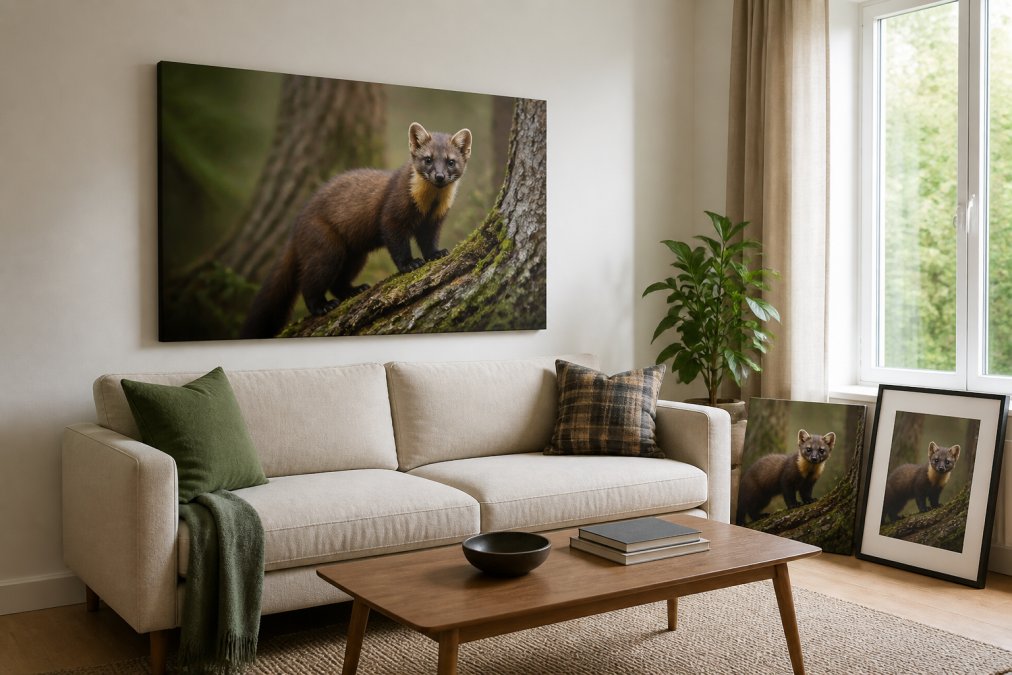
Choosing between framed vs unframed wildlife art for modern homes comes down to one question: should the artwork announce itself as a framed object, or sit flush against the wall as a window into the wild? Unframed gallery wrapped canvas gives you a frameless look, lighter visual weight, and a piece ready to hang. Framed fine art prints give you formal structure, a matte finish behind glass, and stronger UV protection. At Cairngorm Artists, our collective of ten Highland artists ships both formats, so we see how each behaves on a real wall.

Below, we break down the aesthetic, practical, and preservation differences so you pick the right format the first time.
| Factor | Unframed (Gallery Wrap) | Framed |
|---|---|---|
| Look | Frameless, clean lines, contemporary | Formal structure, polished finish |
| Visual weight | Light, floats on the wall | Heavier, anchors the wall |
| Surface | Matte or satin canvas texture | Matte paper behind glass |
| Ready to hang | Yes, out of the box | Usually yes, but bulkier |
| Protection | UV-protected inks, no glass | Glass plus UV-filtering glazing |
| Best for | Minimalist and modern interiors | Traditional, formal, or gallery walls |
| Maintenance | Dust with a dry cloth | Clean glass, watch the frame joints |
| Cost | Lower for the same image size | Higher, framing is a second purchase |
How to Display Original Landscape Paintings in Contemporary Interiors
Display original landscape paintings in contemporary interiors by treating the artwork as the focal point and letting everything around it stay quiet. Clean lines, a restrained palette, and generous negative space do more than any elaborate arrangement. Buy the piece first, then let the wall breathe around it.
But the format you choose changes how the painting reads in a modern room. A frame and a gallery wrap do not just look different, they change the wall's visual weight, how light behaves on the surface, and the piece's perceived size.
Visual weight and the modern wall. A framed piece introduces a hard rectangle around the image, which in a minimalist room becomes a second object competing with the painting. A gallery wrap removes that boundary, so the image floats and the wall reads as one continuous surface. In a room with clean lines and little ornament, the frameless version almost always sits more naturally. In a room with traditional millwork or a gallery wall of mixed pieces, a frame gives the eye structure.
How frame thickness changes perceived scale. Frame width is not neutral. A wide moulding (5 cm or more) adds visual mass and makes a small piece read larger, useful on a big empty wall (nationalgallery.org.uk). A narrow moulding (2 cm or less) keeps the piece closer to its true size and suits tight spaces. A gallery wrap adds no width, so a 60 cm canvas reads as 60 cm. Measure the outer frame dimension, not the image dimension, before you commit.
Light behaviour on the surface. Matte canvas scatters light and holds colour evenly; glass glazing reflects it. In a room with a large window opposite the wall, a framed piece under standard glass shows a bright rectangle of reflected sky for much of the day; a gallery wrap will not. That is why non-reflective or museum glass matters in modern open-plan rooms.
A few practical rules we give collectors:
- Hang the centre of the artwork at roughly eye level, around 145 to 150 cm from the floor.
- Leave at least 15 to 20 cm of bare wall on either side for a single piece.
- On a sofa wall, the art should span about two-thirds of the furniture width.
- Keep 5 to 8 cm between the top of the sofa back and the bottom of the frame or canvas.
- For a gallery wall, keep gaps consistent at 5 to 8 cm and align the outer edges, mixed frame widths in a tight grid look accidental rather than curated.
Tate's guide to hanging and caring for artworks covers the basics of placement and handling, and it is worth reading before you drill anything.
For a contemporary room, an unframed canvas in a matte finish tends to sit more naturally than a heavy gilt frame, reading as part of the architecture rather than an object placed on top of it. The exception is a very large room with high ceilings, where a bare canvas can disappear, there, a frame or a larger canvas is the fix.
Benefits of Gallery Wrapped Canvas for Wildlife Art
The main benefit of gallery wrapped canvas is that the image continues around the edges of the stretcher, so the piece needs no frame. That removes cost, weight, and a whole category of styling problems. A gallery wrap hangs flat, casts almost no shadow, and works where a frame would feel fussy.
A good canvas is stretched tight enough to stay flat but not so tight the weave distorts. Our canvas prints use a poly-cotton blend with a matte/satin finish, water-based HP Latex inks with UV protection, on a solid wooden frame from renewable sources.
For wildlife photography and painting, canvas texture also softens fine detail slightly, which many collectors prefer, it reads as painterly rather than clinical.
Framed Wildlife Art: Structure, Preservation, and Formal Style
Framed wildlife art wins on two fronts: protection and presence. Glazing shields the print from dust, fingerprints, and contact, and UV-filtering glazing blocks much of the light that fades pigments. A frame also gives a small piece visual weight in a large room where a bare canvas would disappear.
The trade-offs are real. Framing adds cost, typically a second purchase on top of the print, and weight that affects where you can hang it. Glass also introduces glare, which is why a matte finish and non-reflective glazing matter in a room with strong window light.
Our fine art paper prints are acid- and lignin-free, with a textured matte surface. That construction is built for the long haul, but know where the piece will hang before you commit.
Lighting, Scale, and Placement for Framed vs Unframed Wildlife Art
Lighting and scale decide more outcomes than the frame ever will. Two pieces the same size can look completely different depending on the wall and the light that hits them.
On lighting: keep art out of direct sun, use warm-white bulbs (around 2700 to 3000K) for accent lighting, and angle picture lights down at roughly 30 degrees so the beam grazes the surface. Unframed canvas handles diffuse light well because the matte surface scatters it; framed pieces under glass need more care, since a poorly angled light turns the glazing into a mirror.
On scale: art should occupy about 60 to 75 percent of the width of the furniture below it, and no more than about two-thirds of the available wall height. A single large canvas usually beats a cluster of small frames in a modern room. For a gallery wall, keep gaps consistent at around 5 to 8 cm and align the outer edges.
The National Gallery's guidance on framing and display is a useful reference for how professional collections handle spacing and sightlines.
Maintenance, Longevity, and Sustainable Framing Choices
Maintenance is where framed and unframed art diverge most in daily life. The two formats fail in different ways, so the care routine is genuinely different.
Unframed canvas: the failure modes. Canvas is a fabric under tension. Over years, humidity changes cause the weave to relax, and a loosely stretched canvas develops a sag or ripple near the corners. Dust sits in the weave, so a dry microfibre pad worked gently across the surface every few weeks is enough. Never use water, solvents, or household sprays, moisture can wick through the weave and stain the back of the print, and solvents can lift the ink. If the canvas loosens, a framer can re-stretch it on the same stretcher bars, which is why a well-built solid wood stretcher matters for long-term appearance. Canvas is also more forgiving of minor knocks: a light scuff often disappears into the texture, whereas the same contact on a glazed print can crack the glazing.
Framed prints: the failure modes. A framed piece protects the print from touch and dust, but introduces its own maintenance. Clean the glass with a cloth dampened with plain water or mild glass cleaner applied to the cloth, never sprayed onto the artwork, because liquid can run behind the glazing and stain the paper or mat. The frame is harder. Wooden frames dry out in centrally heated rooms, joints loosen, and mitre corners can open by a millimetre or two over a few winters. If the piece hangs in a kitchen or bathroom, humidity finds its way behind the glazing and can cause foxing, small brown spots, on the paper. If you see condensation inside the glass, the piece is in the wrong room.
A simple care schedule that works for both.
- Every 2 to 4 weeks: dust canvas with a dry microfibre pad; dust the frame and top edge of the glass with a dry cloth.
- Every 3 to 6 months: clean glass with a damp cloth and mild cleaner applied to the cloth, not the art.
- Once a year: check frame joints and canvas tension. A canvas should sound like a drum when tapped; a frame corner should not flex.
- Never: hang in direct sun, above a radiator, or in a room that swings between damp and very dry.
Sustainability, and why it matters for longevity too. The better end of the framing market now treats sustainability and print longevity as the same problem. Solid wood from renewable or FSC-certified sources, water-based inks, and acid-free papers are standard there. Acid-free, lignin-free paper matters because lignin in cheap paper breaks down over decades and yellows the sheet from the inside, a frame cannot stop that. Water-based inks avoid the solvent load of older printing methods and are less likely to off-gas inside a sealed frame. A frame built from responsibly sourced timber and finished without harsh solvents protects the art just as well as a conventional one, often better, because the materials are chosen for stability rather than cost. When comparing two framed pieces at similar prices, the paper specification and frame material tell you more about how the piece will look in ten years than the image itself.
Conclusion: Choosing Between Framed and Unframed Wildlife Art
The honest answer is that framed vs unframed wildlife art for modern homes is not a contest, it is a match to the room. If your space leans minimalist, with clean lines and plenty of light, a frameless gallery wrap will feel like it belongs. If it leans traditional, or you want the extra protection of glazing on a valuable print, a frame earns its keep.

At Cairngorm Artists, we make that decision easier by shipping every piece ready to hang, backed by our safe-arrival promise, so your only real choice is the image. Start with a piece like the Curious Pine Marten canvas print, the Red Squirrel Leap fine art print, or the Snowy Hare canvas print, and let the artwork tell you which format it wants.

Frequently Asked Questions
Does unframed wildlife art look better in a modern interior?
Unframed wildlife art, especially gallery wrapped canvas, suits modern interiors because the frameless look keeps clean lines and lets the artwork itself become the focal point. A gallery wrap continues the image around the sides, so no frame interrupts the composition. For minimalist or contemporary interior design, this often reads as more current than a traditional frame. That said, a thin float frame can work if you want a polished finish without losing the open feel. The right choice depends on your wall color, lighting, and how much visual weight the room can carry.
How do I display original landscape paintings without overwhelming a room?
Start with scale and proportion. A common guideline is that artwork should take up roughly 60 to 75 percent of the width of the furniture below it, such as a sofa or console. Hang the center of the piece at eye level, usually around 145 to 150 centimetres from the floor. Group smaller works in a grid rather than scattering them. Leave breathing room between pieces, at least 5 to 8 centimetres. For original landscape paintings, match the color temperature of the art to the room's lighting, and avoid direct sunlight to protect print longevity.
What are the benefits of gallery wrapped canvas compared to a framed print?
Gallery wrapped canvas arrives ready-to-hang with no framing cost or glass glare. The image wraps around a solid wooden frame, usually 3.2 to 4 centimetres deep, giving a lightweight display and a contemporary look. If you want a frameless look and lower upfront cost, gallery wrap wins. If you want a formal structure, framing is stronger.
How do I clean and maintain framed vs unframed wildlife art?
For unframed canvas, dust gently with a dry, soft brush or microfibre cloth. Never use water or cleaning sprays, as they can damage the matte finish and canvas tension. For framed fine art paper prints behind glass, spray a microfibre cloth, not the glass, and wipe lightly. Keep both away from direct sunlight and damp walls. Check the hanging hardware yearly, and avoid rooms with high humidity, such as bathrooms, to preserve print longevity.
Is framed or unframed wildlife art better for a minimalist aesthetic?
Unframed gallery wrapped canvas usually fits a minimalist aesthetic better. The absence of a frame reduces visual noise, supports clean lines, and lets the texture and depth of the artwork carry the wall. A single large canvas on a plain wall creates a strong focal point without extra decoration. If you prefer framed work, choose a slim, neutral frame in black, white, or natural wood so the frame recedes and the wildlife remains the subject. Either way, keep surrounding decor simple and let the art breathe.

