

Alternatives to Mass-Produced Coastal Prints for 2026
Sep 10, 2026
Table of Contents
- Why Mass-Produced Coastal Prints Fall Short
- The Benefits of Buying Art From Artist Collectives
- Original Scottish Highland Landscape Art: What Sets It Apart
- How to Style Coastal Art in a Home
- Comparing Your Alternatives to Mass-Produced Coastal Prints
- What to Check Before You Buy Coastal Wall Art
- Frequently Asked Questions
Last Updated: September 10, 2026
Why Mass-Produced Coastal Prints Fall Short
Most big-box coastal prints are not art. They are wallpaper. This guide from Cairngorm Artists examines the alternatives.
A mass-produced print is a digital file reproduced in thousands, often on paper so thin it ripples when humidity changes. Colours are approximated, edges machine-cut, and the same image hangs in a thousand other rooms. A gallery-quality piece differs in kind, not just price.
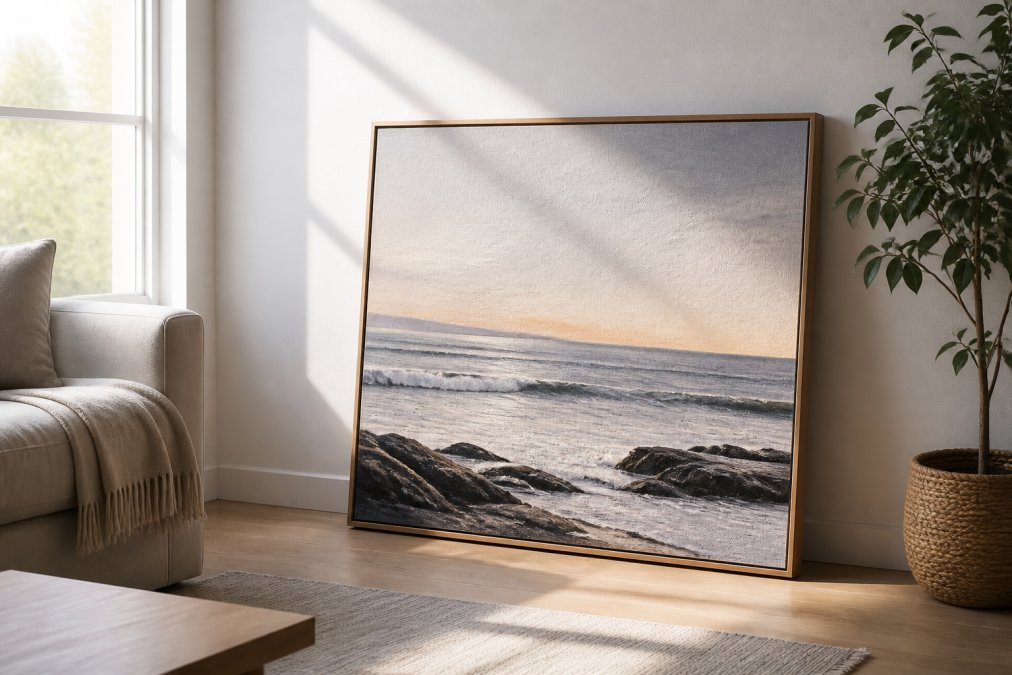
The Problem With Big-Box Wall Decor
Big-box wall decor is manufactured to a price point, and that price point dictates every decision. Paper weight drops. Ink quality drops. Colour accuracy drops. What remains is an image that looks acceptable in a showroom and flat on a real wall.
Many buyers find the unwrapped piece looks nothing like the display model, the predictable result of production built for volume.
What Makes a Print Truly Gallery-Quality
Gallery-quality printing rests on four things: archival materials, high-resolution source files, colour accuracy and durable substrates. A giclée print uses pigment-based inks rather than dye-based inks.
Standard prints use basic paper with a short lifespan; giclée prints use archival inks and heavier stock, which is why galleries and museums use the process for reproduction work.
The difference shows up over time: an archival print holds its tones longer.
Library of Congress guidance on preservation and archival materials
The Benefits of Buying Art From Artist Collectives
Buying from an artist collective changes who gets paid and how much of your money reaches the maker. A collective is a group of artists who sell together and share costs.

That structure has practical effects: you deal with people who know the work personally and can answer questions about materials, process and provenance.
There is also a quality argument: collective members tend to be working artists, not manufacturers.
Direct Support for Independent Artists
When you buy from an independent artist, a larger share of the price reaches the maker.
It also changes what gets made: artists who sell directly can take risks on subjects a mass market would reject.
Original Scottish Highland Landscape Art: What Sets It Apart
Original Scottish Highland landscape art is made by artists rooted in the place they paint, and that grounding is visible in the result. The Highlands offer shifting Atlantic light, sudden weather, and coastlines that change character hour by hour.
Painters who live and work there develop an eye for it. That knowledge shows up in the brushwork.
It also shows up in tactility. Many Highland painters build up layers of paint, a technique known as impasto, so the canvas surface catches light and casts small shadows.
National Galleries of Scotland collection and conservation resources
Cairngorm Artists: A Collective Worth Knowing
Cairngorm Artists is a collective of ten Highland artists whose work is built around the landscapes and wildlife that surround them, spanning coastal seascapes, lighthouse studies, mountain views and wildlife pieces.
Every piece arrives ready to hang, removing the framing guesswork that stops many people buying original work. The collective ships worldwide and backs each order with a safe-arrival promise.
For buyers who want a piece tied to a specific place, the range is unusually specific. Take Ardnamurchan Lighthouse View, a canvas print taken from an original painting, where a tall lighthouse rises from rugged rocks under a soft pastel sky. The vertical tower against the horizontal seascape gives the composition a natural balance that works well above a sofa or in a study.
How to Style Coastal Art in a Home
Styling coastal art in a home comes down to restraint. Coastal pieces work best when the room supports rather than competes with them, so a nature-driven palette of sand, stone, soft blue and off-white lets the artwork carry the colour.
Three placement principles do most of the work:
- Hang at eye level, roughly the centre of the piece at 145 to 150 cm from the floor
- Leave at least 8 cm of wall between the frame and any furniture edge
- Give a statement piece its own wall rather than crowding it with smaller frames
A gallery wall suits smaller works, but a single large seascape usually reads better on its own: a painting with visible brushwork needs space around it so light can move across the surface.
Lighting matters as much as placement. Angled light from above and to one side reveals canvas texture and impasto ridges; flat overhead light erases them. If you cannot install picture lighting, hang the piece where it catches soft daylight without sitting in direct sun most of the day.
Comparing Your Alternatives to Mass-Produced Coastal Prints
The realistic alternatives fall into four categories, each suiting a different buyer. The table below summarises the trade-offs.
| Option | Typical Cost | Material Quality | Best For |
|---|---|---|---|
| Big-box print | Low | Thin paper, dye inks | Temporary decor |
| DIY digital file printing | Low to mid | Depends on your printer | Budget-conscious DIYers |
| Commissioned original | High | Archival, one of a kind | Collectors, meaningful gifts |
| Collective canvas print | Mid | Archival inks, 4 cm frame | Most homes, most buyers |
Big-box prints win on price and nothing else. DIY printing gives you control over size and paper, but you are responsible for colour accuracy, and most home printers cannot hold fine detail at large sizes.
A commissioned original is the top of the range. You work directly with the artist, discuss subject and size, and receive a one-off piece. It takes time and costs more, but nothing else matches it for meaning.
Canvas prints from an artist collective sit in the middle, and for most buyers that is the right place to be: archival materials, a solid wooden frame and a real painting behind the reproduction, at a fraction of the cost of an original.
A Decision Framework, Not Just a Price Ladder
The harder question is which alternative fits your situation. Four variables decide it: budget, timeline, the role the piece plays in the room, and whether you want a one-off or a reproduction.
If the piece is a placeholder while you renovate, a big-box print is rational. If it anchors a room you intend to keep for a decade, the calculus changes. Interior designers often spend on one statement piece per room and treat everything else as supporting cast, that piece is where archival materials and provenance matter most.
Timeline is the second filter. A collective canvas print ships in days; a commission takes weeks to months depending on the artist's queue and the subject's complexity. If you need something for a specific date, start early or choose a commission-free path.
The DIY Printing Path: What It Actually Requires
DIY printing is the most misunderstood alternative. The appeal is control over size, paper and frame; the catch is that you become the production house.
A home inkjet cannot hold fine detail at large sizes the way a professional giclée printer can. For a large DIY piece, source a high-resolution digital file from an artist and send it to a professional print lab rather than printing at home.
When sourcing a digital file, check three things: resolution (a large print needs a file sized for the final dimensions, not a web-optimised image), licence (personal versus commercial), and whether the artist supplies a colour profile. Without one, the print will differ from what you see on screen.
Commissioning a Piece: The Workflow Most Guides Skip
Commissioning delivers a genuinely unique result, and it is the alternative buyers understand least. The workflow is more structured than most people expect.
A typical commission moves through five stages: an initial conversation about subject, size, palette and intended location; a concept or reference material from the artist; a deposit, usually a percentage of the total, covering materials and studio time; production, often with progress images at one or two checkpoints; and final payment, delivery and sometimes a certificate of authenticity.
Cost and timeline depend on size, complexity, whether the artist works from reference photographs or develops the composition themselves, and how busy their queue is. A smaller study is faster and cheaper than a large statement canvas.
A common mistake is commissioning without discussing the intended wall first. The artist needs to know the light, surrounding palette and viewing distance: a piece designed for a bright, north-facing hallway reads differently in a dim, warm-lit study.
Matching the Alternative to the Buyer
The clearest way to choose is to name what you actually want. For decor that looks good for a season, buy the big-box print. For a project where you control the details, the DIY digital file path rewards the effort. For a piece that exists nowhere else, commission it. For archival quality, a real painting behind the reproduction, and ready-to-hang delivery without a commission timeline, a collective canvas print is the pragmatic middle.
None of these is wrong. The mistake is buying one category while expecting another's qualities.
What to Check Before You Buy Coastal Wall Art
Before you buy coastal wall art, check four things: printing method, substrate, frame and provenance. Get these right and you will not be replacing the piece in three years.
Provenance is the check buyers skip most often, and it separates a piece with lasting value from an anonymous reproduction.
Giclée vs Standard Prints
Giclée printing uses pigment-based inks and archival paper or canvas. Standard prints use dye-based inks on lighter stock.
For a piece you intend to keep, giclée is a choice; for temporary seasonal display, a standard print is fine.
Framing and Display for Texture
Framing decisions change how much texture you see. A deep frame with a small gap between canvas and glass protects the surface without flattening it, and non-reflective glass or acrylic reduces glare so brushwork stays visible from an angle.
Skipping glass on a stretched canvas gives you the full surface, but accepts more dust and damage risk. Most buyers with textured work choose a deep frame and non-reflective glazing.
Tate guidance on caring for paintings and frames
How to Verify Provenance and Authenticity
Provenance is the documented history of a piece: who made it, when, where it was sold, and how it reached you. For non-mass-produced art, provenance is the difference between a collectible and a decorative object.
A reputable seller should answer four questions without hesitation: Who is the artist, and where are they based? Is the piece an original, a limited edition, or an open reproduction? If limited, what is the edition size and is the print numbered? Does it come with a certificate of authenticity or a signed statement from the artist?
A certificate of authenticity is not a legal guarantee, but it is a signal. It typically states the artist's name, title, medium, dimensions, edition number if applicable, and date; some artists also sign the verso of the canvas or back of the frame.
For limited editions, the edition size matters: a run of 25 is a different object from a run of 2,500, even if the image is identical. Numbered editions are usually signed, and the numbering (for example, 4/25) tells you where in the run your piece sits.
Red Flags in a Listing
A few patterns should slow you down. Vague artist attribution such as "in the style of" or "studio collection" usually means no named artist is behind the work. Stock photography used as the product image, rather than a photograph of the actual piece, suggests the seller has not handled the item. Unusually low prices for an original painting are worth questioning. And listings describing a reproduction as an "original print" use the word loosely; in art terms, an original print is pulled by the artist from a plate or block, not a digital reproduction.
None of these is automatically disqualifying. A mass-produced print can be a good purchase if you know that is what you are buying; the problem is paying original-adjacent prices for a reproduction without the documentation to match.
The four checks that decide whether a coastal print lasts are printing method, substrate, frame depth and provenance. Provenance is the one that decides whether it is also worth keeping. Ask for the artist's name, the edition details, and a certificate of authenticity before you buy.
Frequently Asked Questions
How can I tell if a coastal print is mass-produced?
Check the print run. Mass-produced coastal prints are usually unlimited reproductions sold across multiple retailers, often on thin paper. Look for a stated edition size and a named artist. If the seller cannot tell you who made it or how many exist, it is likely mass-produced.
Why choose original landscape art over mass-produced prints?
Original Scottish Highland landscape art carries texture, impasto brushwork and colour depth. You get a one-of-a-kind piece, direct support for the artist, and often better materials.
Where can I find authentic Scottish coastal wall art?
Look for artist collectives and galleries that name their makers and explain their process. Cairngorm Artists, for example, is a collective of ten Highland artists selling original and canvas prints from original artwork, with pieces arriving ready to hang and a safe-arrival promise. Buying directly from a collective means you can ask about provenance, materials and the specific location each piece depicts.
What are the benefits of buying art from artist collectives?
Artist collectives pool resources so individual makers can reach buyers worldwide without losing creative control. You get a curated collection. The benefits of buying art from artist collectives also include knowing your money supports multiple local artists rather than a middleman or licensing agency.
Is original art more affordable than high-end mass-produced prints?
It depends on the piece. A large framed mass-produced print from a design retailer can cost several hundred pounds once framing is added. Cairngorm Artists offers canvas prints from original artwork starting at £35, with larger statement pieces at £218. When you factor in archival materials, hand-stretched canvas and the fact that you are supporting a named Highland artist, original art offers a unique value.

