

Contemporary Scottish Landscape Painting Styles Explained
Sep 08, 2026
Table of Contents
- What Defines Contemporary Scottish Landscape Painting?
- Abstract vs Realistic Scottish Landscape Art: Key Differences
- The Role of Light, Weather, and the Highland Terrain
- Techniques and Mediums Shaping Modern Highland Art
- Regional Variations: From the Hebrides to the Cairngorms
- Why Support Independent Scottish Artists?
- Collecting Contemporary Scottish Landscape Paintings
- Conclusion
- Frequently Asked Questions
Last Updated: September 8, 2026
Contemporary Scottish landscape painting styles have evolved far beyond the misty, romanticized glens of the Victorian era, yet the dramatic topography of the Highlands remains an irresistible muse for modern artists. Today, the genre is a dynamic conversation between tradition and innovation, where the raw, elemental power of places like Glencoe and the Cairngorms is filtered through abstract expressionism, bold color fields, and deeply personal visual narratives. At Cairngorm Artists, we represent a collective of ten painters who live and work in this landscape. This guide breaks down the key stylistic movements, the technical choices behind them, and how to find a piece that speaks to your own connection with Scotland.
What Defines Contemporary Scottish Landscape Painting?
Contemporary Scottish landscape painting is defined by a shift from pure topographical representation toward a subjective, emotional response to the land, often blending elements of abstraction with recognizable Highland scenery. Today's practitioners prioritize mood, atmosphere, and the sensory experience of being in the wilderness, carrying the legacy of the Northern Romanticism tradition, which treats nature as a powerful force that shapes cultural identity and personal memory.
The genre spans a spectrum from near-photographic realism to works where the landscape is barely discernible beneath layers of gestural paint. A defining feature is the emphasis on the artist's internal reaction to the environment, making each piece as much a self-portrait as a depiction of a specific munro or loch. For collectors, this offers a way to own not just a view, but a feeling.
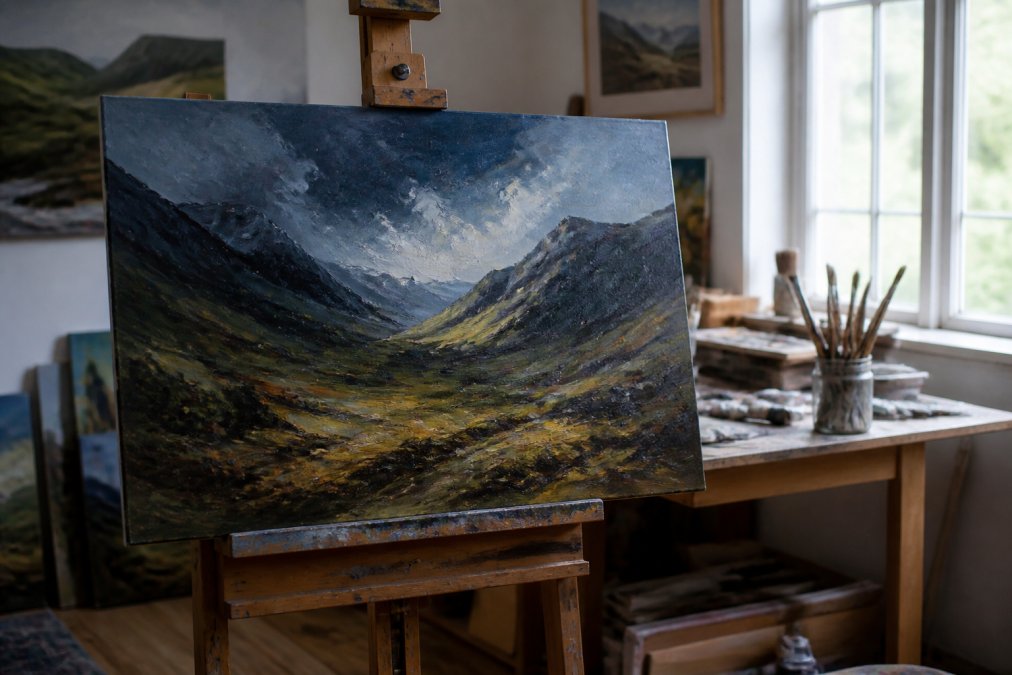
Abstract vs Realistic Scottish Landscape Art: Key Differences
The most significant divide in contemporary practice is between abstract and realistic interpretations. Realistic Scottish landscape art seeks to capture the topography, geology, and specific light quality of a place with fidelity, allowing viewers to recognize a specific vista, such as the jagged ridge of the Cuillin or the rolling expanse of Rannoch Moor. This approach often relies on plein air studies and keen observation of atmospheric effects.
Abstract Scottish landscape art, conversely, uses the landscape as a starting point for exploring color, texture, and composition. The goal is not to replicate the scene but to evoke its emotional essence, the chill of a north wind, the weight of a storm front, or the ethereal glow of a Hebridean sunset. As explored by the Tate's guide to abstract art movements, abstraction allows artists to distill a landscape down to its fundamental visual language. The choice between the two often comes down to personal taste: do you want a window into a specific glen, or a vessel for the feeling that glen inspires?
| Style | Primary Focus | Typical Techniques | Best For |
|---|---|---|---|
| Realistic | Topography & light | Plein air, fine brushwork | Recognizing a specific place |
| Semi-Abstract | Mood & form | Simplified shapes, bold palette | Evoking a feeling of the wild |
| Abstract | Color & texture | Impasto, layering, gestural marks | Making a contemporary design statement |
The Role of Light, Weather, and the Highland Terrain
You cannot separate Scottish art from its weather; the atmospheric conditions are arguably the primary subject. The rapid shifts between bright sun, dense mist, and horizontal rain dictate the palette and energy of a painting. This unpredictable light quality is a hallmark of the genre and a technical challenge that separates skilled artists from novices.
The terrain itself, ancient, rugged, and geologically complex, also drives stylistic choices. The stark contrast between smooth moorland and sharp peaks encourages a mix of painterly techniques. Many contemporary artists use heavy impasto and palette knives to mimic the physical texture of rock and heather, creating a sculptural surface that catches the light just as the real landscape does.
Techniques and Mediums Shaping Modern Highland Art
While oil on canvas remains the default for its blending time and depth, the most significant technical story in contemporary Scottish landscape painting is the migration toward hybrid and portable methodologies. This is a response to the landscape itself: the weather window on a Highland hill can close in fifteen minutes, and artists increasingly need tools that dry faster, weigh less, and survive a damp rucksack.
The plein air shift: from oil to acrylic and gouache. A growing number of practitioners now carry acrylics or gouache for outdoor studies, reserving oil for the studio. Acrylics dry in minutes, allowing an artist to layer a sky, a ridge, and a foreground within a single session. Gouache has seen a revival because it rewets on the palette, is highly portable, and produces a matte finish that suits the muted light of the west coast. The trade-off is real: acrylics dry darker than they appear when wet, and gouache is unforgiving if reworked after drying.
The palette knife and the materiality of rock. One of the most visible technical signatures in contemporary Highland painting is the use of heavy impasto applied with palette knives or even trowels. This is a direct response to the geology of the Cairngorms and the Cuillin, where the land is jagged and tactile. By building up a thick, sculptural layer of paint, the artist creates a surface that catches raking light in the same way that quartzite scree does. The technique has a practical consequence: heavily impastoed works are more fragile than thinly painted canvases, requiring framing with deep rebates to prevent the paint from being crushed. Collectors should ask whether a piece has been framed with adequate clearance.
Digital-hybrid and mixed-media approaches. A quieter but growing trend is the incorporation of digital tools into the workflow. Some artists use a tablet to compose and colour-test a scene on location, then translate that digital study into a physical painting. Others scan their sketches, manipulate them digitally, and print them onto canvas as an under-painting before working over the top in oil or acrylic. This is not a shortcut; it expands the range of possibilities before committing to a surface. A few practitioners are also experimenting with cold wax medium mixed into oil, which creates a matte, buttery texture that can be scraped back and reworked over weeks.
The practical question of permanence. For the buyer, the medium matters beyond aesthetics. Oil and acrylic are both archival when properly prepared, but gouache and pastel are more sensitive to moisture and UV light and typically require glass framing. A heavily textured acrylic piece may be lighter than an equivalent oil, affecting hanging hardware requirements. The choice of medium is a compromise between speed of execution, surface quality, and practical realities of shipping and display. When you commission or purchase a contemporary Scottish landscape, ask the artist directly about their medium and its handling requirements.
Regional Variations: From the Hebrides to the Cairngorms
Scottish landscape painting is a patchwork of regional styles shaped by distinct geographies and the artistic communities that have historically clustered in each area. Understanding these regional differences is the most reliable way to predict the visual language, palette, and philosophical approach of a given artist.
The Glasgow influence: urban energy meets rural subject. The city of Glasgow, not the Highlands, has been the most influential incubator of Scottish landscape painting since the late 19th century. The Glasgow School, led by figures like the Glasgow Boys, rejected the sentimental Victorian approach and brought a French-inspired, plein air realism to Scottish subjects (nationalgalleries.org). That legacy persists today. Artists trained at the Glasgow School of Art are often characterised by a bolder, more structural approach to composition and a palette that leans toward the tonal and muted. When you see a contemporary landscape that feels architectural or almost cubist, there is a strong chance the artist has roots in the Glasgow tradition.
The Northern and Highland style: solitude and the sublime. In contrast, artists working in the Highlands and the Northern Isles tend to be more directly influenced by the Northern Romantic tradition, which treats the landscape as a place of solitude, awe, and even threat. The palette here is often darker and more restricted: deep purples, iron greys, and stark white snow against black rock. The composition frequently emphasises the verticality of the mountains or the vast horizontality of the moor, with less interest in the human figure. This is a response to the sheer scale and emptiness of the terrain.
The Hebridean coastal school: light, water, and the liminal. The Hebrides produce a distinct body of work defined by the dominance of water and the Atlantic light. The landscape is horizontal, composed of bands of sea, machair, and sky, with a palette of silvery blues, sandy golds, and deep teal. Many Hebridean artists work in small, exposed studios or outdoors, and the constant salt-laden wind affects both materials and subject matter. The result is often a more meditative, abstracted style where the boundary between sea and land becomes blurred.
The Cairngorm plateau: geology and the changing climate. The Cairngorms present a unique case because of their arctic-alpine environment. Artists working here deal with the most extreme weather in the UK, and their work often reflects a growing engagement with environmental themes. The plateau is one of the most sensitive indicators of climate change in Scotland, and contemporary painters are increasingly documenting the retreat of snow patches and the changing treeline (cairngorms.co.uk). This is a form of environmental witness. The palette is often stark, focusing on the greys and browns of granite and heather. For a collector, a Cairngorm painting is often a more intellectually engaged piece that asks questions about land use and conservation.
Why regionalism matters for the collector. Regional style is a reliable indicator of both aesthetic and thematic content. A west coast painting will likely be about light and water; a Cairngorm painting about mass and climate; a Glasgow-trained artist might approach any subject with a more formal, structural eye. When choosing a piece, ask not only where the scene is located but also where the artist is based and trained. This allows you to build a collection that tells a coherent story about Scotland.
Why Support Independent Scottish Artists?
Supporting independent artists is essential for keeping the tradition of Scottish landscape painting alive and relevant. When you buy directly from a maker, you are funding the continuation of a cultural practice and ensuring that the landscape continues to be interpreted through fresh, contemporary eyes. This direct patronage allows artists to take risks and maintain a studio practice rooted in the local environment.
This ensures that the artistic interpretation of the Highlands remains authentic and diverse, reflecting a genuine, lived connection to the land. You also gain the peace of mind that comes with a safe-arrival promise and the knowledge that your piece arrives ready to hang.
Collecting Contemporary Scottish Landscape Paintings
Collecting contemporary Scottish landscape paintings is an accessible pursuit when you focus on emotional resonance rather than investment speculation. Begin by identifying the regions and styles that move you. Consider the practical aspects of the piece, such as its color palette and scale, and how it will interact with your existing interior design and lighting.
When browsing online, look for high-resolution images and detailed descriptions of the artwork's texture and provenance. A common concern is whether the artwork will look as good in person as it does on screen; reputable sellers will often provide multiple angles and close-ups to convey the surface quality. For a bold yet versatile addition to a modern living space, a canvas print from an original abstract work, such as the Storm over Glencoe canvas print, offers the texture and presence of an original without the fragility of a paper print. It is a practical way to start a collection, allowing you to live with a piece and understand how its mood shifts with the light before committing to a larger original work.

Conclusion
Contemporary Scottish landscape painting is a vibrant field that bridges the wild, rugged history of the Highlands with the expressive freedom of modern art. Whether your taste leans toward representational clarity or abstracted emotion, the diversity of styles ensures there is a piece that can capture your personal connection to Scotland.
Finding that connection is about supporting the independent artists who interpret this landscape for us. At Cairngorm Artists, we make this easy by offering a curated selection of original works and high-quality prints from ten local painters, each piece arriving ready to hang with our safe-arrival guarantee. Get started with Cairngorm Artists and bring the lasting spirit of the Highlands into your home.
Frequently Asked Questions
What defines contemporary Scottish landscape painting?
Contemporary Scottish landscape painting is defined by a shift from strict representation toward personal interpretation. While traditional views focused on accurate topography, modern artists often use abstraction, expressive brushwork, and bold color to convey the atmosphere, mood, and raw energy of the land. The result is a visual language that captures the feeling of the Highlands, rather than just its appearance, making each piece a unique artistic response to the terrain.
What is the difference between abstract and realistic Scottish landscape art?
Realistic Scottish landscape art aims to faithfully depict a scene, like a recognizable view of a glen or coastline. Abstract art prioritizes emotion and mood, using color, texture, and form to suggest the essence of a landscape without direct replication. The choice often comes down to personal taste: realistic pieces offer a window to a specific place, while abstract works act as a feeling or memory of the wilderness, creating a more subjective connection.
How do I start collecting contemporary Scottish landscape paintings?
Begin by exploring different styles to identify what resonates with you, whether that is abstract, representational, or somewhere in between. Consider the scale of the piece relative to your wall space and the existing color palette of your room. When buying, prioritize original works from independent artists or reputable galleries that offer secure shipping and a safe-arrival promise, ensuring your investment arrives ready to hang and in perfect condition.


