

The Impact of Local Art on Scottish Culture
Oct 17, 2026
Table of Contents
- What Counts as Local Art in Scotland
- Community Art in Scotland: Participation Over Spectatorship
- Highland Art and Identity: Place-Based Practice
- Contemporary Scottish Art: Responding to History and Landscape
- Art and Community Engagement in Scotland: Measured Impacts
- Regional Comparisons: Beyond the Highlands
- How to Support Local Artists and Cultural Activity
- Frequently Asked Questions
Last Updated: October 18, 2026
What Counts as Local Art in Scotland
Local art in Scotland is work made by artists living and working within a defined Scottish community, rooted in the landscape, language and lived experience of that place. It spans painting, sculpture, printmaking, textiles, photography and digital work, but place is the thread that ties it together.
At Cairngorm Artists, our collective of ten Highland painters works from exactly this position: original pieces shaped by the wildlife and wild coastal landscapes on our doorstep. That grounding is what separates local art from work that simply borrows a Scottish aesthetic.
The distinction matters because the term gets stretched. A print of a Highland view, produced overseas and shipped in bulk, is Scottish-themed. A painting made in a croft studio by someone who watches those hills change daily is local art.
Three markers define the category in practice:
- Residency: the artist lives and works in the community the work depicts or responds to
- Material connection: subject matter drawn from local landscape, history or culture rather than generic scenery
- Economic locality: money from sales circulating back into the regional creative economy
Scottish culture has long treated these markers as meaningful. The Scottish Government's culture strategy frames cultural participation as a national priority, and local art sits at the heart of that ambition, from village halls to city galleries.
Community Art in Scotland: Participation Over Spectatorship
Community art in Scotland is defined less by what hangs on a wall than by who made it. Workshops, open studios, cooperative galleries and participatory projects put residents in the role of maker rather than audience.
The infrastructure explains why participation is so embedded. Creative Scotland funds a network of regularly funded organisations including community-led arts centres, youth arts projects and participatory programmes. Local authorities run their own arts development teams, and regional arts associations and volunteer-run village hall committees fill the gaps.
The shift from spectatorship to participation changes what local art does for a community. A finished exhibition draws visitors for an afternoon; a monthly printmaking workshop builds skills, relationships and a reason to keep coming back.
Practical examples of the model, drawn from how community arts commonly operate across Scotland:
- Open studio weekends where the public watches artists work and buys directly, often coordinated across a town or valley so visitors can move between venues
- Community murals designed with local schoolchildren and sited on buildings the community uses daily
- Cooperative gallery spaces where artists share rent, insurance and decision-making, and where members staff the space on a rota
- Intergenerational craft sessions passing on skills such as weaving, woodwork or printmaking, often hosted in libraries and community centres rather than galleries
- Participatory photography and oral history projects that record a place before it changes, with the resulting archive held locally
What separates strong community art from well-meaning activity is authorship. Projects that begin with a community brief and hand decision-making to residents outlast those designed elsewhere and delivered into a community.
Barriers to Access and Inclusion
Cost, transport, confidence and digital access remain the four stubborn barriers to arts engagement in Scotland. Rural communities face long journeys to the nearest gallery, while materials and course fees put workshops out of reach for lower-income households. Disability access is easy to overlook in older venues: step-free entrances, accessible toilets and quiet spaces are not universal in village halls and converted buildings.
The confidence barrier is most often underestimated. A free event does not remove it; for many people the real hesitation is walking into a space they believe is "not for them." Fixes include beginner-only sessions, materials provided on the day, and local venues such as village halls rather than formal galleries.
Digital exclusion matters too. Where listings, booking and artist profiles live only online, older residents and those with poor connectivity get quietly filtered out. Printing listings and taking bookings by phone closes that gap cheaply.
Highland Art and Identity: Place-Based Practice
Highland art and identity are bound together because the landscape here is not a backdrop but a subject with its own history. Place-based practice means the work could not plausibly have been made anywhere else.
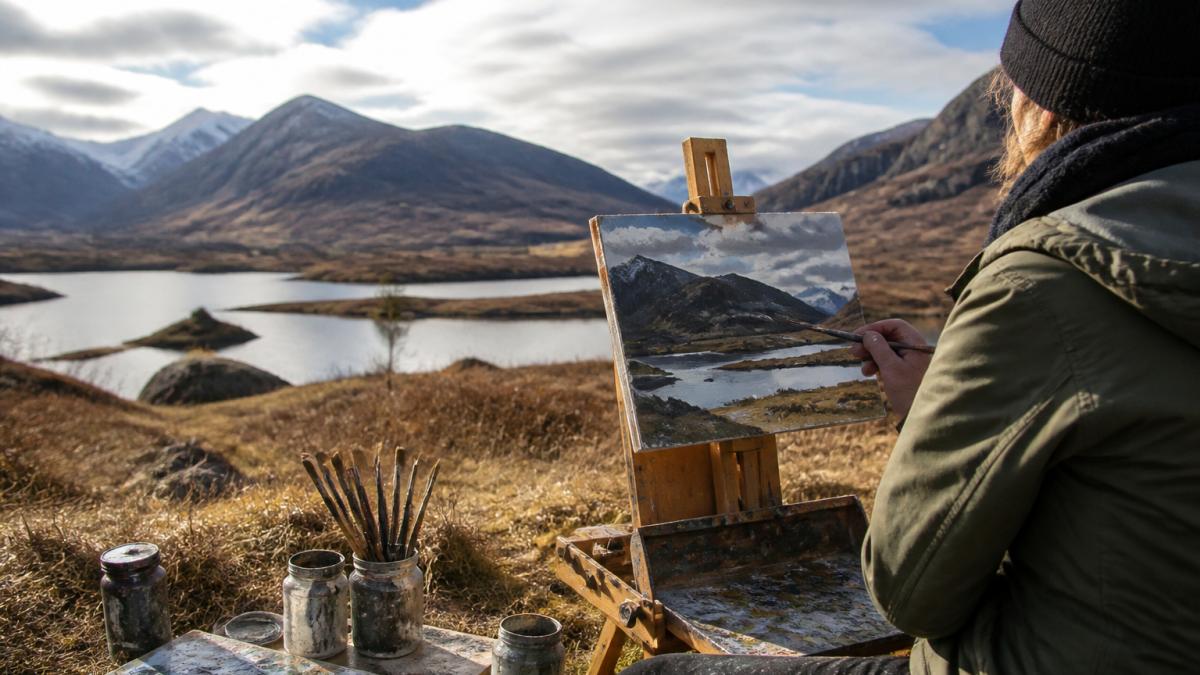
Light behaves differently in the Highlands. Weather moves fast, colours shift by the hour, and artists who live here develop a vocabulary for that restlessness. Our own work leans on this: Scottish Hillside builds an abstract landscape from deep reds and earthy greens beneath shifting, stormy clouds, while Storm over Glencoe pushes indigos and charcoal against vivid greens to convey a storm's approach. Neither could have been painted from photographs alone.

Place-based practice also carries responsibility. Artists working in the Highlands are often documenting landscapes under pressure from tourism, development and climate change. The work becomes a record as much as a decoration.
Gaelic Culture and the Gàidhealtachd in Visual Art
Gaelic culture and the Gàidhealtachd, the Gaelic-speaking heartland, feed into Highland visual art through language, song, story and a distinct way of naming the land. Artists increasingly title work in Gaelic and draw on place-names carrying centuries of meaning.
This is not decoration. Using Gaelic in exhibition text, artist statements and titles keeps the language visible in public life, aligning with national efforts to support it. Norse traditions in the far north and west add a second layer, particularly in coastal communities where place-names and craft patterns reflect that inheritance.
For buyers, a Gaelic title often separates a picture of Scotland from a piece connected to a specific culture. It signals that the artist works from inside a tradition rather than borrowing its surface.
Contemporary Scottish Art: Responding to History and Landscape
Contemporary Scottish art is defined by its willingness to hold history and landscape in the same frame. Artists today respond to the Highland Clearances, nineteenth-century painting traditions and the romanticised imagery that shaped how the world sees Scotland.
The most interesting work interrogates that imagery rather than repeating it. Where nineteenth-century art presented the Highlands as empty and sublime, contemporary practitioners ask who was removed to make it look that way. Historical memory becomes material.
Portree Colours - canvas print from original artwork →
Celtic heritage and the Arts and Crafts Movement both surface here. The latter left a lasting mark on Scottish design through its emphasis on handwork and local materials, visible in studios producing textiles, ceramics and furniture today.
Landscape remains central, but the approach has changed. Abstraction, mixed media and digital techniques let artists respond to shifting light and weather without producing another postcard. That is where contemporary Scottish art earns its place: rooted in place, aware of history, unafraid to look forward.
Art and Community Engagement in Scotland: Measured Impacts
Art and community engagement in Scotland produces outcomes that show up in participation figures, visitor numbers and local economic activity. Galleries and cultural organisations track attendance, workshop uptake and volunteer hours, and these measures tell a clearer story than anecdote.
The social side is harder to quantify but consistently reported. Community-led arts projects build social connection, particularly in rural and island communities where isolation is a real concern. Intergenerational skill-sharing keeps traditional crafts alive while giving younger and older residents a shared activity.
Economic effects are modest but real. Local artists who sell work keep income in the region, and open studios draw visitors who spend in nearby shops and cafes. Culture-led regeneration is now a recognised element of community development planning.
One caveat: measuring impact well requires consistent data collection, and many small organisations lack the capacity, so the sector often undersells itself.
Regional Comparisons: Beyond the Highlands
Regional comparison shows that local art works differently across Scotland. The Highlands and Islands lean on landscape, Gaelic heritage and tourism. Glasgow and Dundee carry reputations for contemporary and digital practice.
| Region | Dominant Character | Main Challenge |
|---|---|---|
| Highlands and Islands | Landscape, Gaelic heritage, tourism | Seasonality, transport distances |
| Glasgow and Dundee | Contemporary and digital practice | Competition for affordable studio space |
| Edinburgh | Festival footfall, established galleries | High costs squeezing out local artists |
| Fife and the Borders | Traditional crafts, studio networks | Limited exhibition infrastructure |
| Aberdeenshire and the North East | Rural studio practice, craft and design | Distance from major galleries and buyers |
The pattern is consistent: places with strong tourism see seasonal income, while cities see cost pressure.
In the Highlands and Islands, the binding constraint is geography.
In Glasgow and Dundee, the constraint is space. Both cities have strong art school pipelines and dense networks of artist-run spaces, but affordable studio provision is under pressure as rents rise.
Edinburgh's challenge is the opposite of scarcity: it has more gallery footfall than any other Scottish city, concentrated in August, but high rents and business rates squeeze the year-round local scene.
Fife, the Borders and Aberdeenshire share a different profile: strong craft traditions, active studio networks and open studio trails, but limited formal exhibition infrastructure.
To understand your own region, ask which constraint binds: distance, space, cost or infrastructure.
How to Support Local Artists and Cultural Activity
Supporting local artists is a set of small, deliberate choices rather than a grand gesture. The most direct route is buying original work from artists who live in the community they depict.
- Buy directly from artists or artist collectives rather than resellers
- Ask where the artist is based before purchasing "Scottish" work
- Attend open studios and buy at source
- Commission a piece tied to a specific place or memory
- Book onto a workshop and pay the full fee rather than haggling
- Share artist profiles with people who are redecorating or gift-shopping
- Choose original work over mass-produced reproductions where budget allows
For buyers furnishing a home, original pieces do more than fill a wall. A watercolour such as Portree Colours brings the colour of a Highland street into a living room, and every purchase keeps a working artist in the region.
Frequently Asked Questions
How does local art influence Scottish culture and identity?
Local art gives Scottish communities a way to express who they are and where they live. In the Highlands, painters and makers draw on the landscapes, wildlife and Gaelic heritage around them, turning everyday scenery into a shared visual language. This place-based practice keeps regional culture visible and helps residents and visitors alike connect with a sense of belonging, while supporting the artists who live and work in those communities.
What role does community art play in Scottish culture?
Community art in Scotland moves creativity out of galleries and into halls, schools and public spaces. It invites people who would not call themselves artists to take part in workshops, murals and exhibitions, building skills and social connections along the way. This participation strengthens community heritage and gives rural and island communities a way to tell their own stories rather than having them told by outsiders.
How do Scottish artists represent local history and landscapes?
Artists in Scotland often work directly from the places they know, from stormy glens to coastal villages. Some respond to historical events such as the Highland Clearances through memory and symbolism, while others focus on the light, weather and colour of a specific location. The result is contemporary Scottish art that feels rooted rather than generic, and that gives collectors a genuine connection to the landscape.
How can I support local artists in Scotland from home?
Buying original work or prints directly from artists is the most direct way to support creative practice in Scotland. You can also attend local exhibitions, follow artists online and share their work, or commission a piece inspired by a place you love. Choosing work made by artists who actually live and work in the region ensures your money supports the local creative community rather than a reseller.
Scotland's cultural life depends on people choosing local art over imported reproductions, and that choice is easier than it looks. Cairngorm Artists exists to make it straightforward: ten Highland artists creating original work inspired by the wildlife and wild coastal landscapes of the Scottish Highlands, each piece arriving ready to hang with our safe-arrival promise and worldwide shipping. Explore the collection at Cairngorm Artists and bring a genuine piece of the Highlands into your home.


