

How to Identify Authentic Hebridean Art: A 2026 Guide
Sep 25, 2026
Table of Contents
- Understanding Hebridean Art and Its Cultural Heritage
- How to Identify Authentic Hebridean Art: Visual Characteristics
- Original vs Print Art Identification: Key Differences
- How to Verify Art Provenance and Authenticity
- Spotting Counterfeits and Mass-Produced Imitations
- Investing in Local Scottish Artists: Why It Matters
- Your Hebridean Art Verification Checklist
- Frequently Asked Questions
Last Updated: September 24, 2026
Understanding Hebridean Art and Its Cultural Heritage
Hebridean art captures Scotland's islands, their raw beauty, shifting light, and coastal topography, through the eyes of artists who live there. At Cairngorm Artists, we work with Highland creators who translate this landscape into paintings with genuine cultural weight.
What makes Hebridean art distinct is the approach: artists engage in lifelong observation of their landscape, studying light, water, and seasonal change. This is the result of deep observation and technical skill, not decorative art designed for mass appeal.
Understanding this heritage matters before you buy. A genuine piece tells you something real about the islands; a mass-produced imitation tells you nothing.
How to Identify Authentic Hebridean Art: Visual Characteristics
Authentic Hebridean art has visual markers that distinguish it from reproductions and commercial knockoffs. Once you know what to look for, they become obvious.
Coastal landscape and topography markers
Real Hebridean art depicts the islands with geographical specificity: recognizable landmarks, accurate water formations, and light conditions that match the region's climate.
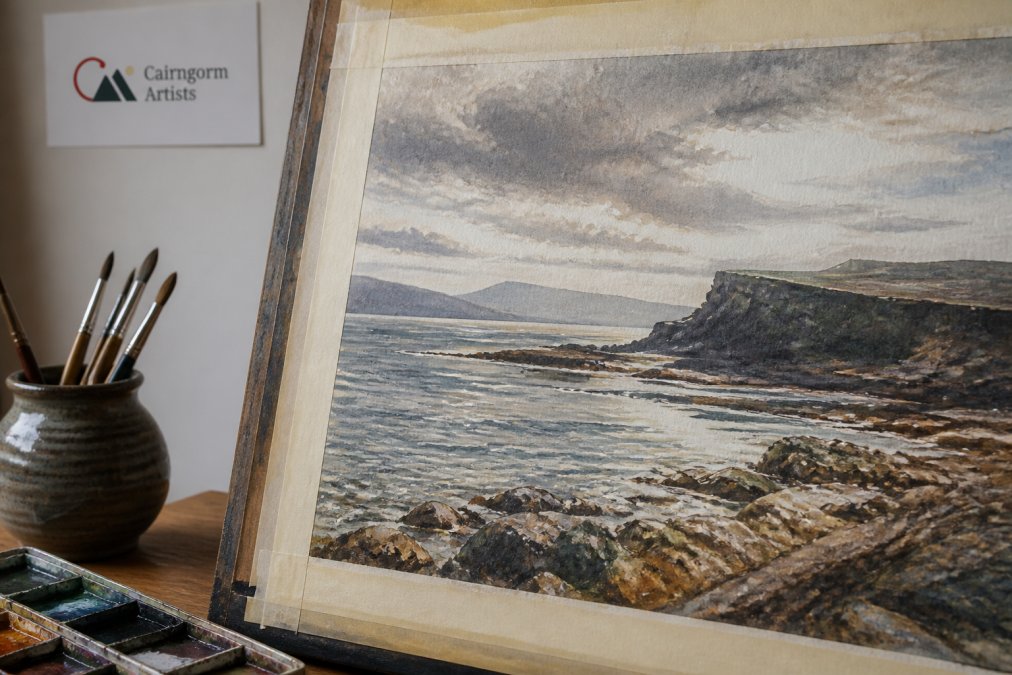
Look for these markers:
- Accurate topography: Cliffs, headlands, and rock formations match real geography
- Authentic light quality: The pale, shifting northern light characteristic of Scottish islands
- Water movement: Waves and currents depicted with understanding of actual sea conditions
- Vegetation patterns: Moorland, grasses, and sparse trees positioned as they grow in harsh island environments
- Weather effects: Mist, cloud formations, and atmospheric conditions true to the Hebrides
Mass-produced work flattens these details, a mountain could be anywhere, a coastline could be any coast. Authentic Hebridean art grounds itself in specific places.
Artistic techniques and medium authenticity
The medium matters. Watercolour remains a dominant medium for Hebridean landscape work because it demands skill, you can't hide mistakes. The artist must understand water, pigment behavior, and layering.
Original artworks show visible brushwork, pigment variation, paper texture, and layering evidence. Prints show uniform color, smooth surfaces, perfect registration, and no visible process.
Original vs Print Art Identification: Key Differences
The price difference between originals and prints can be substantial. This difference reflects real distinctions in how the work was made.
Physical texture and brushwork indicators
Run your hand across the surface. Original artwork has physical texture; prints feel flat and uniform. Original artworks show the artist's hand with varied pressure and layering. Prints capture the image but not the process, the brushwork is a photograph of brushwork with no dimension.
Paper quality and print detection methods
Original artwork uses quality art paper with weight and texture. It has character and a slight tooth that catches pigment. Print paper is thinner, smoother, and uniform, chosen for how it receives ink, not for artistic qualities.
Check the back: original artwork shows the paper back with evidence of the artist's work; prints show uniform backs with barcodes or printing information. Original edges are natural or deliberately finished; prints are cut with mechanical precision.
How to Verify Art Provenance and Authenticity
Provenance is the documented history of a work, where it came from, who made it, and how it reached you. For Hebridean art, this involves artist authentication, material documentation, and official certification marks.
Artist signatures and certification marks
Every authentic original bears the artist's signature, usually on the front. Study it carefully: does it match the artist's known signature across multiple works? Forgers often show inconsistent pressure, different letterforms, or mismatched placement. Compare to other works by the same artist through gallery records, websites, or museum collections.
Beyond the artist's personal signature, look for these official certification marks that indicate genuine Hebridean origin:
Look for these official marks:
Artist registry numbers: Legitimate galleries assign registry numbers to authenticated works, allowing cross-reference against the artist's official catalog.
Gallery authentication stickers: Reputable galleries apply embossed or holographic stickers to the back of framed pieces, including the gallery name, artist name, work number, and authentication date. Cairngorm Artists uses numbered authentication labels verifiable against our registry.
Documentation and certificate of authenticity
A certificate of authenticity should include: artist name and biographical information, work title and creation date, medium and materials, dimensions, edition information, unique work identification number, seller's statement with signature, seller's credentials and gallery registration, and a holographic seal or tamper-evident security feature.
A real certificate comes from the artist, gallery, or recognized authentication service, not a generic printout. It includes specific details and references the artist's official catalog for independent verification. Keep the certificate with the artwork; it increases resale value and proves authenticity to future buyers.
When buying from Cairngorm Artists, authentication is built into the process. Every piece arrives with documentation confirming the artist, creation date, materials, and a unique registry number. Our certificates include our gallery authentication seal and can be verified against our artist registry. This removes doubt and protects your investment from the moment of purchase.
Spotting Counterfeits and Mass-Produced Imitations
Counterfeit and misrepresented Hebridean art is a growing problem. Sellers create fake artwork, misrepresent prints as originals, or import mass-produced work labeled as "Hebridean-style." Understanding these counterfeits helps you avoid them.
How counterfeits enter the market
Forged originals: Works mimicking known artists with forged signatures, lacking technical skill and consistent approach. Often sold with vague stories ("found at estate sale"). Legitimate provenance includes specific dates and documented history.
Red flags and detection methods
Price inconsistency: Authentic original artworks by established Hebridean artists have a price range that reflects their size and artist reputation. Prices below a certain threshold may indicate a print, import, or forgery. Unusually high prices without clear artist credentials warrant verification through gallery records and auction results.
Verification questions to ask before buying
Ask these questions before purchasing:
- Artist's full name and contact information? Legitimate sellers provide this without hesitation.
- When and where was it created? Specific dates and locations; vague answers are red flags.
- What materials did the artist use? Knowledgeable sellers know specific pigments, paper types, or fiber content.
- Is there a certificate of authenticity? Request a copy with specific details and official seals.
- Artist's exhibition history or gallery representation? Ask for verifiable links to galleries or museum collections.
- How did you acquire this artwork? Legitimate sellers provide clear provenance; counterfeits have vague stories.
- High-resolution photos of signature, back, and labels? This allows detailed examination.
If a seller hesitates or refuses to answer, walk away.
Investing in Local Scottish Artists: Why It Matters
Buying authentic Hebridean art supports real artists working in challenging conditions. Money goes directly to the creator, enabling them to continue their work and invest in better materials. Mass-produced alternatives funnel money to manufacturers; the artist receives nothing. Original work by established artists appreciates in value over time; prints do not. Beyond investment, authentic art connects you to place and culture, a window into how a real artist sees their world.
Your Hebridean Art Verification Checklist
Use this checklist when evaluating any Hebridean artwork:
| Verification Point | What to Check | What Indicates Authenticity |
|---|---|---|
| Artist Information | Is the artist named? Can you research them? | Named artist with verifiable background and body of work |
| Signature | Does it match known signatures? Is it consistent? | Clear, intentional signature matching artist's documented style |
| Physical Texture | Does the surface have dimension and variation? | Visible brushwork, paper texture, layered paint |
| Paper Quality | Is the paper substantial and textured? | Watercolour paper with weight and character, not smooth stock |
| Provenance | Is there documentation of origin? | Certificate of authenticity with artist, date, medium, dimensions |
| Geographical Accuracy | Do landscapes match actual Hebridean terrain? | Recognizable landmarks, authentic light, accurate topography |
| Medium Authenticity | Is the medium consistent with Highland art tradition? | Oils or mixed media applied by hand |
| Seller Credentials | Can the seller answer detailed questions? | Seller provides artist background, creation details, documentation |
| Price Point | Does the price match original artwork? | Original work priced appropriately for artist and size |
| Documentation | Is there a certificate or proof of authenticity? | Formal certificate with specific work details and seller credentials |
Work through this checklist before buying. If the artwork fails multiple checks, walk away. Authentic Hebridean art is worth seeking out, but only when you're certain of what you're buying.
Frequently Asked Questions
How can you tell the difference between a print and an original Hebridean painting?
Original Hebridean art has visible brushwork, texture you can feel, and unique colour variations across the surface. Prints appear flat with uniform ink coverage and no dimensional texture. Hold the piece at an angle under light, original paintings show directional brushstrokes and paint layers, while prints show a consistent, smooth surface. Original artworks also have slight variations in colour intensity that mass-produced prints cannot replicate.
What documentation should accompany an authentic piece of Scottish Highland art?
Authentic Hebridean art should include a certificate of authenticity with the artist's name, title, date of creation, and medium used. Look for the artist's signature on the work itself. Reputable sellers provide provenance information showing the artwork's history and the artist's studio location. Documentation may include artist biography, details about the specific Highland location that inspired the piece, and the artist's contact information or studio details for verification purposes.
Why is it important to buy directly from local Hebridean artist collectives?
Purchasing directly from local creators ensures you receive genuine, handmade artwork while supporting the artists who create them. Direct purchases guarantee authenticity, eliminate middlemen markups, and provide you with detailed provenance and artist stories. When you invest in local Scottish artists through established collectives, you contribute to sustaining cultural heritage and ensuring fair compensation reaches the artists who dedicate their talent to capturing the rugged beauty of their homeland.
How do I verify the provenance of art purchased from Highland artists?
Request the artist's studio location, exhibition history, and previous sales records when available. Authentic Highland artists can provide details about their creative process and the specific geographic origin of their inspiration. Check for artist signatures matching official records, ask about any hallmark or certification marks used by the collective, and request contact information to verify directly with the studio. Reputable sellers like established Highland artist groups offer transparent provenance documentation and are willing to answer questions about the artwork's creation and authenticity.


