

Hebridean vs Mainland Scottish Art: Key Differences
Oct 01, 2026
Table of Contents
- Hebridean vs Mainland Scottish Art: A Visual and Cultural Divide
- How Geography Shapes Artistic Identity
- Atlantic Light and Atmospheric Perspective
- Color Palettes: Island vs Mainland Approaches
- Why Support Independent Scottish Artists
- Authentic Scottish Landscape Paintings: What to Look For
- Frequently Asked Questions
Last Updated: September 30, 2026
Hebridean vs Mainland Scottish Art: A Visual and Cultural Divide
When studying hebridean vs mainland scottish art, artists see their surroundings through fundamentally different lenses. The islands demand one artistic language; the mountains and glens demand another. Understanding these differences shapes how collectors choose work that resonates with their space and values.
The distinction matters because it changes everything about how the art feels, what it costs, and why you'd want it on your wall.
| Characteristic | Hebridean Art | Mainland Scottish Art |
|---|---|---|
| Light Quality | Soft, diffused Atlantic light | Dramatic, directional mountain light |
| Color Palette | Cool blues, grays, muted greens | Rich golds, deep purples, warm browns |
| Compositional Focus | Horizontal, expansive seascapes | Vertical, towering landscapes |
| Atmospheric Perspective | Misty, layered depth | Sharp contrasts and shadows |
| Subject Matter | Coastal scenes, island isolation | Mountain peaks, glens, valleys |
| Artistic Approach | Contemplative, restrained | Bold, expressive brushwork |
How Geography Shapes Artistic Identity
Geography shapes how artists think, what they see, and what they feel compelled to paint. Island and mainland artists inherit entirely different visual vocabularies because they live in fundamentally different environments.
Island Isolation and Coastal Influence
Hebridean islands offer complete, uninterrupted horizons where the Atlantic dominates. The water is not a feature of the landscape, it is the landscape. This fundamentally changes how artists approach composition and subject matter.
Island artists work within tight geographical constraints where repeating patterns emerge across seasons: tidal rhythms, weather cycles, the same rocky outcrops in different light. This repetition breeds intimacy. Artists paint the same stretch of coast dozens of times, each version revealing new atmospheric subtleties. The result feels meditative rather than dramatic.
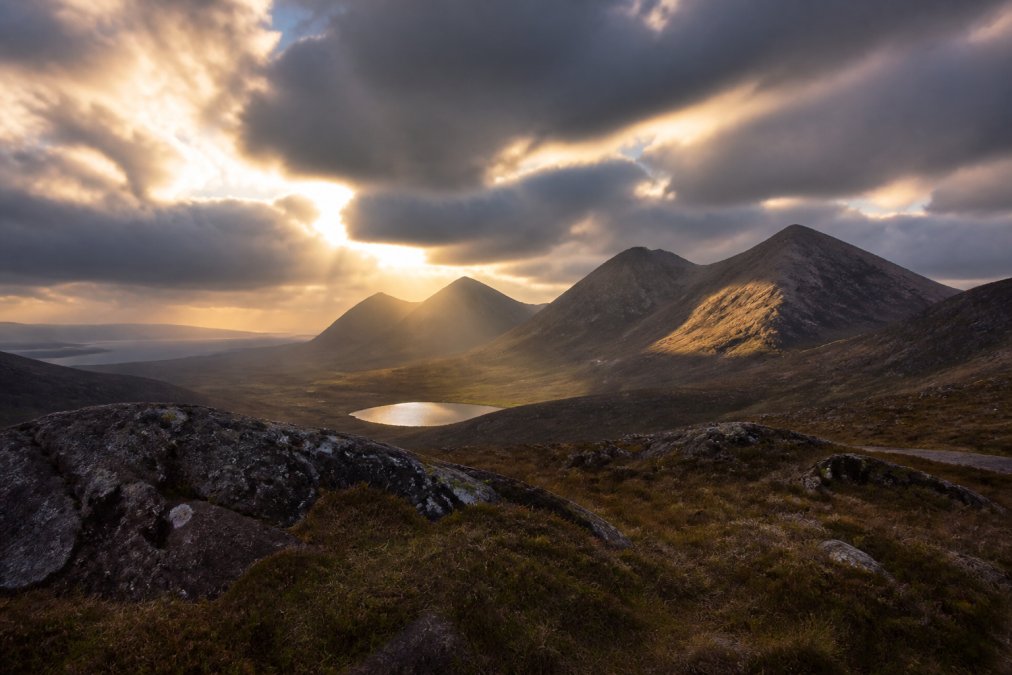
The Atlantic light itself is a character in island work. Softer and more diffused than mountain light, it filters through moisture-laden air, creating gentler shadows and constantly shifting colors. Artists naturally develop palettes of cool grays, muted blues, and restrained greens, honest responses to what the light actually does.
Mainland Topography and Mountain Perspective
Mainland Scottish art emerges from vertical space. Mountains, glens, and valleys create drama through elevation and depth, demanding bold compositional choices that command attention.
Mainland topography creates sharper light contrasts. Mountain valleys funnel light differently than open water, producing darker shadows and brighter highlights. Mainland artists work with richer palettes: deep purples in distant peaks, warm golds in foreground grasses, burnt oranges in rocky outcrops.
The mainland tradition embraces more expressive brushwork. Mountains invite bold, gestural painting with thick impasto and energetic mark-making that the subject matter supports.
Atlantic Light and Atmospheric Perspective
Atlantic light defines Hebridean art through specific optical and atmospheric conditions that fundamentally alter composition, color mixing, and brushwork. An artist cannot apply mainland techniques to island subjects without the work appearing false.
The Physics of Atlantic Light vs. Mountain Light
Hebridean light travels through moisture-saturated air. The Atlantic Ocean creates a perpetual humidity layer that scatters light wavelengths, reducing contrast and softening shadows. This is the baseline condition, not a matter of weather or season.
In practical terms: shadow edges are soft and gradual, requiring more intermediate tones and encouraging subtle brushwork. Color saturation is muted at source, the light itself offers fewer saturated hues. Atmospheric depth is visible and measurable through distinct mist layers. Reflected light from surrounding water creates a secondary cool-toned light source that fills shadows and reduces contrast.
Mainland Scottish light operates under different optical conditions. Mountain valleys funnel light directionally with drier air, darker shadows, and brighter highlights. An artist encounters sharp shadow edges defined through contrast, saturated color at source (granite, heather, earth tones), reduced atmospheric haze with dramatic tonal transitions, and direct light that supports bold, expressive mark-making.
How Light Determines Technique
These optical differences directly determine which techniques work. Island artists develop sophisticated glazing techniques and restrained mark-making because soft light will not support bold impasto. Mainland artists use confident impasto and wet-into-wet techniques because sharp light emphasizes texture and contrast. Techniques that work in one light condition actively undermine work in the other.
Old Bothy, Isle of Harris - canvas →
Seasonal Variation and Artistic Response
Atlantic light varies seasonally with extended winter cloud cover and summer mist, creating monochromatic winter palettes and dramatic summer atmospheric shifts. Mainland light varies differently, winter snow creates bright reflective surfaces, summer brings sustained daylight, autumn brings warm light and vivid vegetation. Mainland work often feels more seasonally specific than island work with its more consistent atmospheric conditions.
Color Palettes: Island vs Mainland Approaches
Color selection in Scottish landscape art is rarely arbitrary. It emerges from the light available, the geological character of the land, and the artist's understanding of how pigments behave under specific atmospheric conditions. Hebridean artists and mainland artists work with distinctly different color vocabularies because their environments offer different hues and because the light conditions that govern their work demand different mixing strategies.
The Hebridean Palette: Cool, Restrained, and Specific
Authentic Hebridean work operates within a deliberately limited color range, honest observation translated into pigment. The islands' ancient gneiss and sandstone, weathered vegetation, and gray Atlantic water offer subdued earth tones. Artists develop palettes of cool grays and blue-grays (foundation), muted earth tones (mixed with gray and blue), restrained greens (desaturated and cool-toned), limited warm color (mixed with gray or blue), and white as a primary mixing color to reduce saturation and create soft tonal transitions.
This narrow palette is liberating. Within these constraints, sophisticated artists create extraordinary tonal complexity. An artist using mainland color palettes on Mull or Lewis would paint something false, bright cadmium yellow or saturated alizarin would appear garish in island light.
The Mainland Palette: Warm, Saturated, and Dramatic
Mainland Scottish art embraces warmer, more saturated color because the landscape and light conditions offer it generously. Granite, heather, and soil create warm earth tones revealed with clarity by direct light. Artists develop palettes of saturated earth tones, deep rich purples, warm greens and olive-golds, bold warm accents, and reduced white in mixing, creating depth through color temperature shifts rather than saturation reduction.
Practical Comparison: The Same Subject, Two Palettes
Consider how a Hebridean artist and a mainland artist would approach painting a rocky shoreline with heather.
Hebridean approach: The artist mixes a base of Payne's gray with ultramarine and white, establishing the dominant cool-gray tone. Heather is rendered as muted purple-gray, created by mixing alizarin with ultramarine and white, no bright purple.
How Authentic Artists Develop Their Palettes
Why Support Independent Scottish Artists
Independent Highland artists create work because they live in the landscape they paint, not for market demands. Supporting independent artists means supporting the continuation of Hebridean and mainland Scottish art traditions. Cairngorm Artists brings together Highland artists who have chosen the Highlands as both home and primary subject, reflecting genuine engagement with Scottish landscape and wildlife.
Authentic Scottish Landscape Paintings: What to Look For
Authenticity in Scottish landscape art comes from specificity. Genuine work contains details revealing the artist's intimate knowledge of place.
Identifying Genuine Hebridean and Mainland Work
Authentic Hebridean art shows evidence of repeated observation with soft color transitions, complex tonal relationships, and horizontal compositions revealing understanding of tidal patterns and seasonal light shifts. Genuine mainland Scottish art demonstrates geological accuracy, realistic color relationships, and confident brushwork handling dramatic compositional challenges.
Frequently Asked Questions
What defines the aesthetic of Hebridean art?
Hebridean art centers on coastal scenery, tidal patterns, and the raw Atlantic light that characterizes island geography. Artists emphasize water formations, weathered textures, and the isolation of island life. The color palette tends toward cool blues, grays, and muted greens, capturing the moody, changeable atmosphere of the Outer Hebrides. Pieces often feature cottages, boats, and rocky shores as focal points within vast seascapes.
How does mainland Scottish art differ from Hebridean work?
Mainland Scottish art draws from mountain topography, glens, and river valleys rather than coastal subjects. Mainland artists explore distant peaks and the play of light across varied terrain. While Hebridean work emphasizes isolation and water, mainland landscape painting often incorporates human settlement, forestry, and the layered depth of mountainous geography. The atmospheric perspective differs too.
Why should I choose authentic Scottish landscape paintings over prints or reproductions?
Original paintings and fine art prints from independent Highland artists offer a unique connection to the landscape that mass-produced reproductions cannot match. Each piece reflects the artist's direct experience of the landscape and their response to specific locations. Authentic Scottish landscape paintings arrive ready to hang from artists committed to quality. You're investing in a connection to real Highland artists and the places they paint.
How can I identify authentic art inspired by the Scottish Highlands?
Look for artists based in or deeply connected to the Highlands who document specific geographical locations and atmospheric conditions. Check the artist's background and whether their pieces reference named locations like Isle of Harris, Mull, or Iona. Fine art prints and canvas works from independent Highland artists typically include detailed artist statements explaining the inspiration and technique, setting them apart from generic Scottish-themed merchandise.


