

Decorating Your Living Room with Highland Art
Aug 18, 2026
Table of Contents
- Why Highland Art Works So Well in a Living Room
- Choosing the Right Size and Placement for Highland Art
- Best Color Schemes for Highland-Inspired Decor
- Styling a Gallery Wall with Scottish Art
- Modern Alternatives to Classic Highland Loch Art
- Balancing Rustic Farmhouse Charm with a Modern Interior
- Art Maintenance, Framing, and Budget-Friendly Display Tips
- Conclusion
Last Updated: August 18, 2026
Why Highland Art Works So Well in a Living Room
Highland art belongs in a living room the way a fireplace does: it creates warmth, commands attention, and gives the whole space a reason to exist. At Cairngorm Artists, we've watched countless homeowners transform ordinary walls into genuinely memorable rooms simply by choosing the right piece of Scottish landscape or wildlife art.
Highland art is defined here as original or print-based artwork depicting the landscapes, wildlife, and coastal scenery of the Scottish Highlands, including everything from sweeping glen vistas and stormy loch scenes to intimate portraits of red deer and Highland cattle.

The living room needs to welcome guests, reflect personality, and feel restful. A bold canvas print of a storm rolling over Glencoe achieves all three: it reads as a statement piece, introduces a colour palette for the room, and carries a sense of place that mass-produced wall art cannot replicate.
The psychological impact of wild landscape and wildlife art
Research from environmental psychology studies on nature imagery and wellbeing consistently shows that exposure to natural landscapes, even in painted form, reduces perceived stress and supports calm. Wild landscape art triggers what psychologists call restorative attention: the gentle, effortless focus we experience watching clouds or waves. A large canvas of a misty glen recreates that experience on your living room wall.
Wildlife portraiture adds personality and rural humour without kitsch. When an artist has painted directly from the landscape rather than stock imagery, that authenticity reads in the finished piece.
Choosing the Right Size and Placement for Highland Art
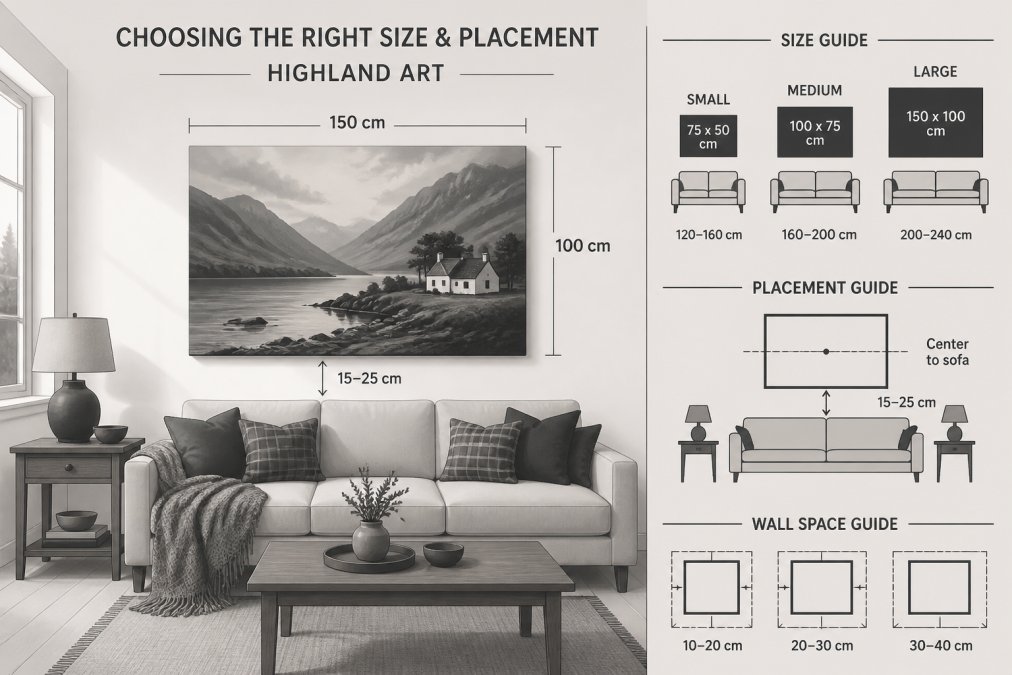
The most common mistake when buying wall art is choosing a piece that's too small. Your artwork should fill roughly two-thirds of the available wall width above furniture. For a standard sofa, that means a single canvas of at least 90-100cm wide, or a gallery arrangement spanning a similar footprint. The colour and design guidance from the Design Council confirms that scale is one of the most decisive factors in whether art enhances a room's visual balance.
The 3-5-7 rule and visual balance
Group decorative elements in odd numbers: three small prints clustered together read as one visual unit; five elements create a layered arrangement; seven pieces fill a larger wall without rigidity.
For highland art:
- A single large statement piece works as a solo focal point above a sofa or fireplace
- Three prints of varying sizes create a relaxed, editorial grouping
- Five or more pieces open the door to a full gallery wall arrangement
Asymmetric arrangements feel more natural than perfect symmetry. Anchor the arrangement with your largest piece, then build outward.
Art placement for non-standard wall layouts
Alcoves suit a single tall canvas or two stacked prints. Chimney breasts benefit from centring your primary highland art piece at eye level above the mantle. Sloped ceilings suit smaller, portrait-format prints placed lower on the wall.
The centre of a piece should sit at roughly 145-150cm from the floor, corresponding to average eye level. Many people hang art 20-30cm too high, which disconnects it from furniture below and makes the room feel top-heavy.
Best Color Schemes for Highland-Inspired Decor
Highland landscapes carry a distinctive palette: deep heather purples, earthy ochres, slate greys, moss greens, and burnt sienna where bracken meets autumn light. Building a room's colour scheme around these tones creates aesthetic cohesion.
The most versatile starting point is a neutral base: warm whites, oatmeal linens, and undyed wools that let the art do the work. Against neutral walls, a canvas featuring deep indigos and stormy cloud tones becomes the room's primary colour statement. Echo those tones in smaller accents: a cushion in slate blue, a rug with ochre, a ceramic in muted green.
For rooms with stronger wall colours, choose highland art with contrasting tones. A warm terracotta wall calls for cooler-toned art: misty blues, pale silvers, washed-out greens. Moody colour schemes suit highland art particularly well. Deep teal, charcoal, and forest green walls create cozy atmosphere that amplifies landscape drama, especially in rooms with good natural light.
The frame matters as much as the art. Natural wood frames warm cooler palettes; black frames sharpen contemporary schemes; unframed canvas prints suit relaxed, farmhouse-style rooms.
Styling a Gallery Wall with Scottish Art
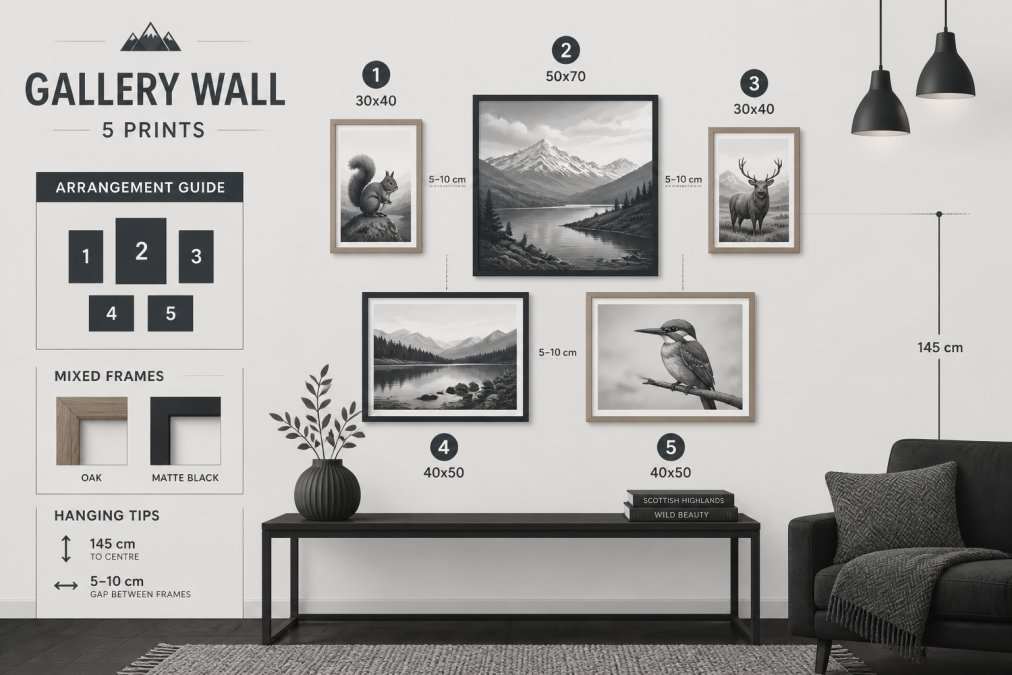
A gallery wall is the most flexible format for displaying highland art. Start with a plan on paper or the floor before anything goes on the wall. Lay frames out flat and experiment until the grouping feels balanced. The anchor piece, usually the largest, should sit slightly left or right of centre rather than dead-centre.
Mixing textures, frames, and scales
Mixing frame finishes, print sizes, and subject matter creates textural layering that makes a wall genuinely interesting. Keep to a family of frame tones: all natural woods, or a mix of black and dark walnut. Mix landscape orientations: one tall portrait-format print alongside two landscape-format pieces creates rhythm. Include at least one piece with strong textural qualities, such as a canvas print with visible brushwork. Leave consistent gaps between frames: 5-8cm for a tight, editorial feel; wider gaps suit farmhouse-style rooms.
Scottish art lends itself naturally to this format because subject matter varies richly. A highland cow study in warm ochres sits comfortably alongside an abstract coastal landscape in blues and greys. The shared countryside aesthetic creates cohesion.
The Scottish Hillside canvas print from Cairngorm Artists works particularly well as an anchor piece: its deep reds and earthy greens carry enough visual weight to ground a multi-piece arrangement, while the abstract quality leaves room for more figurative pieces around it.

Modern Alternatives to Classic Highland Loch Art
The classic Highland loch scene is timeless but ubiquitous. For a more interesting approach, consider abstract landscape or traditional portraiture.
Abstract landscape vs. traditional portraiture
Abstract highland landscape translates the emotional experience of a Highland landscape, the weight of a storm, the quality of light on bracken, into colour, texture, and form rather than literal representation. This reads as contemporary art that carries a sense of place without looking like a souvenir.
Storm over Glencoe from Cairngorm Artists exemplifies this: deep indigos, layered colour fields, and textured marks convey the approach of a storm without depicting it literally. This work sits comfortably in modern interiors.
Traditional portraiture focuses on Highland animals and people. A well-executed Highland cow portrait, painted with expressive brushwork and strong personality, functions as both fine art and conversation piece. The key distinction is evidence of a real artist's hand. When an artist has worked directly from observation rather than stock photography, the painting has specificity and life that reproductions cannot replicate.

Abstract landscapes suit contemporary, Scandi-influenced, or minimalist rooms. Traditional portraiture and classic loch scenes suit farmhouse, country, or heritage-influenced interiors.
Balancing Rustic Farmhouse Charm with a Modern Interior
Rustic farmhouse decor and modern interiors are not opposites. The most interesting living rooms sit somewhere between the two, and highland art bridges this gap naturally.
The farmhouse aesthetic centres on warmth, natural materials, and honest craft: exposed wood, linen textiles, handmade ceramics, and art that looks made by a person. The modern interior, particularly Scandi-influenced design, values restraint, clean lines, and limited palette. Together they create a room that feels both contemporary and genuinely liveable.
A canvas print of a Scottish glen in loose watercolour washes with warm reds and cool greens introduces organic farmhouse quality without full rustic commitment. In a room with clean-lined furniture and white walls, it adds warmth and character. In a room with natural wood floors and woven textiles, it reinforces the countryside aesthetic.
According to interior design trend research from the Design Institute, the combination of natural textures and landscape-inspired art consistently ranks among the most enduring approaches to living room styling.
If your room leans heavily modern, choose highland art with contemporary execution: abstract rather than literal, loose rather than tight, and consider unframed canvas to keep presentation clean.
Art Maintenance, Framing, and Budget-Friendly Display Tips
Choosing the right art is only half the work; protecting and presenting it well determines how it looks five years from now.
Canvas prints are the most practical format for living rooms. They arrive ready to hang, require no additional framing, and canvas material is more forgiving of humidity and temperature changes than paper. Cairngorm Artists' canvas prints arrive ready to hang.
Fine art paper prints offer higher colour fidelity and traditional gallery feel, but require proper framing and glazing to protect against UV fading and moisture. UV-protective glazing is the single most important investment for framed prints.
Budget-friendly framing options:
Format |
Approximate Approach |
Best For |
|---|---|---|
Unframed canvas print |
Hang directly on stretcher bars |
Contemporary, relaxed interiors |
Simple wood float frame |
Low-cost, clean presentation |
Scandi or farmhouse rooms |
DIY clip frames |
Very low cost, works for paper prints |
Temporary display or experimentation |
Repurposed vintage frames |
Often found cheaply at markets |
Eclectic or heritage-style rooms |
Professional custom framing |
Higher cost, longest-lasting result |
Investment pieces or fine art prints |
Maintenance tips:
- Dust canvas prints with a soft, dry brush rather than a damp cloth
- Keep art away from direct sunlight where possible
- Avoid hanging art above radiators or heat sources
- For paper prints behind glass, check occasionally that condensation isn't forming between print and glazing
As documented in conservation guidance from the National Trust for Scotland, temperature stability and UV protection are the two most significant factors in long-term preservation of artworks displayed in domestic settings.
Original artworks carry higher upfront cost but appreciate in ways prints do not. The Scottish Glen fine art print from Cairngorm Artists is a print from an original watercolour, giving access to quality and character of original Highland art at a more accessible price point.
Decorating a living room with highland art improves with time: the right piece becomes more meaningful as it becomes part of daily life. The challenge is finding work that carries real authenticity, made by artists who know the landscape from the inside. Cairngorm Artists brings together ten Highland artists whose work is rooted in direct experience of the Scottish landscape, and every piece arrives ready to hang with a safe-arrival promise. Browse the collection and find the piece that makes your living room feel like it has a reason to exist.
Frequently Asked Questions
How do you style a gallery wall with Highland art?
Start by laying your pieces on the floor to test arrangements before committing to the wall. Mix canvas prints with fine art paper prints at different scales to create visual rhythm. Keep frames within a consistent finish — natural wood or matte black both suit the countryside aesthetic well. Leave roughly 5-8 cm between each piece. Anchor the arrangement with your largest or most striking piece at eye level, then build outward. A cohesive color palette across the pieces ties the whole wall together without making it feel rigid.
What are the best color palettes to pair with Highland landscape art?
Highland landscape art typically carries deep indigos, earthy reds, soft greens, and stormy greys. These pair well with warm neutrals like oatmeal, stone, and aged linen on walls and soft furnishings. For a moody color scheme, lean into charcoal or slate walls that let the art's natural tones glow. If your room is lighter, ochre, rust, and forest green accents echo the palette in the artwork without overwhelming the space. Avoid cool blues or stark whites, which can clash with the warmth of Highland-inspired decor.
What kind of art looks good in a living room?
Art that creates a focal point and complements the room's existing palette tends to work best. In a living room, large-scale landscape prints or abstract pieces with strong tonal contrast draw the eye and anchor the space. Highland art specifically adds warmth, texture, and a sense of place that mass-produced prints rarely achieve. Canvas prints are practical for living rooms because they are lightweight, ready to hang, and hold detail well across larger sizes. The key is choosing a piece whose mood matches how you want the room to feel.
How do you balance rustic Highland decor with a modern living room?
The contrast between raw, organic imagery and clean contemporary interiors is exactly what makes modern Scandi and rustic Highland styles work together. Choose abstract or loosely painted Highland pieces rather than highly detailed traditional scenes — these read as contemporary art first and landscape second. Keep furniture lines simple and avoid overly ornate frames. Let the artwork carry the warmth and texture while the rest of the room stays minimal. One or two well-chosen pieces create far more impact than many smaller decorative items competing for attention.

